Rescuers on Monday pulled a 21-year-old man out of the rubble of a collapsed building in La Guaira, the hardest-hit state in earthquake-shattered Venezuela, where he had been trapped for 106 hours. The rescue operation lasted 43 hours, President Delcy Rodríguez said on social media, where she shared video of workers hoisting the man, Aaron Levi Cantillo, onto a stretcher.
Onlookers erupted in cheers.
The possibility of finding more survivors continued to fuel rescuers digging through collapsed buildings in northern Venezuela on Monday, even as the search was growing increasingly desperate with every passing hour.
The death toll from Wednesday’s 7.2- and 7.5-magnitude quakes rose to 1,719 people, with more than 5,000 injured and 15,800 displaced, the Venezuelan government said on Monday. But the official numbers are probably a vast undercount. Doctors have said that in La Guaira (pronounced La-WHY-ra) officials have been processing about 750 bodies each day.
The United Nations has procured 10,000 body bags because many collapsed buildings have yet to be fully excavated, the U.N. coordinator in Venezuela, Gianluca Rampolla, told reporters on Monday. “That is the applying assumption; it’s very sad,” he said adding that there was no definitive number of people missing.
Still, Mr. Rampolla said, he was encouraged that rescuers found seven people alive on Sunday, past the 72-hour window that disaster-response experts consider critical for finding survivors.
Venezuela has been jolted by more than 600 aftershocks since last week’s earthquakes, including a 4.6-magnitude quake on Monday that prompted officials to shut down the subway in Caracas, the capital, for inspection. Jorge Rodríguez, the leader of the National Assembly, said the government had received no immediate reports of additional damage. But the shaking has underscored the ongoing danger facing residents and rescuers who have been combing through the rubble of flattened homes and businesses.
Twenty-seven countries have sent more than 2,000 rescuers and 160 dogs to help find survivors, Mr. Rampolla said.
Ms. Rodríguez, whose government has been criticized for not doing enough to respond to the disaster, said the rescue efforts would continue. The government has also announced plans to create two commissions: one to oversee temporary shelters and the other to review the safety of roads, bridges and buildings, many of which were made of brittle concrete without adequate steel reinforcement.
A preliminary analysis of satellite images taken before and after the earthquakes estimated that 58,870 buildings were likely damaged or destroyed, with some of the worst damage concentrated along the coastline in La Guaira. That figure far exceeds the official government count of 855 damaged buildings. The analysis by two remote sensing experts, Jamon Van Den Hoek and Corey Scher, both of Oregon State University, amplified what other experts have said about the vulnerability of Venezuela’s buildings.
“Not a single building should have collapsed in those earthquakes,” Ilan Kelman, a professor of disasters and health at University College London, said in an interview on Monday. He compared the impact with that of recent earthquakes in other places that resulted in lower death tolls. “We have all the knowledge, science and engineering that we need to build in a seismic zone without having a catastrophic disaster following an earthquake,” he said.
President Trump has been under pressure to help Venezuela recover from the earthquakes because of the influence the United States now wields in the country after U.S. forces seized its longtime dictator, Nicolás Maduro, in January and helped bring Ms. Rodríguez to power. At Mr. Trump’s direction, she has opened Venezuela’s vast oil reserves to American energy companies.
The American military has been sending planes, ships, helicopters and personnel to Venezuela. But even in well-organized response efforts, many survivors end up being rescued by their friends, family and neighbors, as has happened in Venezuela, said Emily So, a professor of architectural engineering at the University of Cambridge.
Even if they are rescued, some of Venezuela’s survivors may later die from their injuries, in part because its overstretched health system is ill-equipped to help them, Professor Kelman said. The response has been further hampered by traffic on the main highway into La Guaira, as well as by a lack of heavy machinery and medical supplies.
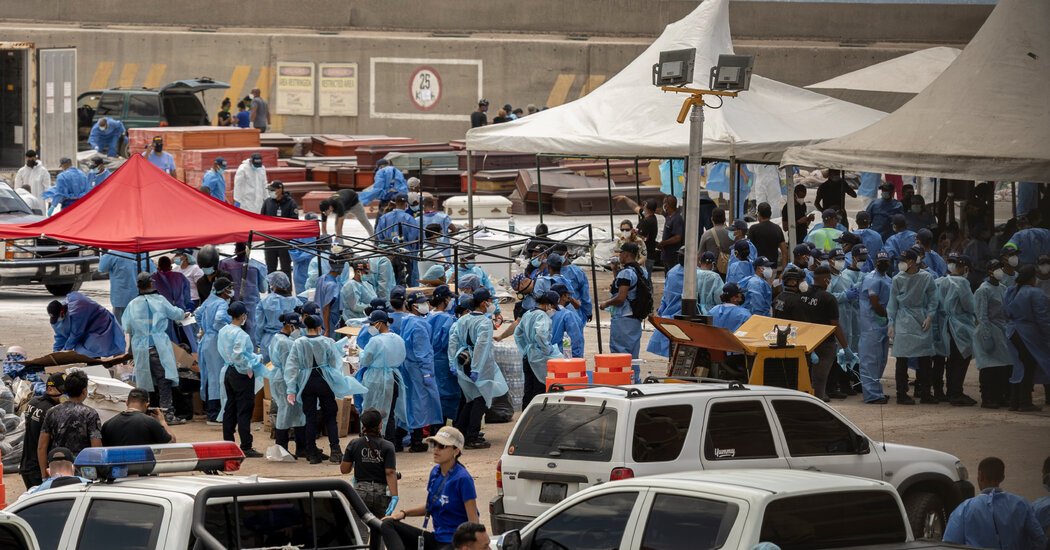
In La Guaira, bodies are being moved from the morgue at the main public hospital to the open yard of a state-run port, where the authorities are continuing identification efforts.
At the Caracas morgue on Sunday afternoon, 150 bodies remained unclaimed, including 130 that had yet to be identified. Two doctors at the morgue said it had been offering free cremations and that officials had not ruled out mass graves if the death toll continued to climb.
The Venezuelan Society of Infectious Diseases issued guidance discouraging mass graves on Sunday, saying they make identification difficult, can prolong the anguish for grieving families and are unnecessary for public health.
Volunteers have also been racing to help the thousands who have been displaced.
At a school in Caracas on Monday, more than 50 volunteers were caring for 1,200 people, including 300 children, who were sheltering there. Many of the families had been sleeping in tents in a nearby park. The volunteers were providing them with food, clothing, health checkups and educational activities for the children.
“Many completely lost their homes or their homes are so cracked that they’re not allowed back in,” Enilba Galindo, the director of the school, said in an interview. As she spoke, medical workers in blue scrubs scurried about.
Reporting was contributed by Sheyla Urdaneta, Yan Zhuang, Tibisay Romero, Genevieve Glatsky, Julie Turkewitz, Farnaz Fassihi and Michael Levenson.