

Ethereum has slipped below the critical $2,000 level, reinforcing a broader bearish market structure as selling pressure intensifies across the crypto sector. The breakdown comes amid weakening macro sentiment, persistent outflows from risk assets, and declining confidence in short-term crypto demand. Together, these factors have pushed ETH into a defensive phase, with traders increasingly focused on downside liquidity zones rather than recovery signals.
Recent data highlighted by Lookonchain points to three major on-chain liquidation clusters that could shape Ethereum’s next moves. These zones represent areas where leveraged positions may be forced to close if price declines continue, potentially accelerating volatility. Historically, such liquidation pockets tend to act as magnets during corrective phases, amplifying both panic selling and short-term price swings.
Market sentiment has also been affected by reports of Ethereum co-founder Vitalik Buterin moving and selling ETH. While these transactions are often linked to funding ecosystem development, charitable initiatives, or operational needs rather than outright bearish positioning, they can still influence trader psychology. In fragile markets, even neutral fundamental events can trigger disproportionate reactions.
Lookonchain data highlights three major on-chain liquidation clusters that could significantly influence Ethereum’s short-term price dynamics if bearish pressure persists. According to the analysis, Trend Research reportedly holds about 356,150 ETH, valued near $671 million, with estimated liquidation levels between $1,562 and $1,698. If price approaches this band, forced position closures could amplify volatility and accelerate downside momentum.

Another key concentration involves Ethereum co-founder Joseph Lubin alongside two unidentified large wallets. Combined holdings are estimated at around 293,302 ETH, roughly $553 million, with potential liquidation thresholds between $1,329 and $1,368. This zone sits deeper in the corrective structure and could act as a secondary stress level if broader market weakness continues.
A third cluster attributed to the entity known as 7 Siblings holds approximately 286,733 ETH, valued at around $541 million. Their liquidation prices are significantly lower, near $1,075 and $1,029, representing a deeper capitulation scenario should selling pressure intensify further.
It is important to note that liquidation estimates depend heavily on leverage assumptions, collateral adjustments, and evolving market conditions. Still, these zones provide a useful framework for understanding where volatility could increase, as leveraged positions historically tend to magnify both downward cascades and eventual stabilization phases in crypto markets.
Ethereum’s weekly chart shows a decisive deterioration in market structure after losing the psychologically important $2,000 level. Price has broken below the 50-week and 100-week moving averages, signaling a shift from late-cycle consolidation into a more defensive phase. This type of multi-MA breakdown historically reflects declining momentum rather than a simple short-term correction.
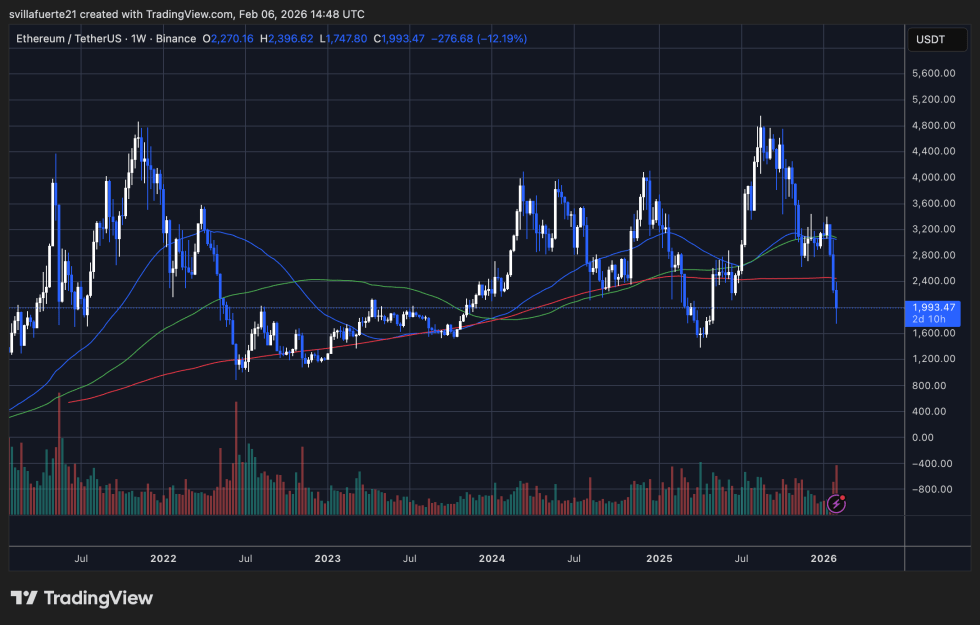
Volume behavior reinforces this interpretation. The latest downside move is accompanied by expanding sell-side volume, suggesting distribution rather than passive retracement. When rising volume coincides with lower highs and lower lows, it typically confirms sustained selling pressure rather than temporary volatility.
Technically, the next key support zone appears between roughly $1,600 and $1,750, where prior consolidation occurred in earlier market phases. A weekly close below this range would likely expose deeper liquidity pockets toward the $1,300 region, aligning with previously identified liquidation clusters.
From a trend perspective, Ethereum is now trading below all major weekly moving averages, which often caps upside attempts unless reclaim levels occur quickly. For recovery credibility, price would need to regain the $2,200–$2,400 region and stabilize above it.
Featured image from ChatGPT, chart from TradingView.com
Editorial Process for bitcoinist is centered on delivering thoroughly researched, accurate, and unbiased content. We uphold strict sourcing standards, and each page undergoes diligent review by our team of top technology experts and seasoned editors. This process ensures the integrity, relevance, and value of our content for our readers.