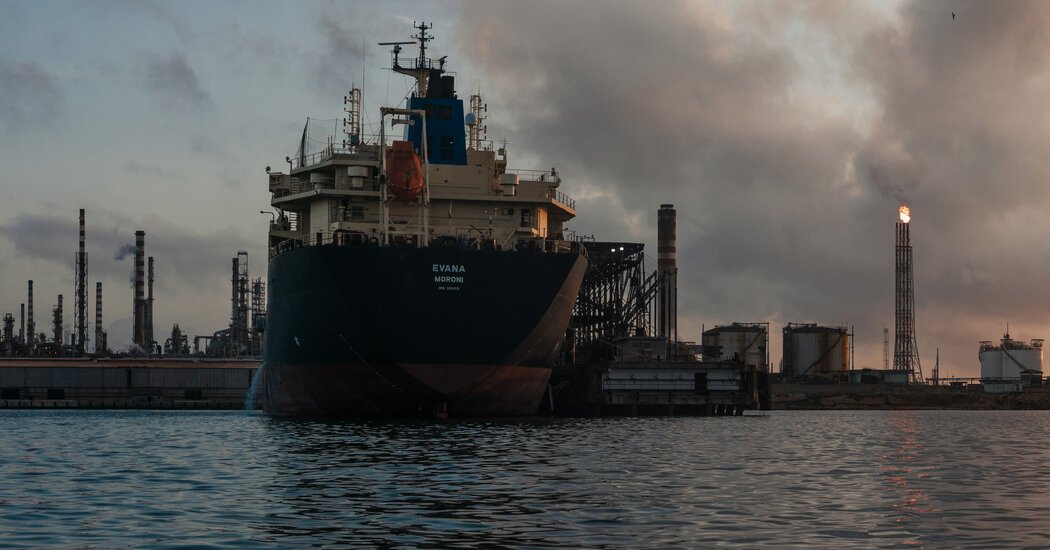
The largest U.S. energy company, Exxon Mobil, is in talks to acquire rights to produce oil in Venezuela nearly two decades after it was effectively expelled from the country, according to several people familiar with the matter.
The deal would be a major victory for President Trump, who has declared the country’s vast natural wealth open to American businesses.
If finalized, the deal would mark Exxon’s return to a country with one of the world’s largest oil reserves after years of legal battles that had turned the oil giant into a nemesis of Venezuela’s ruling Socialist Party.
As recently as January, Exxon had called Venezuela “uninvestable.”
After deposing the nation’s leader, Nicolás Maduro, Mr. Trump installed Mr. Maduro’s vice president to manage Venezuela’s economic opening to the United States.
The deal, which could be finalized and announced as soon as this month, would involve Exxon signing contracts to produce oil in up to six fields in several regions in Venezuela, according to the people familiar with the matter. They spoke on condition of anonymity because they were not authorized to speak publicly about private discussions.
An Exxon spokesman declined to comment. Venezuela’s government and state oil company did not respond to requests for comment.
Any deal between these two archenemies of the global oil industry — Exxon and the Venezuelan government — would be a milestone in Ms. Rodríguez and Mr. Trump’s campaign to turn Venezuela into an economic partner of the United States after decades of rivalry.
Venezuela has on two occasions in past decades nationalized foreign oil ventures, including Exxon’s assets.
A deal would also mark a sharp turnaround in Exxon’s position toward the country where it first began working in the 1940s.
In 2007, Mr. Maduro’s predecessor as president, Hugo Chávez, nationalized oil projects owned by Exxon and other foreign oil companies. Breaking with most of its peers, Exxon refused to negotiate, left the country, and began a protracted legal battle in international courts. Venezuela’s government still owes Exxon roughly $1 billion in damages awarded in those cases.
After leaving, Exxon poured investments into Venezuela’s neighbor and rival, Guyana, and began developing major oil fields in an area of the Atlantic that Venezuela has claimed.
Exxon’s dominant economic role in Guyana made it a frequent foil for attacks by Mr. Maduro, who accused the company of sponsoring a hostile government.
In recent years, Exxon’s executives had rebuffed efforts by Ms. Rodríguez, who ran Venezuela’s oil industry under Mr. Maduro, to entice the company back into the country, according to a person familiar with those offers.
During a high-profile meeting of oil executives on Jan. 9, six days after Mr. Maduro was removed, Exxon’s chief executive told Mr. Trump that Venezuela was a major business risk.
“We’ve had our assets seized there twice, and so you can imagine to re-enter a third time would require some pretty significant changes,” the executive, Darren Woods, said then.
He has softened his position since.
Mr. Woods told analysts in a call this month that the company’s experience producing ultra heavy oil in Canada gave it an advantage in Venezuela, where most of the oil has similar properties.
“The investment and the returns look promising,” he said of Venezuela. “And so I feel positive about what’s happening, the opportunity there.”
Several things have changed since Mr. Woods dismissed Venezuela in January.
The war in Iran has raised global oil and gas prices, making investments in production in different markets more attractive. The Middle East turmoil has also brought urgency to oil companies’ efforts to diversify production sources.
And last month, Exxon’s main rival, Chevron, announced a major expansion of its largest oil field in Venezuela, a move that is expected to solidify the company’s grip on one of the world’s largest oil deposits. Several oil analysts said Chevron’s expansion has made it strategically more costly for Exxon to continue ignoring Venezuela.
It is unclear if the initial deal under negotiation between Exxon and Venezuelan officials would contain binding obligations or merely represent the company’s expression of interest. Ms. Rodríguez overhauled the country’s oil law in January to make the country more attractive to private investors, but is still finalizing a new type of contract for oil producers.
One person familiar with Exxon’s dealings in Venezuela said the company’s negotiators had been aggressively pursuing business in the country in recent weeks, and have prioritized a major entry over incremental deals. A second person said a group of Exxon employees flew to Caracas, the capital, in April to evaluate the oil fields on offer.
Ms. Rodríguez’s administration has pursued a deal with similar urgency, said a third person. That person said the return of a company that in popular imagination embodies American oil power is a cornerstone of Ms. Rodríguez’s efforts to attract investment and curry favor with the Trump administration.
Ms. Rodríguez’s pursuit of the Exxon deal has become a top priority, pushing aside advancing domestic laws on oil investments or attracting other major Western energy companies, the person added.
Rebecca F. Elliott contributed reporting.