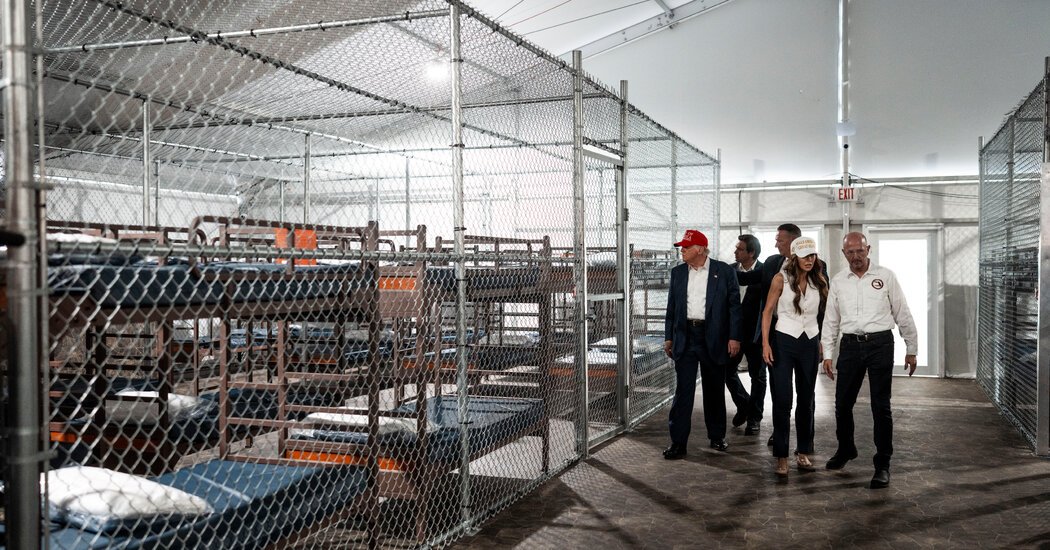
Florida is in talks with the Trump administration to shut down a high-profile immigration detention center that opened last summer in the Everglades and has cost the state hundreds of millions of dollars to operate, according to a federal official, a former Immigration and Customs Enforcement official, and a person close to the administration of Gov. Ron DeSantis.
The shutdown talks are preliminary, the people said. But officials at the Department of Homeland Security have concluded that it is too expensive to keep operating the center, known as Alligator Alcatraz. Homeland security officials have also come to consider the center ineffective, the federal official said. All three people spoke on the condition of anonymity to discuss internal talks.
The DeSantis administration has been spending more than $1 million a day to run the center, which is in a swampy, isolated area between Miami and Naples. Some private vendors hired by the state to operate it have been struggling to front costs, according to the person close to the DeSantis administration.
The Department of Homeland Security did not respond to a request for comment. Neither did the Florida Division of Emergency Management, which operates the center, nor Mr. DeSantis’s office.
Mr. DeSantis, a Republican, has repeatedly called the Everglades detention center a success, saying it has helped the Trump administration by providing more beds to house federal detainees. He has also said that the facility was intended to be temporary.
But the center’s shutdown would be hailed by immigration lawyers, activists and many detainees and their families as a huge win. Critics have denounced what they describe as unsanitary and inhumane conditions at the center since it opened 10 months ago; state officials have consistently dismissed such descriptions as false.
As of last month, the center held nearly 1,400 detainees, all of them men, according to ICE data. The agency classified about two-thirds of the detainees in the center, which it calls the Florida Soft-Sided Facility South, as noncriminal.
Mr. DeSantis has said from the start that the federal government would pay back the state for operating the center. But Florida has yet to receive the $608 million federal reimbursement it requested to run the center for about a year. The money was held up in part by the partial shutdown of the Department of Homeland Security that ended last Thursday. It is unclear why the reimbursement continues to be delayed.
The center became the nation’s first state-run facility to hold federal immigration detainees last July, as Florida pushed the boundaries of aggressive enforcement under President Trump’s immigration crackdown. Its remote location and brazen name gained it international notoriety before any detainees arrived.
At the time, Mr. Trump and Kristi Noem, then the homeland security secretary, toured the center with Mr. DeSantis and Florida’s attorney general, James Uthmeier. Other states later opened immigrant detention centers of their own, though the one in the Everglades stood out as particularly unforgiving given that the site essentially consisted of tents.
Mr. Uthmeier, a Republican and Mr. DeSantis’s former chief of staff, had pushed to build the center at an old training airport, despite the lack of existing infrastructure. Both men argued that it was crucial for the center to be in a remote location, saying that the inhospitable conditions would prompt unauthorized immigrants to think twice about staying in the United States and risking arrest.
But the location made it much more expensive to build and run. Vendors had to truck in things like tents, power generators and trailers for staff members to live in. They also had to constantly truck out sewage and other waste.
A lawyer for two detainees said in a federal court filing last month that guards beat and pepper-sprayed the men after detainees protested that their access to a phone inside the center had been cut off. As part of the sworn declaration, the lawyer submitted a photo of one of the detainees with a black eye.
Also last month, a federal appeals court upheld an earlier decision to block a lower court’s order that the center dismantle operations because it had not conducted an environmental review required under federal law. A panel from the 11th Circuit Court of Appeals found that the center was not under federal control, and thus was not subject to the environmental review.
A landing strip allows flights to arrive at and take off from the Everglades center, though it is unclear how frequently detainees have been moved in or out. At least some of the center’s detainees have been flown to larger federal detention centers in Louisiana and Texas, often as a final stop before they are deported.
Zolan Kanno-Youngs contributed reporting.