Daly signalled the Fed is navigating a highly uncertain outlook driven by geopolitical risks, with policy likely to remain flexible rather than guided by a fixed path.
Summary:
- Daly outlines two scenarios tied to Middle East conflict trajectory
- Quick resolution → energy spike seen as temporary, policy can look through it
- Prolonged conflict → risks of higher inflation, weaker growth, softer labour market
- Fed faces sharper trade-offs between inflation and employment goals
- Emphasises flexibility over firm forward guidance amid uncertainty
- Warns excessive guidance could mislead in a rapidly evolving environment
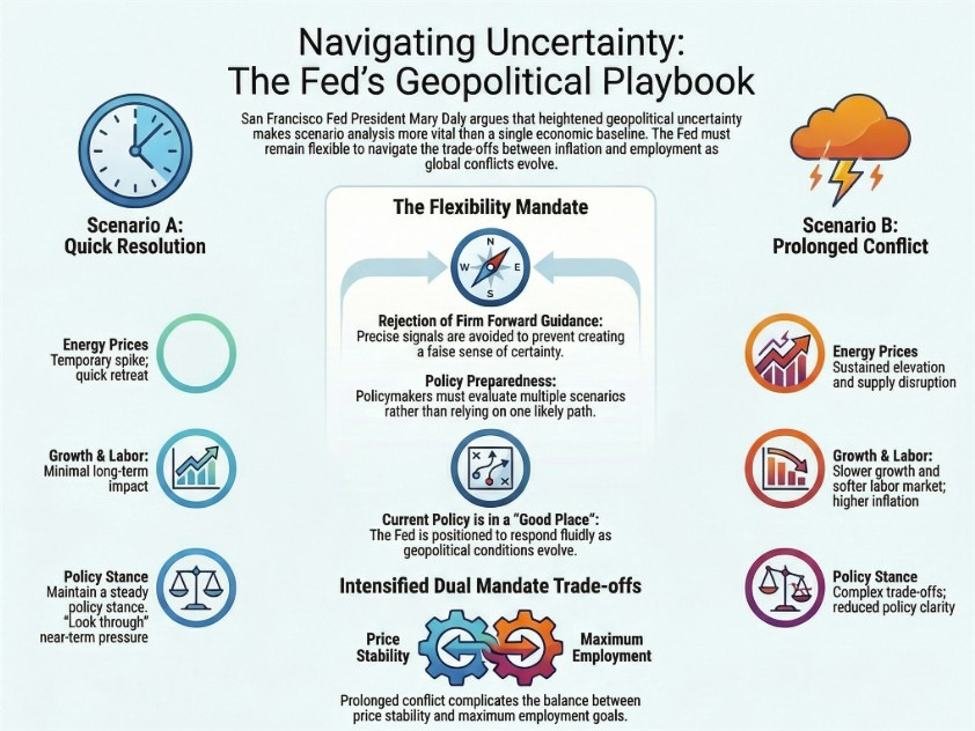
San Francisco Federal Reserve President Mary Daly said heightened global uncertainty—particularly stemming from the Middle East conflict—has made scenario analysis more relevant than relying on a single baseline economic outlook.
Daly outlined two broad paths for the U.S. economy. In one scenario, geopolitical tensions ease quickly, leading to a retreat in oil and energy prices. Under such conditions, any inflationary impulse from higher energy costs would likely prove temporary. Provided inflation expectations remain anchored, policymakers could afford to look through the near-term price pressures and maintain a steady policy stance.
However, Daly warned that a more prolonged conflict would present a materially different macroeconomic backdrop. Sustained disruptions to energy supply could keep prices elevated, feeding through into broader inflation while simultaneously weighing on economic activity. In that environment, the U.S. economy could face a combination of slower growth, rising inflation, and a softer labour market.
Such an outcome would complicate the Federal Reserve’s task of balancing its dual mandate of price stability and maximum employment. Daly stressed that this would intensify the policy trade-offs already facing the central bank, reducing the clarity of the appropriate policy path.
Against this backdrop, Daly emphasised that monetary policy is currently in a “good place” but underscored the need for flexibility. She argued there is no single most likely path forward, and policymakers must remain prepared to respond as conditions evolve.
Daly also pushed back against calls for more explicit forward guidance, noting that providing overly precise signals in an uncertain environment risks creating a false sense of certainty. Instead, she said the Fed’s approach should centre on acknowledging uncertainty, evaluating multiple scenarios, and maintaining focus on achieving price stability and supporting employment regardless of how the outlook develops.