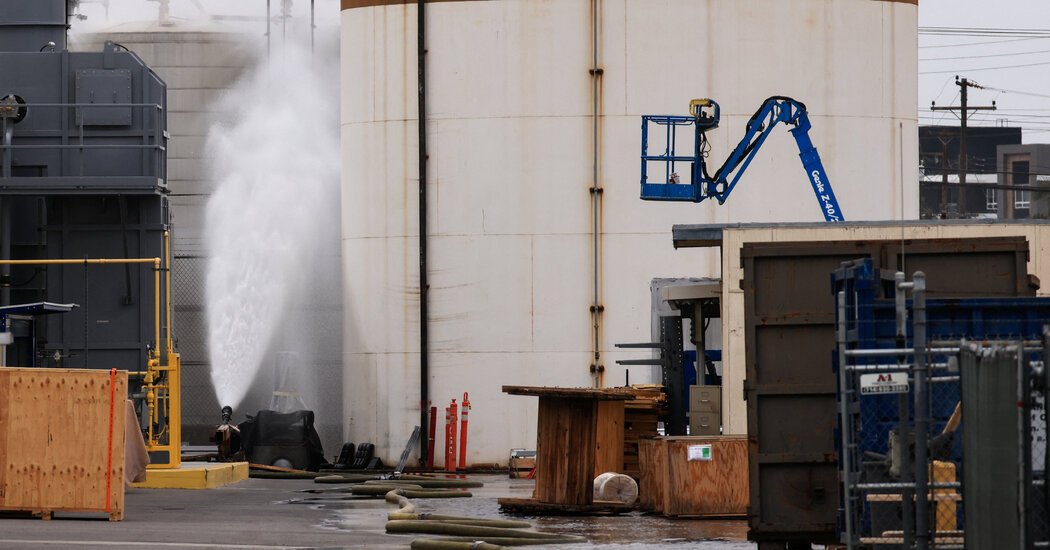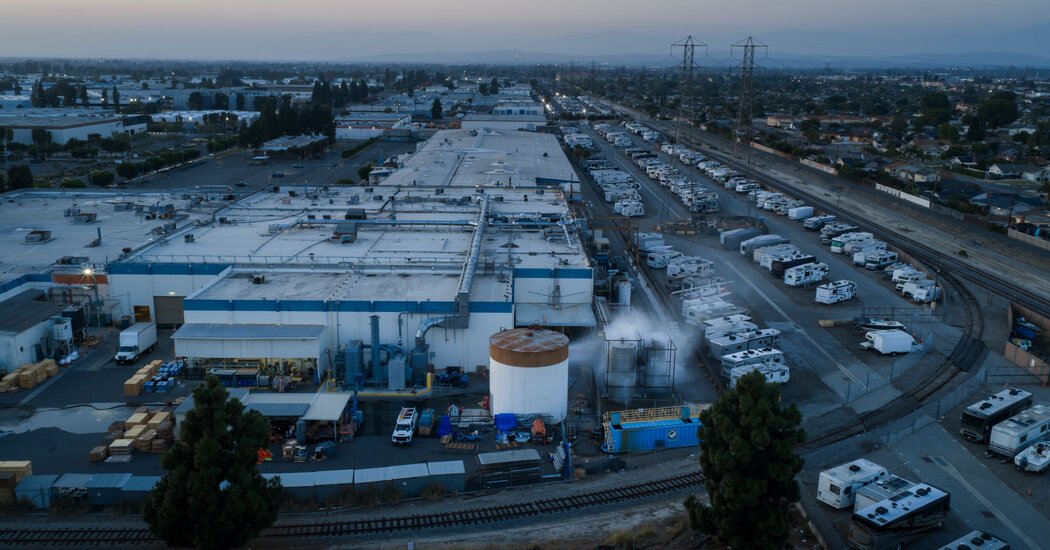
Fire officials said on Saturday that there was renewed hope that their strategy of using water to douse a tank filled with an extremely toxic chemical would help slow a reaction that could lead to an explosion that had the potential to ignite a large fireball at a plant in Orange County, Calif.
As efforts continued, tens of thousands of residents remained out of their homes — some for the second consecutive day — as health officials continued to warn that they were unsure of the extent of the potential danger.
“You could have a combustion event that could be pretty catastrophic,” said Joseph E. Shepherd, a professor at the California Institute of Technology.
Here’s where the situation stands:
What steps are being taken to prevent an explosion?
Firefighters in Garden Grove, Calif., had gone on Thursday to the site, which belongs to GKN Aerospace, where an industrial tank containing about 7,000 gallons of methyl methacrylate was becoming pressurized and releasing gas as it overheated.
The tank was bulging dangerously, a sign that it could eventually explode.
Firefighters continue to spray the tank with water in an effort to lower the temperature of the chemical inside. Officials are looking for a way to stop the chemical reaction that is causing the crisis.
What happened?
Methyl methacrylate, which is used to make plastics, has a low boiling point so it can easily overheat and turn to gas. Chemical plants typically have many fail safes for situations like this, experts said.
But when members of GKN Aerospace’s response team arrived to inject a neutralizing agent into the tank to reduce the liquid’s volatility, they learned that the tank’s valves were gummed up, making the interior inaccessible, said Craig Covey, an incident commander with the Orange County Fire Authority.
That left no clear options to prevent the tank from failing, Mr. Covey said.
How could this crisis end?
It is possible that the tank could crack and allow the 7,000 gallons of liquid to pour out, Mr. Covey said.
The fire department has made sand barriers to prevent the chemical from spilling into storm drains and river channels, he added.
It is also possible, Mr. Covey said, that they tank could explode and launch a fireball into the air.
“If you’ve ever seen videos of tank cars on a railroad track blowing up — and that fireball it puts out — and it blows half the tank car half a mile down the train track, that’s the incident potential we are dealing with if this suffers a catastrophic failure,” Mr. Covey said.
On Saturday, Mr. Covey outlined a third possibility, after noting that the liquid in the tank is rising in temperature about one degree per hour. He said that it is possible the liquid, through a chemical reaction, is turning into a solid and that they hope the tank may have enough capacity to handle the pressure as that takes place.
“Because of the heavy deluge of water and cooling it, we are allowing to cool at a slower rate and reducing its overpressure,” he said. “It’s one of the thoughts. So like an ice cube that freezes from the outside in, this stuff cures, it heats up and cures, from the outside in.”
It is unclear why the liquid in the tank cannot be released in a controlled way to reduce pressure in the tank. It is possible that so much liquid has already vaporized inside that there is too much pressure to do that safely, said Faisal Khan, the head of the chemical engineering department at Texas A&M University.
The worst-case scenario, he said, would be a rupture of the tank that launches fire and debris into the air.
Mr. Khan said that it would be similar to a car collision in which the gas from the vehicles vaporizes and causes a mushroom of destructive fire. In those cases, however, the fireball tends to stay close to the ground. Here, the fireball could fly upward and cause damage elsewhere, he said.
If about half of the material in the tank is released, the fireball from this explosion could be about the size of a house, Mr. Khan said.
What is the extent of the evacuations?
The evacuation area, which included shelters in Garden Grove, Cypress and Anaheim, was designed to be large because officials were not able to predict where a fireball from an explosion would land.
Some 40,000 people were evacuated from areas around the plant.
Is exposure to the chemical dangerous?
Methyl methacrylate is toxic when inhaled, and causes irritation to the respiratory system and potential damage to other organs.
If the pressure keeps building inside the tank, the chemical inside eventually “could be shot outwards everywhere and then you have this cloud of toxin,” said Elias Picazo, a chemistry professor at the University of Southern California.
What company owns the plant?
The plant belongs to GKN Aerospace, a manufacturing company based in the United Kingdom that produces jet engine parts, landing gear and other components for military and civilian aircraft.
About 16,000 people are employed at the company overall, including at least 540 at the location with the leak in Garden Grove, Calif., according to a 2024 news release. Its products are used in planes produced by Airbus, Boeing and Bombardier as well as the space industry.