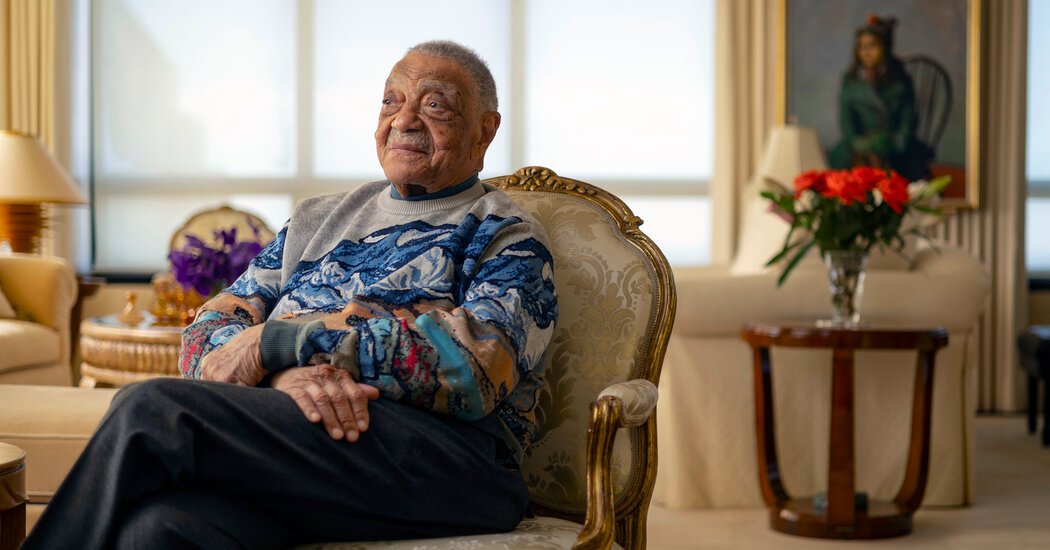
George E. Johnson, a hair-care magnate who rose from a sharecropper’s cabin to found, with his wife, Joan, what was said to be the first Black-owned company listed on a major American stock exchange, and who made a fortune on products like Ultra Sheen and Afro Sheen, died on Monday at his home in Chicago. He was 99.
His death was confirmed by his second wife, Madeline Murphy Rabb, who said the cause was respiratory illness.
Long before sports figures, entertainers and Fortune 500 executives commanded sky-high salaries, the Johnson Products Company, which sold Black hair products and cosmetics, made its founder, Mr. Johnson, one of the nation’s wealthiest African Americans.
He also helped found one of the first, and largest, Black-owned banks, the Independence Bank of Chicago, where he served as chairman until it was sold in 1995. And for decades, Johnson Products indirectly influenced pop culture through its sponsorship of the nationally syndicated television dance show “Soul Train.”
Johnson Products originated in the laboratory of Samuel B. Fuller, a Black cosmetics entrepreneur, where Mr. Johnson worked after dropping out of high school. Up to that point, his experience — starting at the age of 9, when an aunt gave him a shoeshine box — had been menial jobs.
Mr. Johnson started at Fuller Products as a salesman — “carrying the black bag,” as he put it — though he initially found it distressing to peddle pomade and face powder amid urban deprivation.
“I had a problem with it unless I really needed money,” he said in an interview for this obituary. “Then I would sell like hell.”
After requesting to work indoors, Mr. Johnson created his first product, a hair relaxer for men he called Ultra Wave. With Mr. Fuller’s blessing, Mr. Johnson teamed up with his wife and a barber to found Johnson Products in 1954.
After one branch of a finance company rejected his request for a business loan as a “ridiculous” idea, Mr. Johnson secured the $250 in seed money from another branch by saying he needed the funds to take Joan on a vacation to California. Those early financing troubles later inspired him to help start a bank.
He found himself on the road again to peddle his product when his partnership with the barber soured. From his station wagon, he sold Ultra Wave and other products to barbers from the Upper Midwest to Harlem.
But he soon found that barbers were not loyal. “They couldn’t resist the next deal that came along, although it involved poor quality, cheaper stuff,” Mr. Johnson told The New York Times in 1976.
So he started eying beauty shops, where he observed women using hot combs and mineral oil to straighten hair, a smoky and unhealthful process. He modified Ultra Wave for the women’s market, creating Ultra Sheen, which he said reduced smoke by as much as 75 percent and could be used in the home.
Sales took off. In the 1960s, the company had an estimated 80 percent of the Black hair-care market, and by 1970 it had annual sales of $12.6 million, or over $100 million today. The company listed on the American Stock Exchange in January 1971.
Johnson Products spent heavily on advertising in its heyday — $5 million in 1975, or more than $31 million today — and was the first Black-controlled company to sponsor a national television program, “Soul Train,” which aired weekly for almost 35 years, until 2006.
(Johnson Products is not related to Johnson Publishing Company of Chicago, the former publisher of Ebony and Jet magazines. Nor is it related to Robert L. Johnson, a co-founder of Black Entertainment Television.)
Cultural and regulatory challenges — and even severe weather — exacted a toll on Johnson Products, which was struggling for survival by the late 1970s and posted its first loss in the mid-1980s.
The company, which relied on straighteners, was late to adapt to the growing popularity of Afro hairstyles in the 1960s. Near the end of that decade, its reformulation of Ultra Sheen as Afro Sheen resulted in a poor product for long, curly hair, Mr. Johnson acknowledged.
In the 1970s, a Federal Trade Commission investigation into the marketing of hair straighteners disrupted the industry, and in 1976 Johnson Products negotiated a consent order to add a warning that its products containing sodium hydroxide, or lye, could cause scalp irritation and eye injury. This was over a year before Revlon, its far larger competitor, agreed to similar warning labels, a lag that may have given Revlon an edge with Black consumers.
While African Americans made up a small part of Revlon’s market, they represented almost all of Johnson Products’, and its share of the relaxer market skidded to 45 percent from 85 percent in two years.
Mr. Johnson also said he faced racial discrimination, contending that distributors “don’t seem to want Black products to be exposed to all Americans.”
In early 1979, a heavy snowstorm in Chicago brought the company to a near standstill for more than a month, blocking truckers from transporting supplies or shipments and damaging its plant.
George Ellis Johnson was born on June 16, 1927, in a sharecropper’s shack in Richton, Miss., and moved to Chicago with his mother, Priscilla, when he was 2. Although his education ended in 11th grade, he was awarded nine honorary doctorates over his lifetime.
Last year, Mr. Johnson published “Afro Sheen: How I Revolutionized an Industry with the Golden Rule, From ‘Soul Train’ to Wall Street,” a memoir, written with Hilary Beard.
Mrs. Johnson wound up with control of the company when the couple divorced in 1989. After some disruptions, including the departure of her son Eric as president and chief executive, she sold Johnson Products to the Ivax Corporation in 1993, netting about $32 million, or about $75 million today.
The Johnsons remarried in 1995. She died in 2019.
In addition to Ms. Rabb, whom he married in 2022, Mr. Johnson is survived by his sons, Eric, John and George Jr.; his daughter, Joan; 10 grandchildren; and seven great-grandchildren.
Ivax sold the company to Procter & Gamble in 2004 before it was bought by a consortium of African American investment firms in 2009.
“When I think about pioneers, the real pioneers are the people who are able to make a path where none exists,” Eric Johnson told CNN after his mother died in 2019. “Johnson Products in many ways was that company. She and my father had no provided path. They created a path where there was none.”
Robert D. Hershey Jr., a longtime reporter for The Times who wrote about finance and economics, died in 2024.
Ash Wu contributed reporting.