I’ve just started a video call with a general partner at a venture capital firm. “Whenever you’re ready, please start your pitch,” he says.
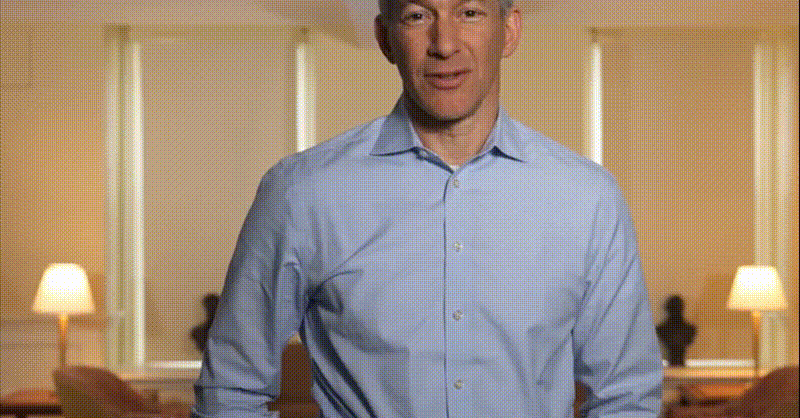
For a reporting experiment, I am playing the role of a hopelessly delusional tech founder. As I outline my plan to build an “Uber for bananas,” his calm, polite smile doesn’t move. Neither do the small shadows cast by the drape of his shirt. His shoulders hover back and forth just slightly — and a little too consistently. Because while it looks like I’m talking with Jeff Bussgang, the co-founder of Flybridge Capital and a senior lecturer at Harvard Business School, I’m actually talking with his A.I. generated video avatar.
When I speak with the real Bussgang — who, much like his A.I. counterpart, is not impressed with my idea for faster banana delivery — he concedes that the simulation is at least a little “creepy.” But, he says, “My students love it.”
Bussgang is one of several teachers at Harvard Business School who volunteered to help create A.I. clones of themselves for a new eight-week entrepreneurship boot camp called H.B.S. Foundry. Harvard has tested the product, which costs $699, with more than 100 universities across 50 states.
Foundry guides participants through a framework for starting a company, from refining the idea to pitching it to investors and customers. Along with Harvard Business School content, its virtual work space includes a community of peers and access to A.I. agents — some intended to “represent” instructors. It also features video call simulations for practicing pitches, sales calls and board meetings with instructor A.I. avatars, like the one of Bussgang.
Experienced founders, investors, and Harvard Business School faculty lead weekly live sessions, but the purpose of the online portal is to guide students through A.I. resources and content from the business school for building a start-up.
The school aims to use Foundry to scale the school’s offerings far beyond the 900 or so M.B.A. students it admits each year. In that way, it is something of a case study for companies facing a similar problem: Consulting firms like PWC, law firms and, at least in one case, a church, are also experimenting with how A.I. can expand their services far beyond their human bandwidth. So are some movie directors — an A.I. version of the actor Val Kilmer, who passed away in 2025, recently appeared in the historical drama “As Deep as the Grave.”
When the team at Harvard started working on the A.I. project in 2024, they imagined a simple chat window that would be similar to ChatGPT, but equipped to advise entrepreneurs, said Katharina Rings, the project director of Foundry. But after the school released a trial product in October, she said, it heard from students that they wanted a more guided experience, which led to the current version, available since April.
Harvard Business School famously grades on a forced curve, and Foundry had to intentionally teach the A.I. to not be obsequious, a common trait of large language models, said Tom Eisenmann, a faculty co-chair for the project.
He said he’s made a point of letting participants know that the A.I. agents are programmed to be so tough that virtually no start-up ideas posed to them have received a blessing on the first take. “We literally would have somebody spend 10 hours with the thing, just sort of trying and trying,” he said. “That’s wonderful, but really it’s not the point.”
The A.I. agents that chat with participants have been trained on the work of specific Harvard Business School faculty, but they also draw from wider knowledge when appropriate.
Foundry created the A.I. generated videos of professors by working closely with the A.I. avatar maker HeyGen. The positive reaction to both the A.I. chat versions of professors and, especially, the A.I. video avatars came as a bit of a surprise.
Rings said that in tests, simply adding a photo of a professor to an A.I. chatbot increased engagement. “It was just so clear from what the users were telling us and what the numbers were saying,” she said. “It seems like people actually much prefer the A.I.s, and they actually trust more, if it is based on one specific person’s input.”
While anyone can apply to buy the Foundry course, many participants have found it through university departments that help students translate their companies into commercial businesses. About 45 percent of founders in the boot camp’s sessions over the summer paid individually. The rest were sponsored by universities, either through a paid subscription or a free trial that H.B.S. Foundry offered to some schools. About 760 founders in the summer sessions found the program through their university.
Harold Solomon, a principal at Georgia Tech’s entrepreneurship program Quadrant-i, said the advantage for schools is they can serve more founders. “I can have 20, 30 meetings a week, but beyond that, I literally can’t,” said Solomon. “We can’t service the class, let alone the campus, in person constantly. So we need a way to scale.”
He incorporated Foundry into a 12-week entrepreneurship workshop for Ph.D. students and faculty over the summer and signed on to continue offering the program to graduate students.
Foundry participants said that the unconventional A.I. instruction didn’t faze them. Some had already been asking A.I. for advice, and found the H.B.S. version more tailored to their needs.
Pranav Sultania, a Ph.D. candidate in mechanical engineering at Boston University, has spent years developing an electromagnetic jet propulsion and pumping system for underwater applications. But he was only a few months into creating a business around it, called Magnesis Robotics, when the B.U. entrepreneurship center gave him access to H.B.S. Foundry.
Talking strategy with the A.I. avatars helped him focus his pitch. “As an engineer you want to think, Oh there’s so many use cases, surely when I pitch that to an investor that is more business worthy,” he said. The A.I. avatars pushed him to pick one to highlight.
It was also helpful, Sultania said, that the A.I. avatars were always available when he had time, which as a busy founder and Ph.D. student, is not always predictable. “I kind of want the platform there that I can talk to, even if it’s a clone, anytime I want,” he said.
When Dragana Savic started Foundry, she had already raised more than $1 million of venture funding for her company, INIA Biosciences, which makes a device for the treatment of autoimmune diseases. The University of Massachusetts Boston’s Venture Development Center, where she is an entrepreneur in residence, sponsored her admission to the program. The video avatar simulations of board and pitch meetings, she said, were one of the best features.
“You can really hash out things before you actually enter a situation like that,” she said. “It’s a good way to practice.”
Eventually, Eisenmann said, Harvard Business School may allow other universities to add avatars of their own professors.
Though for all of the A.I. assistance, he acknowledged, one of the most popular features of the product has been the forums that allow entrepreneurs enrolled in the project to talk with each other: “They love the A.I. They’re using the A.I., they’re learning a lot,” he said. “But it keeps coming back to humanity.”
IN CASE YOU MISSED IT
The government expanded its bond buyback program. In a bid to restore market calm as U.S. government bond yields hit multiyear highs this week, Treasury Secretary Scott Bessent announced the Treasury Department would double the amount of government debt it is permitted to buy back from investors. The surprising move’s impact on the bond market had mostly faded by the end of the week, with yields notching back near where they were before the intervention.
Meta is back on trial. Another bellwether trial over Meta’s role in child social media addiction began on Tuesday, with four states seeking roughly $200 billion in penalties and changes to the company’s platforms. The case is the first in a series of federal test cases that pose a significant legal threat to Meta.
Andreessen Horowitz is facing antitrust scrutiny. The Justice Department has opened an investigation over the board seats that the venture capital firm holds at companies including Databricks and Fivetran, Bloomberg reported. Federal prosecutors have been paying attention to overlapping boards, where people concurrently serve as directors of ostensible competitors. But the probe into A16Z, as the firm is known, strikes at a common practice of venture capital, where firms invest in multiple companies within a sector.
Ro Khanna on the wealth tax
California billionaires are pouring millions of dollars into stopping a proposed 5 percent tax on their assets. And many of them are constituents of Representative Ro Khanna, a Democrat who represents parts of Silicon Valley and supports the proposal.
Last weekend, the congressman found himself in an online debate with the venture capitalist Mark Cuban, the Anduril Industries founder Palmer Luckey and other entrepreneurs after he posted on X that the measure had gained traction. (The most recent polls show a close race with a slight edge in favor of the tax.)
Mr. Khanna talked with Sarah Kessler about the tax and why it has struck a chord. The conversation has been condensed and edited.
Do you understand why Mark Cuban and others have such a visceral reaction to taxing unrealized gains?
I wish these folks had the same passion they have on this issue for why people don’t have health care, why people can’t afford child care and why they can’t afford a house.
I’ve never seen more class solidarity than with the billionaires who are genuinely emotionally affected by this in a deep way.
Do you think any of the issues that he and others brought up, like the difficulties a founder might face paying the tax if their wealth is illiquid, are problems that do need to be solved?
On the edge cases, yes. There are probably 20 percent or so of these billionaires who are paper billionaires and would not have liquid assets and who do need to either have a deferral, as the bill suggests, or other mechanisms. They can pledge stock and if it goes up, then the government can collect on its sale, and if it doesn’t, then they don’t have the tax.
Cuban’s back and forth with me is a legitimate intellectual exercise of solving an edge case problem, and I don’t have all the answers. I just don’t think that that is the central focus.
I have celebrated entrepreneurs, and I understand that they built wealth. The argument I often make to them is, when I was growing up, if you mentioned Andy Grove or Warren Buffett or Steve Jobs, people would have applauded. They were seen as kind of national heroes. And now when you go around the country and you talk about these tech billionaires, there is a real groan. And so I say to them, don’t you want to be respected and seen in a positive light?
You’ve pointed to Jensen Huang, the Nvidia C.E.O., and Lisa Su, the C.E.O. of Advanced Micro Devices, as billionaires who will stay in California if the wealth tax passes.
Of course they will. Because they understand that the A.I. revolution is happening in my district. It’s not happening in Austin. It is not happening in Miami. The valley is the place where all of the talent and the investment is.
So you find the threats about leaving the state to be hollow.
I just think they’re ignorant. I think that a few of them may leave, but they’re still going to be investing in Silicon Valley. Or they may just not care about where the future economic growth is.
Do you understand Jensen Huang and Lisa Sue as endorsing your position or just not fighting it?
I would not overrepresent that. They basically said they’re happy to pay the tax. I have never heard them say that they support the initiative.
Would you be prepared to pay taxes on unrealized gains?
The wealth tax I have supported, Elizabeth Warren’s bill, is for over $50 million. I’ve supported that for a long time.
Do you see California’s wealth tax as a blueprint for a federal wealth tax?
Bernie Sanders and I have a bill for a 5 percent annual wealth tax, which we based in part off the initiative here in California. I think that this is a defining fight for the Democratic Party. Are we going to be the party of the New Deal, or a party of ’90s centrism?
This is, in my view, the defining fight in the biggest state of the country, economically and population-wise. This is as consequential as Prop 13.
You’ve said you’re thinking seriously about running for president in 2028. What factors into your decision?
I’m trying to articulate, beyond this tax on billionaires, a vision of economic re-industrialization. I’ve campaigned for people around the country in the midterms, seeing what the reception is. And then on a personal basis, I’ve still got to talk to my family over Thanksgiving.
Moderna’s big day
This question comes from a recent Times article. Click an answer to see if you’re right. (The link will be free.)
On Wednesday, Moderna and the drugmaker Merck reported that their experimental cancer vaccine delayed the return of melanoma in a clinical trial. It was the first late-stage trial of its kind to succeed, and investors read the news as a promising sign for a new approach to treating certain cancers.
How much did Moderna’s stock jump on Wednesday?
Thanks for reading! We’ll see you Monday.
We’d like your feedback. Please email thoughts and suggestions to dealbook@nytimes.com.
Follow DealBook on Instagram: @nytdealbook