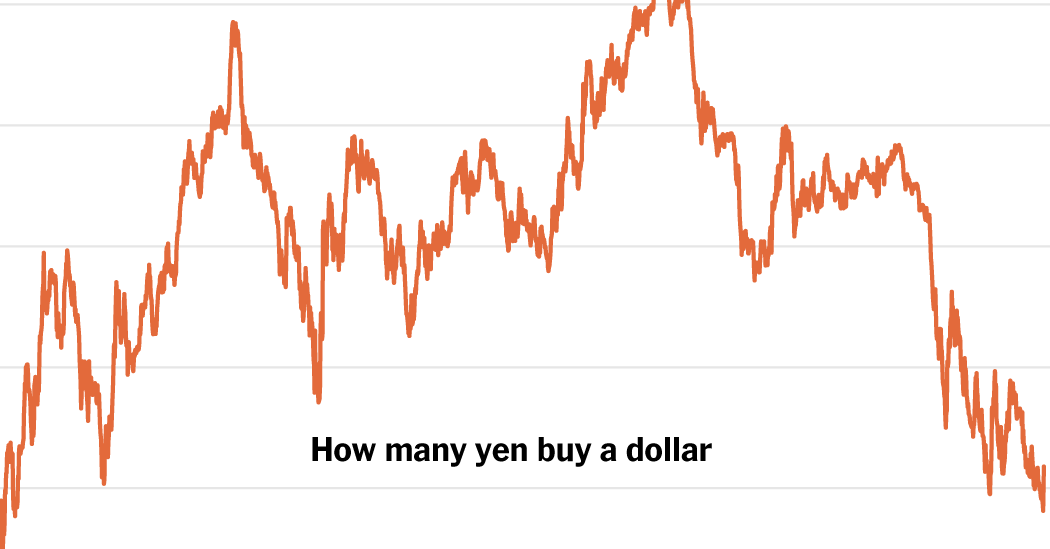
When the Japanese yen recently hit its weakest level against the U.S. dollar in about 40 years, it wasn’t just a problem for the government in Tokyo. It was also a problem for the United States.
The U.S. Treasury Department last week took a rare step to help prop up the yen, reinforcing the Japanese currency’s global significance and the trouble it can cause across borders. The United States and Japan share deep economic and financial ties. Japan’s large holdings of U.S. Treasuries, stocks and other assets — nearly $3 trillion in all — mean that turmoil in Japan can ripple through U.S. markets and beyond.
Here’s why what happens to the yen matters to the United States.
Tight Financial Ties
The U.S. intervention added financial heft to the effort of Japanese officials, who had already spent tens of billions of dollars this year trying to boost the yen. So far, Japan’s interventions have had limited effect and raised the prospect that Japan might sell significant portions of its large pile of U.S. Treasuries to fund further intervention. Japan is the largest foreign holder of U.S. Treasuries, with more than $1.1 trillion in holdings.
By selling Treasuries, Japan could push down their price — and that could ultimately raise borrowing costs for the U.S. government. Already, the yield on U.S. Treasuries have climbed in recent weeks on concerns about inflation. Last week, the yield on 30-year U.S. bonds hit their highest level since 2007.
Moves in the yen also influence other Asian currencies, such as the South Korean won. So supporting the yen can reduce the risk that other Asian countries would come under intense pressure and need to sell their own dollar reserves to prop up their currencies.
“For Washington, supporting the yen is relatively low-cost insurance,” John Bromhead, and economist at Moody’s Analytics in Sydney, wrote in a note.
This was not the first time this year that volatility in Japan’s markets caught the attention of U.S. officials. In January, the Treasury Department considered an intervention in the yen after Scott Bessent, the Treasury secretary, blamed a rise in Japanese bond yields for driving up U.S. government borrowing costs.
Critical Trade Flows
The flip side of a weak yen is a strong U.S. dollar, which can hurt American exporters by making their goods more expensive for foreign buyers. And that could give Japanese exporters a competitive advantage in the United States. Last year, the U.S. imported $146 billion worth of goods from Japan, and exported about $82 billion, according to data from the Office of the United States Trade Representative.
It’s not clear how effective the intervention in the yen will be, even with the help of the U.S. government. A fundamental reason the Japanese yen has sunk so much are investors’ concerns about Japan’s fiscal condition — a heavy debt load and the government’s promotion of tax cuts and spending. The country’s gross debt is more than twice the size of its economy, by far the largest debt burden of any major advanced economy.
The pressure on Japanese finances is growing. Borrowing costs are rising as Sanae Takaichi, Japan’s prime minister, is seeking to help businesses and households with the high cost of living. That includes energy costs, which have risen from disruptions created by the war in Iran, prompting speculation of more government spending and further weakening the yen.
Connected Markets
Mounting inflation encouraged the Japanese central bank to raise interest rates to 1 percent in June, the highest level in 31 years. For years, the Bank of Japan kept interest rates extremely low, even below zero, by purchasing vast volumes of government bonds. The goal was to stimulate growth. Policymakers have started to slowly push rates higher.
But analysts argue that the weakness in the yen will persist as long as Japanese interest rates remain so much lower than those in the United States, where the Federal Reserve has held rates between 3.5 percent and 3.75 percent. Though the Fed hasn’t moved rates this year, growing dissent among policymakers is increasing pressure on the central bank to raise rates. That could widen the gap with Japan’s rates even more.
Last week, the Bank of Japan kept rates steady but traders are betting officials will raise interest rates again later this year. Paradoxically, higher Japanese interest rates could also blow back on the United States, as it would make Japanese assets more attractive for some investors and deter them from U.S. assets.
Japan’s large investments in the United States extend beyond Treasuries, with nearly $1.2 trillion in equities and more than $300 billion in corporate debt last year, according to U.S. Treasury data.
Bound Together
The dollar is indisputably the world’s most powerful currency and sits on one side of 90 percent of nearly all foreign currency exchange trades. The yen is also a significant player. It is the third most traded currency, after the euro. Its share of global trades is notably ahead of the British pound, Swiss franc and Chinese renminbi, according to data from the Bank for International Settlements.
Mr. Bessent and Satsuki Katayama, the Japanese finance minister, have both said that further action to bolster the yen is possible if needed. On Monday, the yen hit 157 to the dollar, the strongest level since early May.
“The Japanese Ministry of Finance remains attentive and in close communication with our counterparts at the U.S. Treasury,” Ms. Katayama said in a statement. “We will not hesitate to conduct further joint intervention.”