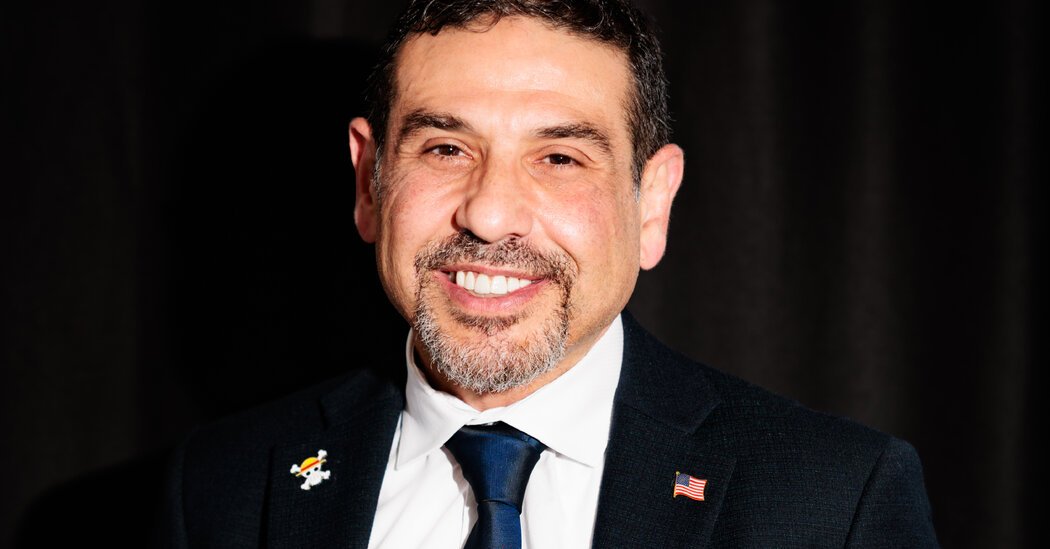
Adam Hamawy, a plastic surgeon and U.S. Army veteran whose parents emigrated from Egypt when he was seven months old, is running for Congress as a healer, of sorts. He has traveled on humanitarian missions in conflict zones, including Gaza. And he has put the issue of health care at the center of his campaign for New Jersey’s 12th Congressional District, saying that money spent on war should instead be used for universal Medicare coverage.
“I go to disaster areas, and that’s where I’m needed now,” Dr. Hamawy said in an interview, referring to Capitol Hill.
He has emerged as a front-runner in the extraordinarily crowded race to fill the seat being vacated by the retiring representative, Bonnie Watson Coleman. At one point, 17 Democrats were in the mix. The field has since dwindled to a mere dozen, including a well-known former leader of the state’s Working Families alliance, a state assemblywoman, two mayors, a patent lawyer, the owner of a chain of fitness studios and a Princeton University neuroscientist with an expertise in gerrymandering. The winner of Tuesday’s election will be heavily favored to win in November.
Dr. Hamawy has led the race for campaign cash and has landed endorsements from such left-wing luminaries as Senator Bernie Sanders of Vermont and Hasan Piker of the internet, who is set to appear with him on Saturday for a get-out-the-vote rally in Trenton. A newly formed pro-Palestinian political action committee, American Priorities, has spent more than $1.5 million on ads that highlight Dr. Hamawy’s work as a surgeon — a figure that dwarfs the campaign budgets of every other candidate.
His critics have been trying with growing urgency to highlight an earlier part of Dr. Hamawy’s history: a gap year the future surgeon spent between graduating from Rutgers University-New Brunswick in 1991 and entering the university’s medical school the next year.
It was then that Dr. Hamawy began spending time with Sheikh Omar Abdel Rahman, a blind, militant Islamist who lived and preached in New Jersey. Four years later, Mr. Abdel Rahman would be tried and convicted of inspiring violence that contributed to the 1993 World Trade Center bombing. He died in 2017 while serving a life sentence.
During Mr. Abdel Rahman’s trial in 1995, Dr. Hamawy, then 26, was called as a defense witness by the sheikh’s lawyers as they tried to undermine the federal government’s star witness, Emad Salem, who was paid $1 million by federal officials while working as an informant and also admitted lying under oath. Mr. Salem had testified that during a road trip to Detroit the sheikh had encouraged him to kill a former president of Egypt, Hosni Mubarak. (Prosecutors had also charged Mr. Abdel Rahman with being at the center of a plot to assassinate the president during a planned visit to New York in 1993.)
Dr. Hamawy, who traveled in a van with the two men, testified that he did not recall hearing Mr. Abdel Rahman say that to Mr. Salem. In the course of his testimony he also told jurors that he helped the blind cleric translate a fax from Egypt in 1993, spent time in his apartment and listened to him speak at area mosques.
Dr. Hamawy, who is now 56, was never accused of wrongdoing and went on to serve with distinction as an Army combat surgeon during the Iraq War, where he helped to save the life of U.S. Senator Tammy Duckworth of Illinois, a Democrat who has also endorsed him. On Sept. 11, 2001, he and other residents at NewYork-Presbyterian went to ground zero to treat those injured in the second terror attack on the World Trade Center.
Andrew C. McCarthy, the lead prosecutor in Mr. Abdel Rahman’s trial, and Michael B. Mukasey, the federal judge who oversaw the case and later served as President George W. Bush’s attorney general, published essays earlier this month reminding readers of Dr. Hamawy’s link to the infamous cleric. Mr. McCarthy, writing for The National Review, referred to Dr. Hamawy as a “sympathizer.” Mr. Mukasey described Dr. Hamawy as “more than a casual traveling companion” of the sheikh in a May 7 essay for The Wall Street Journal.
Dr. Hamawy said his life’s work disproves the guilt-by-association innuendo.
“I have spent my life, really, saving lives rather than taking them,” he said while campaigning in Trenton the day the essays were published.
“I’m against all war and all violence,” he said.
An aide said Dr. Hamawy had “no contact” with Mr. Abdel Rahman after his arrest. Dr. Hamawy has distanced himself from the sheikh on the campaign trail, saying, “I condemn his violent rhetoric and actions.”
When pressed on what had motivated him to travel with Mr. Abdel Rahman as a younger man, Dr. Hamawy downplayed the cleric’s reputation for fiery rhetoric, calling him a “blind old man” who was dependent on volunteers from the Muslim community to care for him. “He wasn’t preaching death and destruction all the time,” Dr. Hamawy added. “He had certain views that he spoke in certain forums, but that’s not what he did every single day.”
On the witness stand, however, Dr. Hamawy made clear that he understood that the sheikh saw Israel and the United States as enemies of Islam. When asked if he recalled the cleric stating that “Muslims had to do jihad against the enemies of Islam,” he said he did.
“Of course, that’s what he always talked about,” Dr. Hamawy testified. “He talked about jihad.”
Three decades later, Dr. Hamawy does not shy away from criticizing Israel and U.S. military aid and weapons sales to the Jewish state, including funding for a missile defense system known as the Iron Dome.
“We are not supposed to be selling weapons, any kind of weapons to any country that is breaking international humanitarian law, that is committing genocide or atrocities,” he told Mr. Piker, a leftist streamer who has been criticized by some Democrats, in an April interview.
“It’s like giving a bully body armor to go bully people some more,” Dr. Hamawy said of U.S. support for Israel’s defensive weapons. “We need to be able to have them feel the effects of war and then they’ll stop, and they’ll actually have a conversation.”
Adrian Mapp, the mayor of Plainfield, is also running for the 12th District seat and has sought to draw a connection between Dr. Hamawy’s positions on Israel and his past association with Mr. Abdel Rahman, as first reported by InsiderNJ.com.
“The association with the blind sheikh was very telling and it speaks to the character of an individual who has associated with an unsavory character,” Mr. Mapp said this week in an interview.
“We ought to ask the question about the affiliation and what it says to the American people about a person who seeks to be a representative in the Congress of the United States of America,” he added.
Mr. Mapp noted that he does not blame Dr. Hamawy for his pro-Palestinian stance. “The Palestinian people need to be treated in a more humane fashion,” he said. But he said he stood by his statement to InsiderNJ that Dr. Hamawy’s views were those of a “radical extremist.”
“I find his statements, quite frankly, to be inflammatory — to accuse the Jewish state of Israel of a genocide,” the mayor said.
Vincent Vertuccio, a spokesman for Dr. Hamawy, called it “disappointing” that a Democratic opponent would “stoop to echoing right-wing, MAGA smears.”
Most of Dr. Hamawy’s opponents have left his past alone. But two of the 10 other Democratic candidates, Shanel Robinson and Brad Cohen, also told the Jewish Insider that his association with Mr. Abdel Rahman raised questions, in an article that was published on Friday.
“As a fellow veteran I truly appreciate Adam’s service to his country, and know that it speaks to his patriotism,” Ms. Robinson, a Somerset County commissioner, told the publication, but “the voters will judge us on our entire adult lives, the choices we have made, and the people we associate with regardless of whether it was 30 days or 30 years ago.”
“The whole matter is of concern,” Mr. Cohen, a gynecologist and the mayor of East Brunswick, said in an interview. “It’s an association with a terrorist.”
Dr. Hamawy has suggested that any criticism of his trial testimony was linked to Islamophobia. “As a Muslim, they’re always going to find something to attack,” he said. “I’m used to this all my life.”
How Dr. Hamawy fares in Tuesday’s primary election might serve as the latest gauge of what kinds of rhetoric resonates with Democratic voters in New Jersey when it comes to Israel. Earlier this year, in a race for Gov. Mikie Sherrill’s old seat in the neighboring 11th District, Analilia Mejia was the only candidate in that contest to call the war in Gaza a “genocide.” She won her February primary against Tom Malinowski — a fellow Democrat who had been the target of negative advertising by a pro-Israel group after refusing to rule out placing conditions on U.S. military aid to that country — and then beat her Republican opponent in a landslide.
Dr. Hamawy’s showing on Tuesday might also shed light on whether a figure such as Mr. Abdel Rahman — whose trial happened before some voters were alive — still looms in the minds of New Jersey Democrats in 2026.
The sheikh appeared to be far from the minds of voters as Dr. Hamawy campaigned earlier this month in Trenton and at a Princeton University forum sponsored by the Young Democratic Socialists of America.
Rickey Sanford, a retired Metropolitan Transportation Authority bus driver, had never met Dr. Hamawy before the candidate knocked on the door of his Trenton brownstone. He said he was mainly concerned about the cost of living and candidates’ willingness to take on President Trump.
“He don’t mind going toe to toe against Trump,” Mr. Sanford said. “I like that part.”
Louise Walpin, a Democrat, is Jewish and politically active. She lives in South Brunswick, N.J. and said she had been a supporter of Dr. Hamawy since hearing him speak at a forum months ago and does not interpret his criticism of Israel to be antisemitic.
“People want something different,” Ms. Walpin, 73, said of the Democratic Party outside Dr. Hamawy’s campaign office in Trenton. “They want a fierceness in the fight.”