Summary:
-
HSBC sees gold hitting $5,000/oz in H1 2026 on geopolitical and debt risks
-
Bank cuts 2026 average forecast slightly to $4,587/oz
-
Warns of deeper correction if Fed halts easing or risks fade
-
Forecast range for 2026 seen at $3,950–$5,050
-
Longer-term forecasts raised for 2027, 2028, and 2029
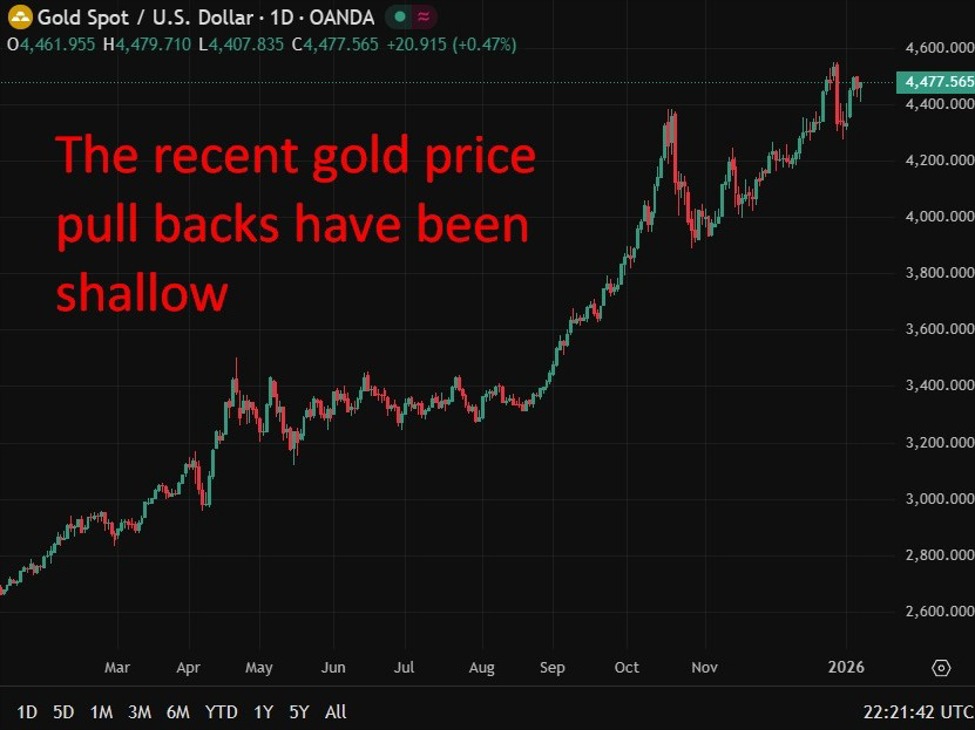
HSBC said gold prices could surge as high as $5,000 an ounce in the first half of 2026, driven by persistent geopolitical risks, elevated sovereign debt burdens, and sustained investor demand for hard-asset protection.
However, the bank simultaneously trimmed its average 2026 gold price forecast, highlighting the risk that such strong gains could ultimately sow the seeds of a later correction. HSBC lowered its 2026 average gold forecast to $4,587/oz from $4,600, while warning that volatility is likely to remain elevated throughout the year.
The bank noted that gold’s powerful rally could face headwinds should geopolitical tensions ease or if the U.S. Federal Reserve pauses or ends its rate-cutting cycle, conditions that could prompt profit-taking and a sharper pullback. HSBC sees a wide trading range of $3,950 to $5,050 per ounce for 2026, underlining the unusually large dispersion of possible outcomes.
Despite the near-term caution, HSBC upgraded its medium- and longer-term outlook for gold, pointing to structural drivers such as rising fiscal deficits, geopolitical fragmentation, and central-bank diversification away from traditional reserve assets. The bank raised its average 2027 price forecast to $4,625 from $3,950, and its 2028 forecast to $4,700 from $3,630, reflecting expectations that underlying demand will remain robust.
HSBC also flagged a 2027 year-end price view of $4,600 and introduced a new 2029 average forecast of $4,775, suggesting the bank sees gold holding elevated levels even beyond the current cycle.
Overall, the outlook highlights a market defined by strong upside potential but rising correction risk, with price action increasingly sensitive to shifts in geopolitics, monetary policy expectations, and investor positioning.