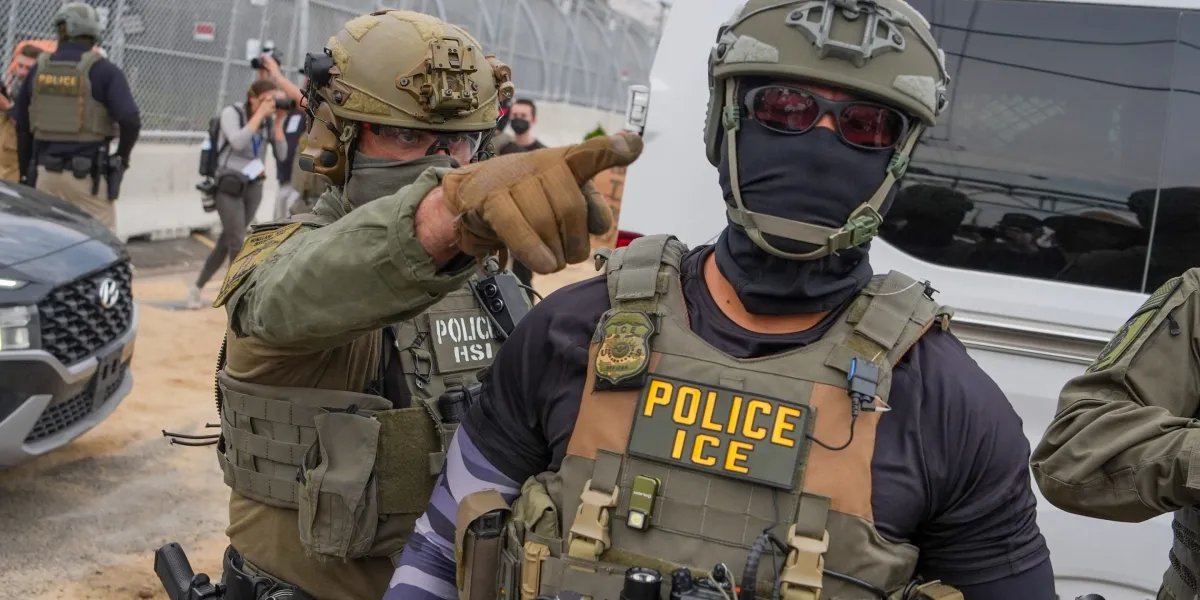

U.S. Immigration and Customs Enforcement (ICE) is preparing to spend up to $20 million on electric shock gloves, an emerging technology already being deployed by police in public schools in Omaha, Nebraska.
ICE will equip officers with high-tech gloves capable of delivering electric shocks, according to documents published this week by the Department of Homeland Security. AP News first reported the plans.
These devices, dubbed G.L.O.V.E. (Generated Low Output Voltage Emitter), have already been deployed by law enforcement officials across the country. In May 2025, the city of Omaha, Nebraska, awarded the Omaha Police Department $65,924 for 40 units of the same electric shock gloves to be used in public schools, city documents show.
“These gloves are being purchased for school resource officers as another use of force option with the goal of deescalating and preventing use of force situations,” according to correspondence from the police department to the city’s purchasing department.
The Omaha Police Department and Omaha Public Schools did not respond to Fortune’s requests for comment on how or why the gloves were being used or about the training school resource officers received to use the devices. The publicly available documents did not provide specific examples of how officers in schools were using the devices, and it is unclear whether the devices are currently being used.
An NPR analysis calculated that more than 50 police departments across 20 states are using the technology at a moment when law enforcement officials, including ICE, are under increased scrutiny from Americans over use of excessive force.
The CTG-5 G.L.O.V.E. products deliver shocks ranging from 324 to 362 volts and have a hard operational limit of 380 volts. By comparison, a taser can reach between 1,200 and 1,500 volts.
The G.L.O.V.E devices are made by the Kentucky-based and veteran-owned Complaint Technologies, which describes the technology as a “Conductive Distraction and De-escalation Device.” The devices, at the time of the correspondence, were being used by “all officers” at the Bellevue Police Department.
In the police department’s purchasing request order, a third-party security expert lauded the gloves’ qualities and outlined policy recommendations, including that G.L.O.V.E. should not be deployed on the elderly, small children, pregnant women, people with physical disabilities, or those with “obvious health conditions.”
How will ICE use G.L.O.V.E. devices?
Most recently, the devices are to be used for Homeland Security Investigations and Enforcement Removal Operations (ERO) for the arrest, detention, and deportation of individuals, according to the document. The contract will likely be awarded in the fourth quarter of fiscal 2026 and run through March 2027.
ICE’s previous uses of force have been cause for concern for some civil rights advocates. American Civil Liberties Union published a report last month that found more than one-third of 1,200 immigration enforcement incidents involved immigration agent misconduct, including use of excessive force or targeting of children or other vulnerable people.
“ICE is constantly assessing the needs of our officers in the field to ensure they have the tools and equipment necessary to safely arrest and remove criminal illegal aliens from our country,” a DHS spokesperson told Fortune in a statement. “Every decision is made with careful consideration and appropriately reviewed to ensure that any technology ICE utilizes is consistent with all applicable law enforcement policies and standards.”
Compliant Technologies did not immediately respond to Fortune’s requests for comment.
According to the Compliant Technologies manufacturer, officers must complete a course to be certified to use the device and be recertified every two years.
The G.L.O.V.E. devices operate as standard gloves until the device is turned on with a button, activating electrode pads on the palm side that deliver a painful electric shock when they come into direct contact with skin.
In a video review testing the device, Mike O’Dowd, a former Navy SEAL and founder of Defense Strategies Group, described the sensation of being grabbed by the arms with the gloves: “It goes into your nerve and it sends this shock up your arm and it hurts so bad,” he said. “It was unbearable.”