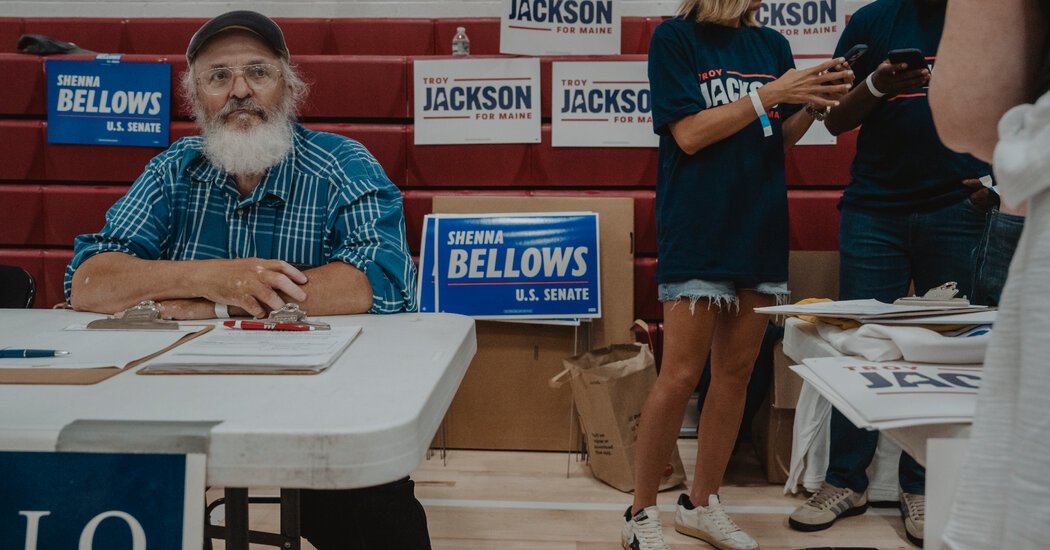
Democrats in Maine took a step on Saturday toward finding a Senate nominee to replace Graham Platner, choosing hundreds of delegates for a party convention next week and delivering a jolt of momentum to one candidate: Troy Jackson.
After Democrats held a day of meetings in stuffy college lecture halls, middle-school gymnasiums, barns, civic centers and virtual gatherings, Mr. Jackson, a progressive former State Senate president, claimed to have secured a significant advantage in eight counties that voted Saturday on their delegates.
A review of the county results, along with campaign delegate slates, and interviews with Democratic operatives, voters and candidates pointed to a very successful showing for him, even as some variables — including a high-profile debate next week — could still shift the race.
“I’ve been getting text messages all day about, you know, what a great job I did,” Mr. Jackson, a logger by trade, said in a video his campaign posted on Facebook, adding, “All of you just smoked it.”
Eight other counties in the state had yet to pick their delegates, and the full scope of the advantage Mr. Jackson might take into the July 25 convention was still unclear. And while some delegates described their preferences in their nominating documents and in forms they submitted to campaigns, they could still change their minds before the convention.
But it was clear by Saturday night that Mr. Jackson had built an imposing head start in a crowded race. The candidate chosen at the convention will take on Senator Susan Collins, who is seen as one of the most vulnerable Republican incumbents in the midterms but has defied political gravity for decades in her Democratic-leaning state.
In many ways, the day appeared to be less an exercise in small-town democracy and more about the political operations that candidates could build in the 10 days since Mr. Platner announced he would withdraw from the race.
Mr. Jackson’s campaign announced it would host a tailgate at York County’s party meeting on Sunday morning to follow his “commanding performance” on Saturday.
Other campaigns struck different notes.
Jordan Wood, who joined the Senate race after falling short in a competitive House primary last month, said the results were “shocking.” He was stunned, he said in an interview, that he and Dr. Nirav Shah, who came in second in the Democratic primary for governor, had not received more support in caucus meetings.
Dr. Shah did not immediately respond to a request for comment. Neither did Dan Kleban, a brewery owner who revived the Senate campaign he’d dropped in the fall.
Shenna Bellows, the Maine secretary of state who lost to Ms. Collins in 2014 and came in fourth in the primary for governor, continued to project confidence on social media.
“No one in Maine has a track record like mine of standing up to Trump,” Ms. Bellows wrote on Facebook on Saturday night. “I can’t wait to take that fight to the US Senate.”
Democratic county parties in Maine have been facing the daunting task of whittling down a group of nearly 3,700 delegate hopefuls into a pack of 500 delegates by Sunday night. Those select few will join about 100 members of a state party committee in voting for the party’s new Senate nominee at the convention next week.
The state party plunged into the complicated caucus process after Mr. Platner ended his campaign earlier this month, following a rape allegation he denied. The party has been racing against a July 27 deadline to pick a new candidate, and created the nomination process essentially from scratch.
Around 11,500 Mainers participated and voted in Saturday’s nominating meetings, the executive director of the Maine Democratic Party, Devon Murphy-Anderson, said in a video posted to social media on Saturday night. A total of 19,000 Democrats were expected to participate throughout the weekend, she said.
“Meetings like this normally take months,” Wayne Kinney, chair of the Franklin County Democrats, told voters at a meeting in Farmington on Saturday morning. “Here, we’ve done this in days.”
In Cumberland County, which is the state’s most populous county and includes Portland, a Zoom gathering to elect 149 delegates out of nearly 1,300 candidates was silent and faceless for most of the three and a half hours of voting.
Voters were sent ballots via email and text.
At the end of the night, the chair, Joseph Zamboni, broke a tie for the 30th alternate by pulling one of two names out of a baseball cap held out for him while he averted his eyes.
Candidates zigzagged across the state throughout the day, seeking to appear at as many of the in-person gatherings as they could. Dr. Shah, a former public health official, brought green “Shah for Senate” signs and posed with supporters in Calais, Wiscasset and Augusta, while Mr. Kleban chatted with voters in Augusta and Farmington.
The process will continue on Sunday as the other eight counties elect their delegates.
Peter Stein, a 67-year-old scientist and engineer who was elected as a delegate for Franklin County, volunteered for Mr. Jackson during his unsuccessful run for governor and previously supported Mr. Platner.
”Jackson is a lifelong Mainer and speaks like one. That matters to people,” Mr. Stein said, adding, “He’s incredibly intelligent, he puts smart people around him and he wears his heart on his sleeve.”
He drew a contrast between Mr. Jackson and Dr. Shah, who he said was too much of an outsider. Dr. Shah moved to the state in 2019 to lead the Maine Center for Disease Control and Prevention.
Others were less certain whom they would back.
Anne Smith, 70, a retired translator who was also elected a delegate for Franklin County, said at the start of Saturday’s meeting that she was still making up her mind.
“I want to wait for another week, nearly a week, and weigh up all the options, listen to debates, do more research,” said Ms. Smith before she was chosen as one of the county’s nine delegates. “And at that point I’ll be ready to commit myself.”
On Sunday in York County, where Mr. Jackson’s campaign will hold its tailgate, more than 80 delegates will be elected at a meeting in Sanford, on the state’s southwestern edge.
“It looks like Troy’s in the catbird position,” said David Farmer, a Democratic consultant in Maine. “If his delegates hold true. And I have no reason to believe they won’t.”