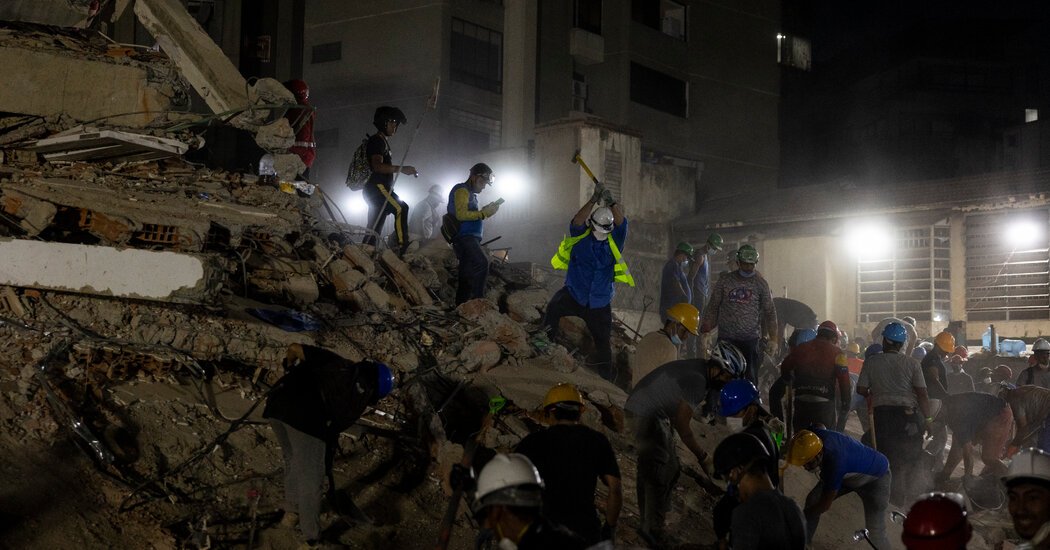
A single jackhammer. A pair of pickaxes. Men swinging with all their might to break through multiple stories of concrete to try to reach the living.
The scene on Saturday night in San Bernardino, a middle class neighborhood in Caracas, showcased both the severe shortage of heavy machinery needed to rescue survivors following Wednesday’s double earthquakes and the massive community mobilization that has taken place to try to fill that gap.
At the Residencia Rita, an apartment building that crumbled when the quakes hit, finding anyone alive three days later would have been a miracle. And yet, hundreds of people gathered to help locate survivors on Saturday.
They lined up like firefighters, passing buckets of rubble down the line to try to clear the way.
“We will always have hope,” said María Alejandra Navarro, 25, a journalist with rescue training who said she had brought a team of 14 volunteers to the scene.
Compared with the situation in La Guaira, the nearby state that was hit hardest by the disaster, conditions at Residencia Rita seemed favorable for a rescue. Electricity had already returned to the area. The neighborhood is easily accessible by vehicle.
And yet, neighbors watching the rescue operation said that not a single survivor had been found since Wednesday.
A large excavating machine stood by, and was used only briefly during the evening.
Cesar Briceño, 40, a gym owner, said he planned to use his brawn and technical climbing skills to help. He had come from Barquisimeto, a city five hours away. He had three children, he said, and had been motivated by the idea of uniting families separated in the rubble. He didn’t know where he would be sleeping that night, he said. Probably in his car.
The goal was to drill and pick and hammer through the ceilings and floors that had crashed one on top of the other. There was no clear mission leader. Civilians worked alongside firefighters and members of Civil Protection, the national emergency service. Members of the National Guard stood on the perimeter.
Suddenly, one of the rescuers raised a red-gloved hand.
“Silence!” he called out.
Something — someone? — had been found.
Two women in hard hats hugged in celebration.
A man prayed: “Jesus, do not abandon us.”
Many in the crowd, wearing masks to protect them from toxic dust, looked on, expectant.
False alarm. The volunteers kept working. Darkness fell. Sledgehammers pounded the building’s surfaces, trying to break them apart.
The rescuers labored in shifts, resting when exhaustion set in. Several complained that they couldn’t work — there weren’t enough tools.
Then, finally, the rescuers began to shout: Firemen!
A hole in the concrete revealed a person — a body. Firemen cut through the rebar blocking their way. Sparks flew. A body bag was sent up the mountain of rubble, and the person was placed inside, then carried into an ambulance.
Some in the group bowed their heads, paying respects. It was past 9 p.m. But there was still so much more work to do, and so the rescuers kept going.