Summary:
- Iran launched missiles and drones at US military sites in Kuwait and Bahrain over the weekend; the US struck back, but both sides agreed Sunday to halt hostilities and return to talks in Qatar, coming on Tuesday, over the Strait of Hormuz dispute
- Strait of Hormuz vessel transits fell to 48 over June 26-28, down from 70 on Wednesday, underscoring the fragility of the ceasefire and the pace of shipping recovery
- Analysts warn it could take the remainder of the year before Persian Gulf oil supply approaches pre-conflict levels, with tanker backlogs, damaged infrastructure and production shut-ins constraining physical flows
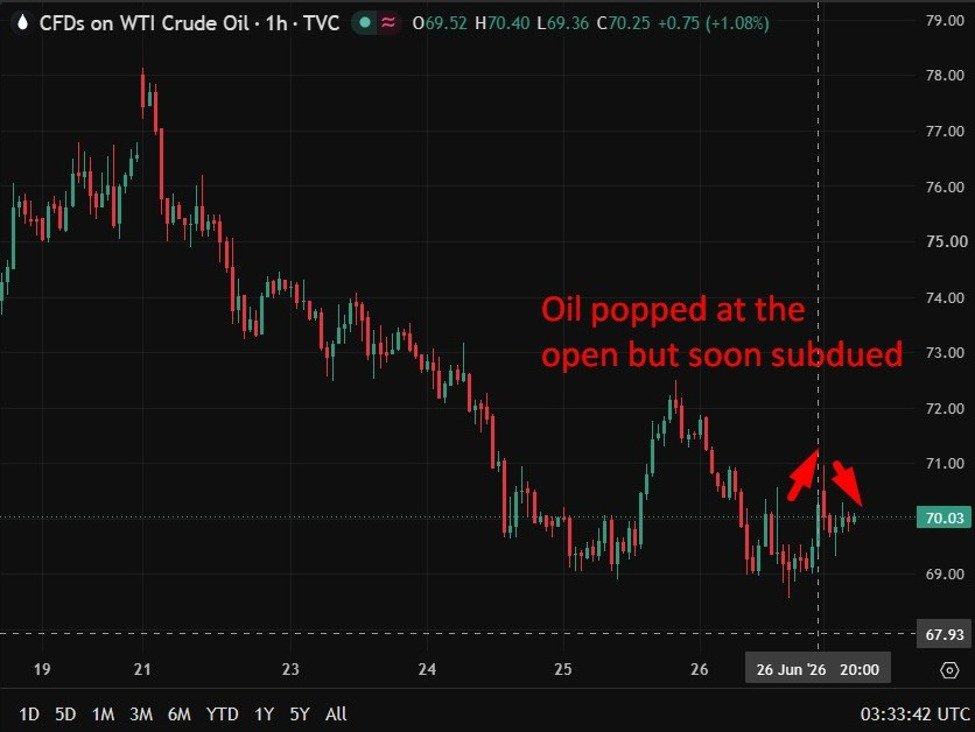
- Oil prices rose at Monday’s open on the weekend strikes before gains were capped by the renewed ceasefire and talks announcement; gold eased as oil’s rise reduced safe-haven demand
- A helicopter crash at Saudi Aramco’s Ras Tanura terminal killed 14 nationals on Sunday; loadings continued and the cause remained unknown
- China’s PBOC debuted overnight reverse repo operations, offering 300 billion yuan to financial institutions without disclosing the borrowing rate, surprising traders awaiting guidance
- China added 20 Japanese entities to its dual-use export control list, including the National Institute for Defense Studies and subsidiaries of Mitsubishi, Komatsu and Fujitsu, citing Japan’s remilitarisation and nuclear ambitions
- South Korean shares fell more than 1% as chipmakers slumped on Friday’s US session losses; President Lee unveiled a $651 billion AI, semiconductor and robotics investment programme
- Japan’s May retail sales rose 5.3% year-on-year, the strongest since November 2023, beating all estimates; a draft economic blueprint targets above 1% real growth and above 3% nominal growth with $2.29 trillion in investment through 2040, while urging the BOJ to align policy with the government’s growth agenda
Oil markets opened the week under a familiar cloud, with the US-Iran ceasefire once again the dominant price driver after a weekend of missile and drone exchanges gave way to a fresh agreement to stand down and return to talks, this time in Qatar and focused squarely on the mechanics of Strait of Hormuz passage.
The relief rally in crude was real but contained. Analysts were quick to temper optimism about a swift supply recovery, noting that tanker backlogs, damaged infrastructure and production shut-ins mean physical flows from the Persian Gulf could remain constrained through the remainder of the year even if the diplomatic track holds. Strait traffic data reinforced the point: vessel transits through the strait fell to 48 over the June 26-28 period, down sharply from 70 on Wednesday before the latest round of strikes. Gold eased as oil’s move absorbed the risk premium. At Aramco’s Ras Tanura terminal, loadings continued despite a helicopter crash that killed 14 nationals on Sunday, with the cause unknown.
Elsewhere in the region, China moved on two fronts. The PBOC debuted overnight reverse repo operations, injecting 300 billion yuan without disclosing the borrowing rate in a move that wrong-footed traders expecting guidance on the new instrument’s pricing. Separately, Beijing added 20 Japanese entities to its dual-use export control list, including defence research and industrial names, citing Tokyo’s remilitarisation agenda.
In equity markets, South Korean shares shed more than 1% as chipmakers tracked Friday’s US losses, even as President Lee unveiled a $651 billion AI and semiconductor investment programme. Japan offered a brighter domestic read: May retail sales surged 5.3% year-on-year, the strongest print since November 2023, while a draft economic blueprint laid out an ambitious 1%-plus real growth target and called on the BOJ to keep policy supportive of the government’s reflation drive.