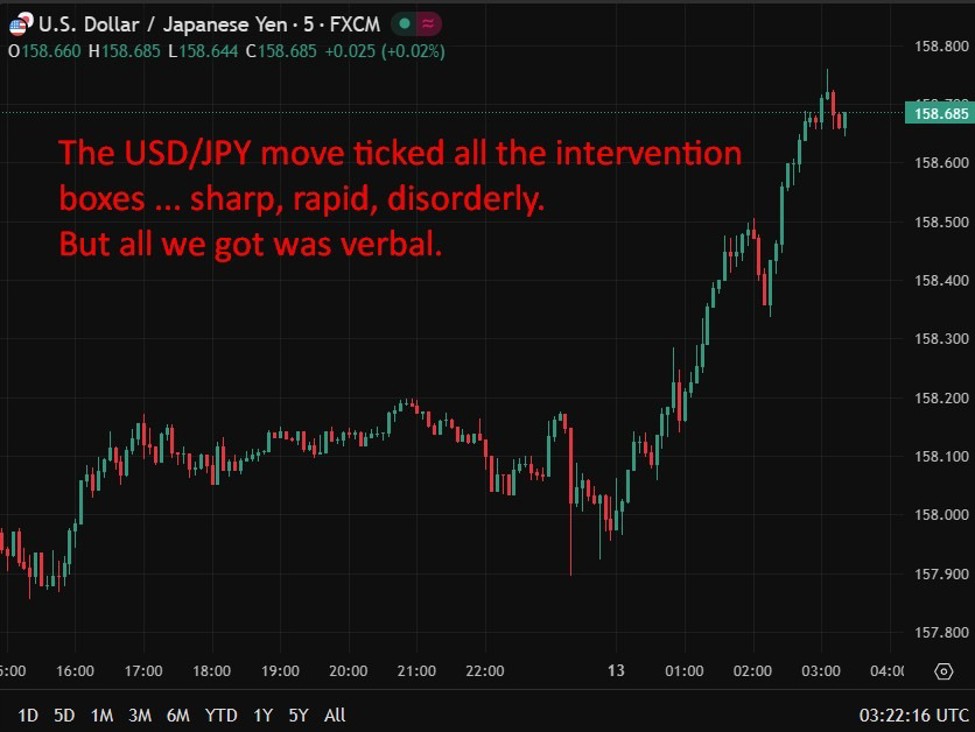
- USD/JPY is surging still. Do we pencil in January 19 for Bank of Japan intervention?
- Japan steps up FX warnings, Tokyo jawboning returns, but yen reaction limited
- Japan govmt spokesperson says ready to respond on sharp, one-sided yen weakness
- Oil rises as geopolitics clash with new supply; Iran tensions vs. Venezuela exports
- Nikkei hits record as weak yen and election speculation fuel rally
- PBOC sets USD/ CNY central rate at 7.0103 (vs. estimate at 6.9734)
- Fed’s Williams sees no urgency to change rates, policy well placed
- US convenes allies to strengthen critical minerals supply chains
- Bank of Korea seen holding rates as next cut delayed to 2027 (poll)
- UK consumer spending slumps in December as household caution deepens
- Fed Williams continues to discover multiple ways to say no rate cut this month, clever boy
- Australian consumer confidence slips, 92.9 (94.5 prior), as rate expectations turn higher
- Japan’s Katayama warns on weak yen in talks with US Treasury, invokes Bessent’s name
- Fed’s Williams defends Powell, warns against eroding central bank independence
- Fed’s Williams says policy near neutral, sees inflation back at 2% in 2027
- Trump threatens 25% tariff on countries doing business with Iran. No detail, just bluster.
- Fitch warns Fed independence is key pillar of U.S. sovereign credit rating
- investingLive Americas FX news wrap: US equities shrug off Trump Fed independence attack
- Trump: Countries doing business with Iran to pay 25% US tariff
- S&P and Dow close at new record levels
- New Zealand business confidence surges to decade high as recovery gathers pace
- New Zealand data: Q4 2025 business confidence 48% vs. +18% in the prior quarter
Summary:
-
NZ business confidence jumps to highest since 2014
-
Fitch flags Fed independence as key US rating support
-
Trump tariff threat on Iran-linked trade adds uncertainty
-
Williams signals Fed patience, defends policy framework
-
Yen resumes slide; crosses hit fresh record highs
Asia opened to a mixed macro backdrop, with pockets of optimism offset by persistent FX stress and rising geopolitical uncertainty.
In New Zealand, sentiment improved sharply after the New Zealand Institute of Economic Research reported business confidence at its highest level since 2014. The QSBO showed hiring and investment intentions lifting, activity stabilising and inflation pressures remaining contained, reinforcing expectations that the Reserve Bank of New Zealand is done cutting rates this cycle. NZD/USD ticked modestly higher on the release.
In the US, institutional risk remained in focus. Fitch Ratings said Federal Reserve independence remains a key support for the US AA+ sovereign rating, warning it is monitoring governance and institutional checks closely following renewed political pressure on Chair Jerome Powell.
Policy uncertainty was amplified after Donald Trump said the US would impose a 25% tariff on any country doing business with Iran, effective immediately. The White House provided no implementation detail, leaving markets to assess (guess?) the implications for global trade and Iran’s major partners. Market speculation if intensely focused on how, if?, this applies to China, one of Iran’s largest trading partners. Its hard not to see a TACO on this, at least as it applies to China.
Fed messaging itself remained steady. New York Fed President John Williams said policy is near neutral and well positioned, with inflation expected to return to 2% in 2027 and no urgency to cut rates further. Williams defended Fed independence, the current rate-control framework, and reiterated that the dollar remains the world’s reserve currency.
FX markets were dominated by renewed yen weakness. Japan Finance Minister Satsuki Katayama said she raised concerns about one-sided yen moves with US Treasury Secretary Scott Bessent, briefly lifting the currency. The bounce faded quickly. USD/JPY pushed on to a one-year high near 158.25, and then accelerated further. Cross-yen pairs marked a series of fresh extremes: GBP/JPY hit its highest level since 2008 near 213.20, EUR/JPY rose to a record 185.02, and CHF/JPY to a record 198.90. Japanese equities continued to thrive on the weak yen, with the Nikkei 225 surging to a historic high.
In the UK, demand signals softened further. Barclays card data showed consumer spending fell 1.7% y/y in December, the sharpest drop since 2021, while British Retail Consortium data showed retail sales growth slowed for a fourth straight month as shoppers waited for post-Christmas discounts.
Overall, the session highlighted a familiar pattern: resilient risk assets, firm USD support, and a yen under sustained pressure despite repeated official warnings.
Asia-Pac
stocks:
- Japan
(Nikkei 225) +3.08%, loving yen weakness and the prospect of more government fiscal stimmy - Hong
Kong (Hang Seng) +1.12% - Shanghai
Composite flat - Australia
(S&P/ASX 200) +0.94%
Authorities watching JPY crosses: