The cease-fire between Iran and the United States hung in the balance on Saturday, as Iranian leaders met with Pakistani mediators for rounds of talks in an effort to stave off a renewed American assault.
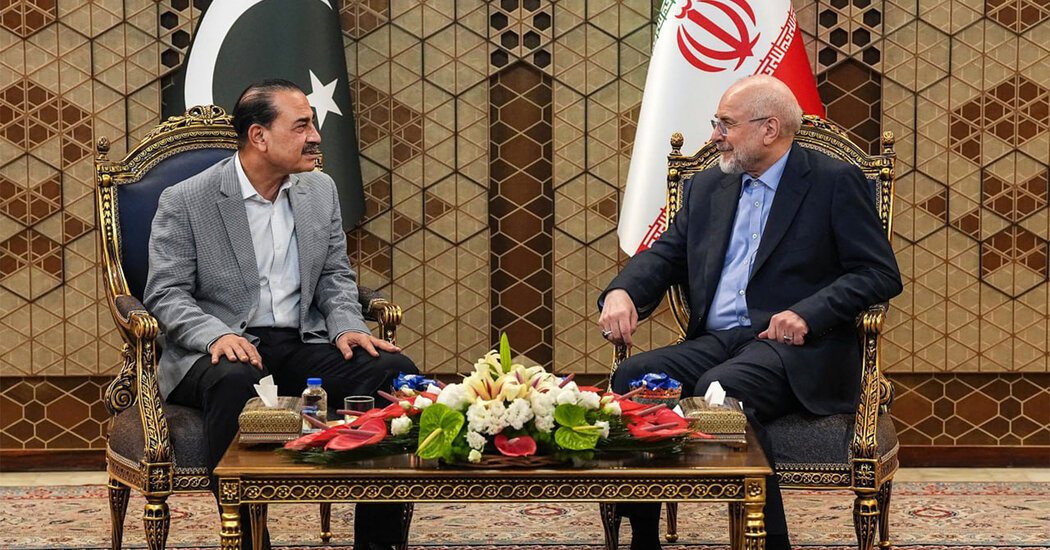
Syed Asim Munir, the Pakistani Army’s chief of staff, met with Mohammad Bagher Ghalibaf, Iran’s chief negotiator and parliamentary speaker, in Tehran, according to Iranian state media.
Mr. Munir, who has played a central role in his country’s mediation efforts, left Tehran on Saturday afternoon, a day after his arrival in the country, Iran’s state television said.
During the meeting, Mr. Ghalibaf said that Iran’s military had been rebuilt during the cease-fire, according to Iranian state media. “If Trump acts foolishly and the war resumes, the response against the United States will certainly be more crushing and bitter than on the first day of the war,” Mr. Ghalibaf reportedly said, referring to President Trump.
On Saturday, Mr. Trump spoke with Sheikh Tamim bin Hamad Al Thani, the emir of Qatar, to discuss “regional and international efforts to stabilize the cease-fire,” according to a statement by Sheikh Tamim’s office. A Qatari delegation had joined Pakistani mediators in Iran on Friday, two diplomats with knowledge of the mediation efforts said. There was no immediate comment from the White House.
The United States, Israel and Iran agreed a cease-fire in early April after more than a month of war. The truce was intended to allow for talks on Iran’s nuclear program and the reopening of the Strait of Hormuz, a crucial waterway for oil and gas shipping that Iran has effectively closed since the early days of the war, causing energy prices to soar worldwide.
After about six weeks of on-and-off negotiations, however, the United States and Iran appear to still be far apart on several sticking points.
With talks at an apparent impasse, Mr. Trump has frequently threatened to resume strikes on Iran, although military analysts are skeptical that further aerial attacks would force Iran to compromise. He has just as frequently pulled back on his threats as he pursued a resolution to the war.
On Friday, Abbas Araghchi, the Iranian foreign minister, accused the United States of “excessive demands” in a call with António Guterres, the United Nations secretary general. Mr. Trump recently denounced one Iranian counterproposal as “totally unacceptable.”