Iran’s armed forces struck a container ship that was passing through the Strait of Hormuz on Thursday, according to U.S. and Iranian officials, bringing a halt to a plan to evacuate about 11,000 seafarers from the Persian Gulf.
The attack came as Secretary of State Marco Rubio met Gulf Arab leaders in Bahrain to try to allay their security concerns and hours after Iran had warned ships that the only route through the strait, a vital pathway for oil and natural gas, was through its waters. Many ships had been using a route on the southern side of the strait, hugging the Omani coast.
Iran’s Islamic Revolutionary Guards Corps warned ships earlier on Thursday that they must coordinate with its navy and said that they should not take an alternative route, in an apparent reference to Omani territorial waters. The threat came just as shipping in the waterway was surging this week after months of paralysis.
“This route is unacceptable and extremely dangerous,” the Revolutionary Guards’ Navy said early on Thursday in a statement carried by Tasnim, an Iranian news agency tied to the Guards. “We warn all vessels to strictly refrain from any movement outside the designated routes,” it added, warning that action would be taken against vessels that did not heed its instructions.
The attack prompted the International Maritime Organization to suspend its plan to evacuate the seafarers from hundreds of ships that had been stranded in the Persian Gulf during the U.S.-Israeli war on Iran.
The United Kingdom Maritime Trade Operations organization, which is administered by Britain’s Royal Navy, reported that the cargo vessel had been hit by an “unknown projectile,” damaging the bridge. The episode happened 7.5 nautical miles southeast of Dahit, Oman, where vessels taking the Omani route were transiting.
The ship struck, the Ever Lovely, is owned by Evergreen Marine, a shipping company based in Taiwan, according to Equasis, a ship data base. A spokeswoman for the maritime organization said the Ever Lovely had not coordinated its passage with the agency.
Oil prices jumped after the strike, which halted shipping traffic through the crucial waterway. The price of Brent crude, the global benchmark for oil, rose over 2 percent to about $75 a barrel. West Texas Intermediate crude, the U.S. benchmark, also rose over 2 percent, to around $72 a barrel.
Jakob Larsen, the chief security officer at BIMCO, the world’s largest shipping association, said in a statement on Thursday that the attack underscored the importance of having clear agreements between the United States and Iran on the resumption of shipping through the strait. The current agreement is “not sufficiently clear,” he said.
The Iranian official, who asked not to be named because he was not authorized to speak publicly, said Oman’s providing an alternative route to vessels for transiting the strait had angered Iran and undermined its control over the passageway, therefore it had decided to take action to create deterrence.
The official said Oman was in a difficult position, working with Iran to create a management system over the strait and under pressure from the United States to reject all monetization and open the waterway. He added that Oman did not have the ability to provide security guarantees to vessels without Iran on board, and that Iran, which was insisting on maintaining its control over the area, would not tolerate a second or third party intervention.
The Wall Street Journal initially reported the strike on the vessel in the strait.
Traffic through the strait — a vital energy route that Iran and the United States blockaded during the war — has jumped this week as vessels stranded for months in the Persian Gulf began leaving. Shipping companies are seeking to take advantage of a temporary two-month window to move Middle East crude oil.
About 70 vessels transited the waterway on Wednesday, including 29 tankers, making it the busiest day since March 1, according figures offered on Thursday by Kpler, a maritime data company. Before the war, 130 or more ships passed through the strait every day.
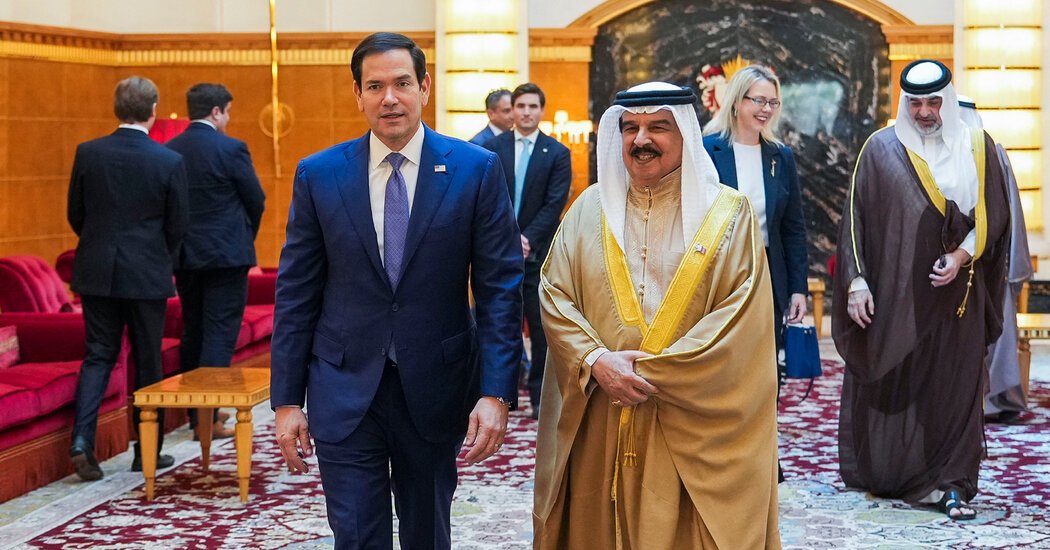
Bahrain is the final stop of a three-country tour for Mr. Rubio, which also took him to the United Arab Emirates and Kuwait. At a meeting with representatives of the six-member Gulf Cooperation Council in the Bahraini capital, Manama, Mr. Rubio sought to allay concerns among regional allies over a framework peace agreement with Iran that has left some of their central security questions unaddressed.
“We want to ensure that in any decisions that are made throughout this negotiating process, the interest of our partners and our allies in the region are always taken into account,” Mr. Rubio told the council’s representatives on Thursday.
The deal should not undermine “the security, the stability, or the prosperity of any of our partners in the Gulf region,” he added.
Gulf Arab states have broadly welcomed efforts to end the war but remain uneasy about provisions of the preliminary agreement. The deal does not address Iran’s missile and drone programs, which Tehran used to attack Gulf countries — some of which host American military bases — after the conflict with the United States and Israel began in late February.
The crucial question of how shipping will be managed through the Strait of Hormuz also remains unresolved.
The naval arm of the Revolutionary Guards, in its latest threat, repeated that coordination with the guards was “mandatory” for vessels seeking to transit the strait. Iran has insisted on this since the framework U.S.-Iran peace deal was announced last week.
The warning appeared to refer to a southern route through Omani waters, which the International Maritime Organization is using to coordinate the exits of as many as 600 ships that have been stranded in the Persian Gulf.
The Revolutionary Guards said the route had been announced without consultation and called it “unacceptable and extremely dangerous.”
Several container ships, some of which were stranded for more than three months, have also been able to leave the Persian Gulf.
The Danish shipping giant Maersk said two of its vessels had left the Gulf between late Wednesday and early Thursday after “security assessments” and consultations with regional security partners. Three Maersk vessels remain in the Gulf and are expected to leave later, the company said.
During his meeting with Gulf Cooperation Council foreign ministers on Thursday, Mr. Rubio rejected Iran’s continued claim to control passage through the strait.
“International waterways do not belong to any nation state,” he said. “This is a foundational principle in the world today, without which the world would be in total chaos.”
Leily Nikounazar and Rebecca F. Elliott contributed reporting.