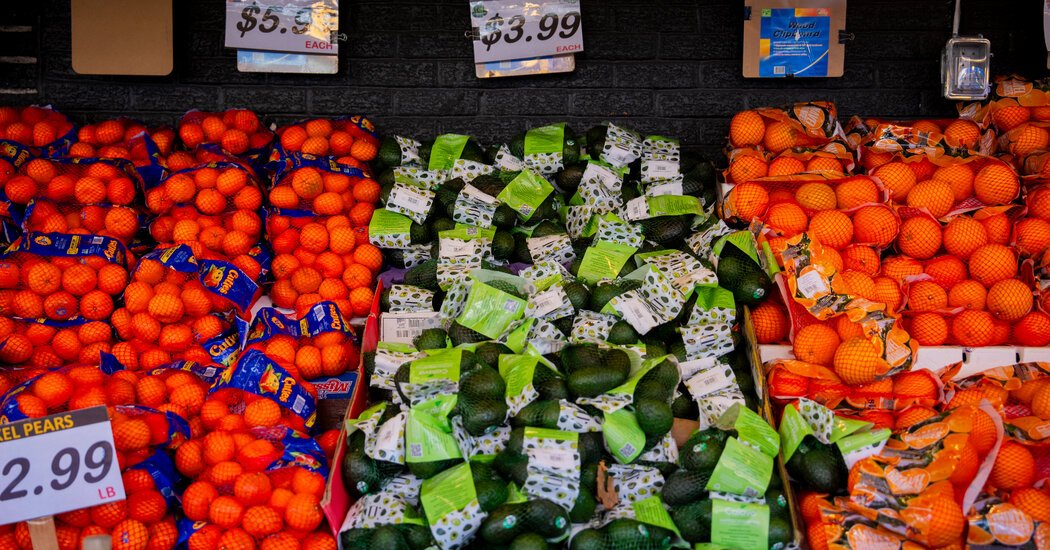
A measure of inflation closely watched by the Federal Reserve accelerated in April to a three-year high, reinforcing the central bank’s budding support to consider raising interest rates if price pressures do not ease.
The Personal Consumption Expenditures index rose 3.8 percent from the same time last year. It was the fastest annual pace since May 2023, when the Fed was in the midst of raising rates to tame a burst of inflation that had emerged in the wake of the pandemic. Over the course of the month, prices rose 0.4 percent.
A measure of underlying inflation that strips out volatile food and energy prices also notched a multiyear high. That measure, “core” inflation, increased 3.3 percent on a year-over-year basis after rising 0.2 percent in April.
The latest data, which the Commerce Department released on Thursday, provided officials at the central bank with yet more evidence that they need to prioritize the risk of resurgent price pressures stoked by the war with Iran over shoring up the labor market, which has stabilized in recent months. Earlier this month, the Consumer Price Index, another inflation gauge, showed that consumer prices had risen at the fastest pace since May 2023.
The war, which began in late February, has severely disrupted global energy markets, raising the urgency of a deal between President Trump and Iranian officials.
The Fed typically ignores or “looks through” supply shocks because they historically tend to affect prices only temporarily. But some officials have begun to question whether this is the right approach, given that the war with Iran is the fourth shock in five years to push inflation further from the Fed’s 2 percent target. The U.S. economy has weathered a series of events that have raised prices, including the Covid-19 pandemic, Russia’s invasion of Ukraine and Mr. Trump’s global trade war.
Since 2021, inflation has been higher than the central bank would like. Expectations about inflation in the next five or 10 years still reflect confidence that the central bank will eventually succeed in bringing inflation down to 2 percent. But the longer inflation stays above that target, the more likely that confidence could begin to ebb.
With the labor market on firmer footing than just a couple of months ago, more Fed officials have embraced the possibility that rates may need to rise to get inflation fully under control.
“I want to be clear about my risk assessment: The risks remain tilted toward higher inflation,” said Lisa D. Cook, a Fed governor, in remarks on Wednesday. “I am prepared to raise rates, if the expected disinflation does not appear in a timely manner.”
That followed a speech last week from Christopher J. Waller, another governor, who made clear that he could “no longer rule out rate hikes further down the road if inflation does not abate soon.” That, he added, was “especially true if measures of inflation expectations, some of which have risen lately, show signs of becoming unanchored.”
The specter of higher rates comes amid a leadership transition at the Fed. Kevin M. Warsh, whom Mr. Trump picked to replace Jerome H. Powell as Fed chair, was sworn in to the top job last week. Mr. Trump has long berated the Fed for not lowering rates quickly enough.
Mr. Trump has hinted he will try to ease up on his pressure campaign now that Mr. Warsh is at the helm. At Friday’s swearing-in ceremony, which was held at the White House for the first time since 1987, the president said he wanted Mr. Warsh to be “totally independent.”
But that leeway could quickly disappear, especially if the Fed begins to more seriously consider rate increases, which would make all types of borrowing more expensive.
Traders in federal funds futures markets expect the central bank to eventually raise rates early next year.