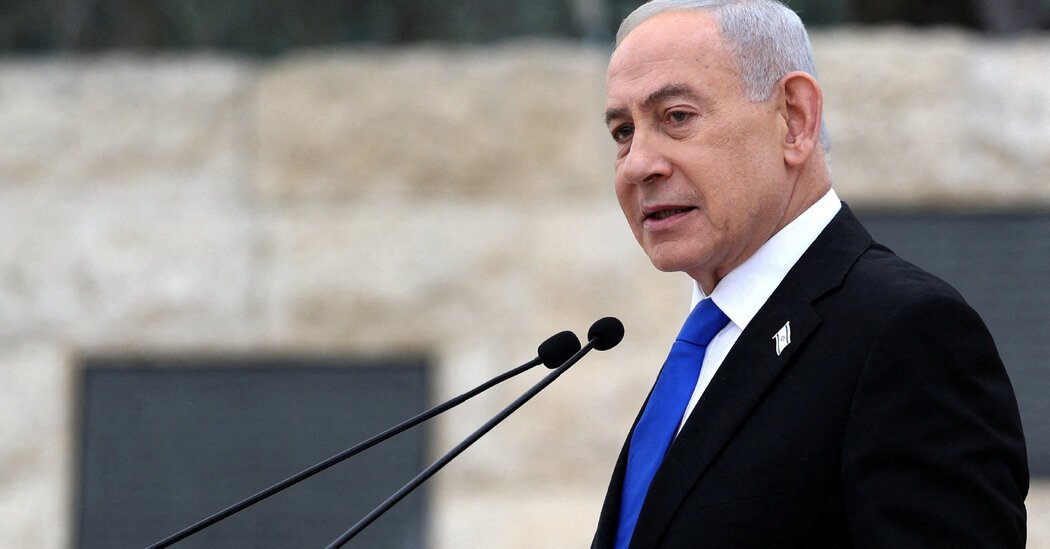
For Prime Minister Benjamin Netanyahu of Israel, the war he had hoped would secure his legacy — Israel and the United States together attacking Iran — may be ending in a way that could sully it.
The framework agreement to end the war, announced on Sunday, omits some of the most important things Israel wanted.
The full text of the deal has not yet been released, and Israel was not directly involved in the negotiations. But initial details suggest that it does nothing to curb Iran’s ballistic missile arsenal, or its funding of regional proxies like Hezbollah in Lebanon and the Houthis in Yemen, who have attacked Israel with their own arsenals. It could help Iran bolster those proxies by easing sanctions, which would allow billions of dollars to flow into its bank accounts.
When it comes to constraining Iran’s nuclear program — a matter of greatest importance to Israel and the greatest priority of Mr. Netanyahu’s career — the terms of the deal remain undisclosed or still to be negotiated during the agreed 60-day cease-fire. Questions remain over what will become of Iran’s stock of highly enriched uranium and whether the country will be able to keep enriching nuclear fuel.
And while Israeli officials disputed this, Iranian officials said on Sunday that the framework included a halt to “military operations on all fronts, including Lebanon, effective immediately.” That could constrain Israel’s battle against Hezbollah.
In a news conference Monday night, Mr. Netanyahu said that Israel would seek to “preserve its freedom of action” to act against threats, including in Lebanon. He said Israel had done just that earlier in the day, killing four people he said had posed a threat to Israeli soldiers.
Asked whether the same principle would apply to Iran, he said he was committed to ensuring the country never posed a nuclear threat to Israel, but did not elaborate.
Mr. Netanyahu alluded only obliquely to any differences of opinion with Mr. Trump over the agreement, saying that while he and the president “often see eye to eye,” there were also “cases where we see less eye to eye.”
Others in his government were more blunt.
“The agreement with Iran is bad for Israel and the entire free world. Period,” Bezalel Smotrich, the far-right finance minister, wrote on social media earlier on Monday.
Worse still for Mr. Netanyahu, who faces re-election in a few months and is behind in the polls, President Trump, the Israeli leader’s most valuable political asset, has publicly rebuked him multiple times in recent weeks.
While Mr. Trump has praised Iran’s new supreme leader, Mojtaba Khamenei, as pragmatic, he has called Mr. Netanyahu “crazy,” ungrateful and lacking in judgment.
“The strategic mistake that Netanyahu made was failing to understand that just as Trump is with you, he could also flip on you,” said Yaakov Katz, an analyst and co-founder of the Middle East-America Dialogue.
On Sunday, Mr. Trump added “difficult” to that litany of insults hurled at Mr. Netanyahu. That came after Israel’s military — precisely as the United States was trying to close its deal with Iran — struck what it described as a Hezbollah target on the outskirts of Beirut, the Lebanese capital, in retaliation for a Hezbollah attack that wounded two Israeli soldiers.
In effect, Mr. Netanyahu appeared to have fallen into a trap.
Had he refrained from hitting back at Hezbollah at that moment, his growing number of critics, including on the Israeli right, surely would have accused him of allowing a new “equation” to take hold. Striking Beirut could have been seen as off-limits to Israel because of Iran’s alliance with Hezbollah and Mr. Trump’s determination to close a deal with Tehran.