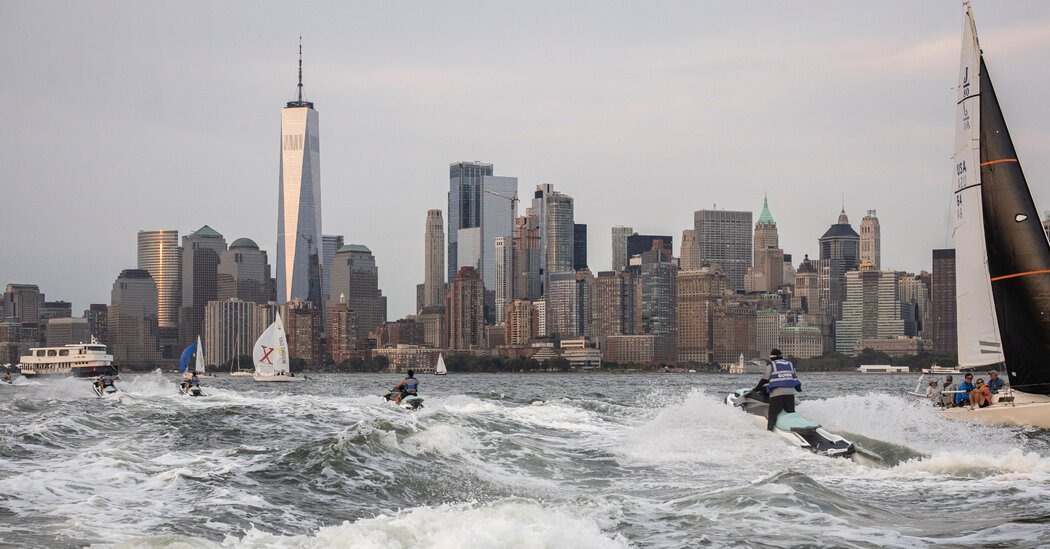
Jet Skis and booze cruises veer uncomfortably close to oil tankers and loaded barges. Ferries steaming past the Statue of Liberty send out rolling wakes that rock little sailboats and charter vessels that seem more suited for placid lakes.
New York Harbor, one of the busiest cargo ports in the country, has long been a crowded, chaotic waterway. Now, the tragic fate of a mother and her infant daughter, who died after an overloaded charter boat capsized near the Statue of Liberty, has put a spotlight on safety in the waters south of Manhattan.
Some mariners describe the harbor as something of a wild west, where there’s no guarantee that the practices and regulations designed to keep the waterway safe and orderly will be observed.
“It’s become a free-for-all,” said Roland Rexha, secretary-treasurer of the Marine Engineers Beneficial Association, an international union.
“You have everything from bootleg mariners to jet skis and people in canoes out there cutting in front of the Staten Island Ferry,” Mr. Rexha said. “And they just don’t realize that the ferry is not a car that can just stop on a dime.”
“It really is a zoo,” said Mike Zlotowicz, 45, a charter boat owner. “It’s a dizzying array of commercial and private traffic.”
Ferry traffic in the harbor has increased in the past decade. Kayakers and paddleboarders now flock to once-polluted waters that have been cleaned up. Pleasure crafts abound.
Many novice boaters often lack local knowledge of the deep channels heavily trafficked by huge commercial craft, as well as the swift tidal currents flowing in and out of the Hudson and East Rivers. And they may be unfamiliar with formal admonitions about avoiding security zones and yielding to large, less nimble craft that can only navigate in channels.
“It’s remarkable how many recreational boaters are unaware of the rules of the water, even simple right of way,” said Jess Yeomans, a crew member aboard tugboats in New York Harbor for the past 10 years.
Even though many recreational boat owners have no nautical background or training, enforcement of boating regulations in the harbor is “like a void,” said Carter Craft, who conducts tours of the harbor on a retired U.S. Navy harbor security boat.
“People can buy a boat, register the boat and get the registration sticker from the Department of Motor Vehicles,” Mr. Craft said. “They never ask if you’re a licensed captain.”
The incident that claimed the lives of Sara Sanchez, 27, and her 5-month-old daughter, Antonella, has drawn particular attention to the credentialing of charter boat captains.
The man operating the charter boat did not have the license required to carry more than six commercial passengers, according to a federal criminal complaint. At the time it capsized — possibly after hitting the wake of a larger vessel — the boat was carrying 14 people, according to court documents, and lacked a lifejacket for the infant who died.
Coast Guard officials are investigating whether the boat may have been operating as an illegal charter to avoid safety regulations. The pilot has been charged with two counts of misconduct and neglect in connection with the fatal accident. He and his court-appointed lawyer have declined to comment.
Many of the dozens of charter boats zipping around New York Harbor on any given weekend are skippered by so-called six-pack captains — operators who are licensed to pilot vessels with six or fewer paying customers onboard, said Mr. Zlotowicz. Commercial boats with groups that small do not need to be inspected by the Coast Guard.
Few small vessels hold a Coast Guard certificate of inspection required for a boat carrying more than six paying passengers, Mr. Zlotowicz said.
But some unscrupulous operators find ways to increase the number of paying customers on their boats, said Bjoern Kils, the owner and an operator of New York Media Boat, a charter company.
One way unscrupulous charter companies can circumvent the rules, he said, is by having passengers sign a “bareboat” contract — essentially an equipment rental in which the customer agrees to take legal and operational control of the vessel. The idea is that if the charter company relinquishes all control of the trip, it is no longer designated as a commercial vessel and can carry up to 12 passengers even if the Coast Guard has not inspected it.
Mr. Kils said he routinely spots overloaded vessels flocking around the Statue of Liberty.
“It’s a dead giveaway when there’s loud music playing, and everybody’s wearing a captain’s hat and dancing on the bow,” he said.
“A lot of these operators are not familiar with the rules of the road out there,” he said. “They drive their boats out there like they would drive a go-kart in a park.”
Over the last decade Mr. Kils and Mr. Zlotowicz said they have regularly reported suspected illegal charter boats to the New York investigations division of the U.S. Coast Guard. “But nothing ever happens,” Mr. Kils said. “It’s just more and more of these illegal charter boat operators.”
The Coast Guard declined to comment for this article, citing the ongoing investigation into the boat that capsized.
Shortly after the fatal accident, posters appeared at Liberty Landing Marina and Chelsea Piers Marina cautioning tour takers to check their “U.S. Coast Guard Issued Merchant Mariner’s Credentials.”
Mr. Kils said the posters were a good thing, but said that it shouldn’t be up to customers to make sure their charter pilots are properly licensed. Mr. Zlotowicz compared the flier campaign to hanging a sign at Newark airport advising passengers to ask to see their pilot’s credentials before takeoff.
Boating in New York Harbor requires focus, said Ms. Yeomans.
“There’s so much crisscrossing traffic that, as a recreational boater, you can’t just be looking at what’s right in front of you,” she said. “You have to have your head on a swivel and be familiar with the bare minimum of the navigational aspects of the harbor.”
Out on the water, the benefits of experience and awareness become clear. On Wednesday night, Mr. Zlotowicz and a reporter accompanied Mr. Kils as he piloted his 25-foot vessel through the Hudson River and into New York Harbor.
A thrill boat was barreling through a sailboating school near Liberty Island. “They do donuts by the statue and they roll us all over,” he said. “Look at the sailboat getting hammered.”
As the swell approached, he eased the throttle and turned the bow into the wall of water. The surf splattered on the windshield.
“Imagine if we had 14 people on board,” he said. “That water would be in our boat.”
On the other side of the wave, Mr. Zlotowicz scanned the horizon.
“If you’re not paying attention at night,” he said, “these waves come out of nowhere and swamp you.”
Mark Bonamo and Oishika Neogi contributed reporting.