Good morning. Many companies are working to tie token usage to actual business value rather than raw consumption—a challenge CFOs are already grappling with. A new group of experts plans to offer solutions.
The Linux Foundation’s Tokenomics Foundation—focused on standardizing how companies measure and manage AI token costs and connect it to business value—officially launches today, backed by 29 initial members. Founding supporters at the time of launch include companies such as Accenture, Booking.com, BNY, Flexera, IBM, JPMorgan Chase, KPMG, Oracle, SAP, and ServiceNow.
That roster reflects the foundation’s goal of uniting “token users and suppliers”—companies burning through tokens and the model providers and cloud platforms selling access to them—under one vendor-neutral roof.
To learn more, I asked J.R. Storment, executive director of the Tokenomics Foundation, a few questions:
CFO Daily: How should a CFO who has never budgeted for token consumption before start building that competency?
Storment: A CFO should collaborate with their teams to build visibility into consumption by model, workload, team, and project. The goal is to guide budgets toward outcomes rather than flat limits: a flat limit tells you nothing about whether the spend earned anything, while an AI budget tied to value survives a rising bill.
CFOs should partner with the CTO, CIO, and CAIO on what AI activity the business runs today, what is planned, and what each is expected to produce. The CFO does not need the deep AI vocabulary, they need a counterpart who has it and a forward view rather than retroactive.
Credit pricing, seat licenses, and bundled “unlimited AI” plans sever usage from cost, and you cannot allocate costs you cannot measure to understand value. Managing how contracts expose token-level telemetry takes no new literacy, but gains you more visibility into AI value.
CFO Daily: What specific gap in the market made the Linux Foundation decide that a standalone Tokenomics Foundation was needed, rather than folding this work entirely into the existing FinOps Foundation?
Storment: The Tokenomics Foundation arrives at a defining moment for the global technology economy when every company in the world is struggling to quantify the value of AI. While per-token costs fell heavily during 2023-2025 they have leveled off—and new model token prices are rising—making AI costs the largest and fastest-growing line item on enterprise technology budgets. Add to that the pace of AI change, the increasing cardinality of model options, the rapidly rising costs with projects going into production leading to AI value questions. This has made tokenomics a CEO-level concern and organizations are looking for alignment on industry best practices and standards for AI ROI.
There will be close alignment with the FinOps Foundation, however tokenomics and the AI supply chain is broader and deeper, it also has different technical challenges that require dedicated focused investment and governing strategy.
CFO Daily: With 29 founding members spanning hyperscalers, enterprises, and vendors, some of them are competitors. How did you get them to work together? How do you keep the framework from tilting toward suppliers’ interests over buyers’ cost-management needs?
Storment: The Linux Foundation has a deep history of bringing organizations together in a vendor-neutral environment. We focus first on the needs of the end-user enterprises and aim to solve their challenges in a collaborative environment. Organizations want to standardize pre-competitive technology, frameworks, and benchmarks to avoid the duplicative work for everyone so they can focus on their unique offerings. This also adds additional value to end users who can then accelerate investment and get more value from their AI as more pieces are standardized.
Best practice development includes input from a global technology value community of more than 120,000 people. The outputs of the Tokenomics Foundation will always be focused on vendor-agnostic best practices to solve the tokenomics challenge.
CFO Daily: The governing board convened on July 30, and the technical steering committee is forming next. Do you have a timeline for when there will be usable frameworks or benchmarks created?
Storment: Things are moving very quickly in the world of tokenomics, so it’s a balance between speed and standardization. We’ve already begun to publish lightweight best practices such as the Big-T Notation framework, with more projects in draft for presentation at the upcoming Tokenomicon in Amsterdam in September.
The demand is high for enterprises to understand the value of AI and anticipate it’s only going to increase, so we anticipate nearly monthly releases of new frameworks and value metric definitions through the end of the year. As the technical steering committee forms, this will give structure to the best practice priorities and working groups as there are a lot of areas to cover on the economics of AI.
CFO Daily: Is there a planned education and certification track?
Storment: Yes. Training and education was a clear priority from the first Governing Board meeting. AI is being adopted by more people across the organization than most technologies before it, educating people to use it effectively and efficiently is what unlocks the value. AI literacy is a key part to scaling AI responsibly.
Sheryl Estrada
Sheryl.Estrada@fortune.com
Leaderboard
Fortune 500 Power Moves
The weekly Fortune 500 Power Moves column tracks Fortune 500 company C-suite shifts—see the most recent edition.
More notable moves:
Michael Easton was promoted to EVP and CFO of Clarivate Plc (NYSE: CLVT), a global analytics and data information company, effective Aug. 8. He succeeds Jonathan Collins, who is stepping down as CFO to pursue another opportunity. Easton brings more than 25 years of experience in finance, accounting, and operations to the role. He most recently served as SVP and chief accounting officer, leading Clarivate’s core financial reporting and planning functions.
Ray Morel was appointed CFO of Transflo, a provider of workflow automation solutions for the transportation industry. Morel is a seasoned financial executive with experience across private equity-backed SaaS, fintech, health care, and technology organizations. Throughout his career, he has led finance organizations through periods of transformation and successful exits.
Big Deal
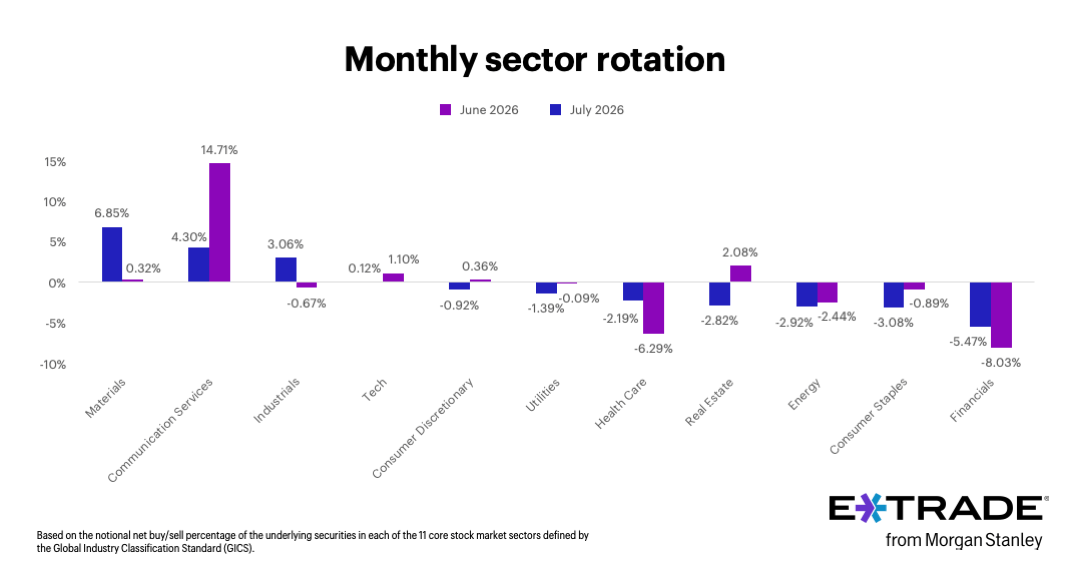
E*TRADE from Morgan Stanley clients were net buyers in just four of the S&P 500’s 11 sectors in July, and they appeared to be buying weakness and selling strength in key areas of the market.
The sectors with the most net-buying activity were materials (+6.85%), communication services (+4.30%), and industrials (+3.06%). Meanwhile, financials (-5.47%), consumer staples (-3.08%), and energy (-2.92%) experienced the most net selling.
“The buying in the materials sector was highlighted by activity in mining and rare-earth stocks, some of which fell to multi-month lows in July,” according to Chris Larkin, managing director, of trading and investing at E*TRADE from Morgan Stanley. “But the net selling in energy and financials suggested some clients may have chosen to take profits in the two sectors that rallied the most last month. The fact that they also sold the defensive consumer staples sector could mean they adopted more of a “risk-on” posture, while the tech sector’s absence from either list suggests the potential for further market rotation and a broadening of the rally.”
Going deeper
“Palantir CEO Alex Karp celebrates 93% revenue growth as stock soars after blockbuster earnings: ‘For the first time people believe us’” is a Fortune article by Preston Fore.
Fore writes: “When it was Alex Karp‘s turn to speak on Palantir’s second-quarter earnings call Monday evening, the CEO could barely contain his excitement. Grinning as he repeatedly pounded his pen on the table—and taking jabs at unnamed Silicon Valley AI competitors who “eat vegetables” and don’t support the U.S. military—a pugnacious Karp reveled in what he saw as a landmark moment for the AI software company and a vindication of its approach of selling customized AI services to businesses.” Read more here.
Overheard
“We’re using the game as a catalyst, to get people interested, to get them talking, to get the media to pay attention.”
—Tim Ellis, National Football League (NFL) chief marketing officer, told Fortune regarding a strategy to deepen the league’s foothold in Europe. The Pittsburgh Steelers and the New Orleans Saints will play at the Stade de France on Oct. 25—their first competitive game on French soil. It’s part of a record nine game international run this season, spanning four continents and seven countries, including London, Madrid, Melbourne, and Rio de Janeiro.