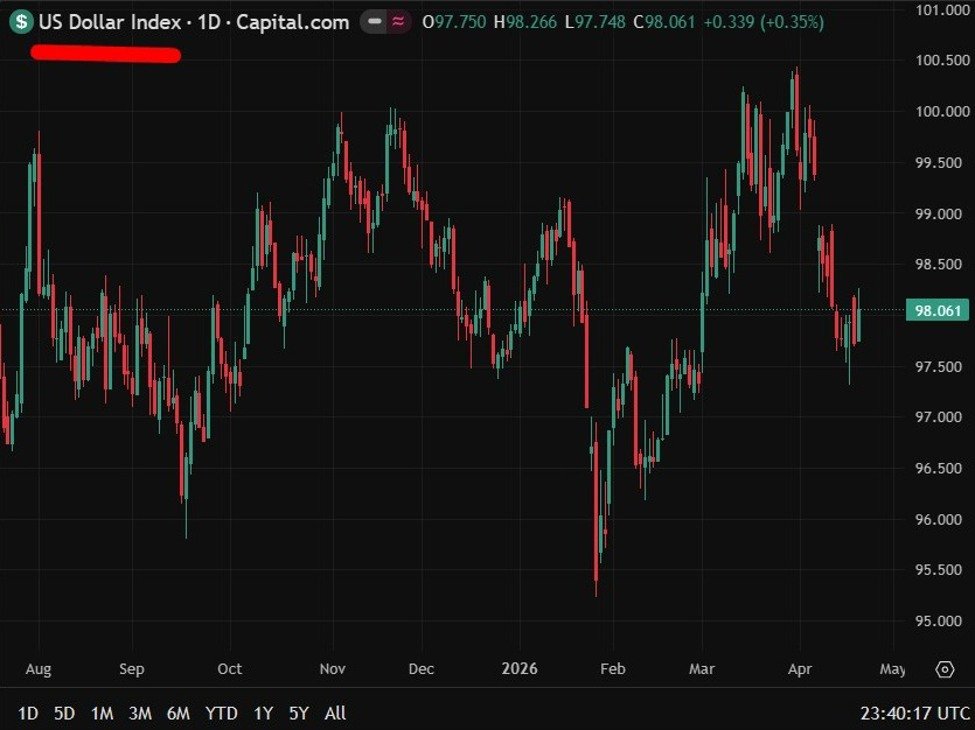
JPMorgan says the U.S.-Iran ceasefire is bearish for the dollar, re-entering selective USD shorts and favouring high-yielding currencies like AUD, NZD and EM FX as geopolitical risk eases.
Summary:
- JPMorgan sees U.S.-Iran ceasefire as USD-negative
- Re-enters USD shorts with more selective approach
- Focus shifts to carry-efficient positioning
- Sticky inflation supports high-yielding currencies
- Commodity FX and EM currencies favoured
- Reduced geopolitical risk weakens USD demand
- Gradual, not broad-based, USD downside expected
JPMorgan sees the U.S.-Iran ceasefire as a negative catalyst for the U.S. dollar, arguing that easing geopolitical tensions reduces the currency’s safe-haven appeal while reopening opportunities to position for renewed weakness in the greenback.
Strategists Meera Chandan and Arindam Sandilya say they are selectively re-entering short USD positions, though with a more disciplined and targeted approach than prior to the conflict. Rather than broad-based bearish bets, they emphasise the importance of carry efficiency and careful currency selection in the current macro backdrop.
The shift in strategy reflects a changing market environment following the de-escalation in the Middle East, where reduced geopolitical risk is expected to unwind some of the defensive demand that had supported the dollar during the height of tensions. At the same time, the bank expects global inflation pressures to remain persistent, reinforcing the appeal of higher-yielding currencies.
In this context, JPMorgan highlights a basket of currencies it views as well positioned in a post-conflict scenario. Commodity-linked currencies such as the Australian dollar, Norwegian krone and New Zealand dollar are favoured, supported by resilient global demand and relatively attractive yield profiles. The euro is also included, reflecting improving macro stability in the eurozone.
In emerging markets, the bank points to the Hungarian forint, Brazilian real, Mexican peso and Chinese yuan as offering compelling opportunities. These currencies combine relatively high carry with sensitivity to improved global risk sentiment, positioning them to benefit from a stabilisation in geopolitical conditions and a potential rotation out of defensive dollar holdings.
Overall, JPMorgan’s view suggests that while the dollar may not see a sharp or uniform decline, the balance of risks has shifted toward gradual depreciation, particularly against currencies that offer yield advantages and exposure to a recovery in global risk appetite
Trump seems keen on the ceasefire holding:
Iran is coy: