I have some good news and some bad news for those whose job it is to drive more traffic to a website.
Well, some bad news and some interesting news, at least.
First, we’ll go with the bad: Referral traffic continues to decline for many websites.
As reported by The Press Gazette this week (based on data from Chartbeat/Reuters Institute):
“Google search traffic to publishers declined globally by a third in the year to November […] Since May 2023, Google search referrals were down 21% globally, with Google Discover down 18% and all external referrals down 24%.”
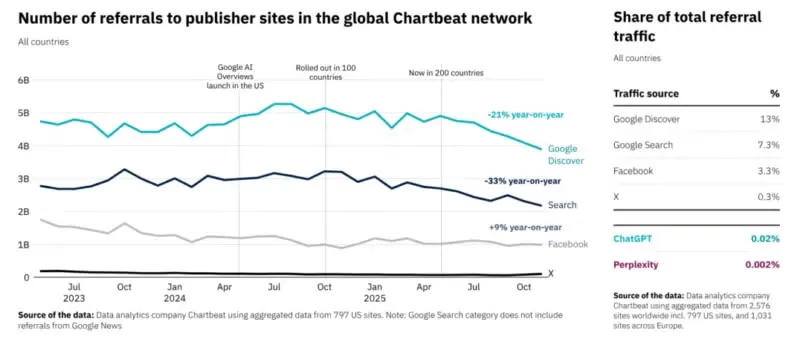
Yeah, not ideal, and you can see in the above chart how website traffic has declined since the implementation of Google’s AI previews, which now see far more searches beginning and ending within Google itself.
Though that’s not what Google says is happening.
In August last year, in response to claims that web traffic is down across the board due to Google’s AI previews, the search giant explained that:
“Overall, total organic click volume from Google Search to websites has been relatively stable year-over-year. Additionally, average click quality has increased and we’re actually sending slightly more quality clicks to websites than a year ago.”
Yet, this latest data backs up various other primarily publisher-focused reports, which all indicate that referral traffic has declined by between 20% and 50% for most websites.
There may be variances, but I’m guessing that you’re seeing declines in your Google referrals, and if that’s the case, you might want to ensure that reports like this are made available to those setting your KPIs.
But that’s not to say that you should just throw in the towel, and accept that your traffic has tanked. Maybe you just need to work out where people are looking, and how search is evolving, which could give you another avenue of focus for your SEO efforts.
Or maybe look to Generative Engine Optimization (GEO) to ensure that you’re meeting searchers where they’re looking.
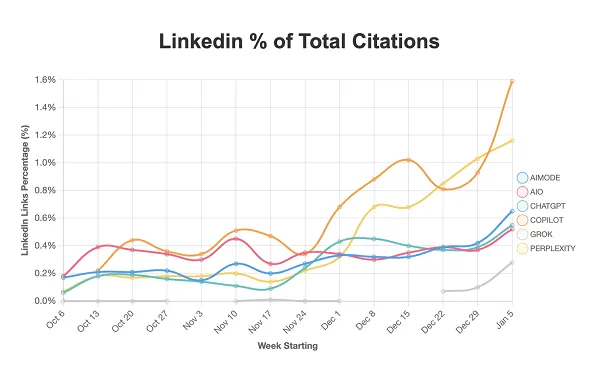
That’s where the interesting data comes in, with two new reports indicating that LinkedIn is quickly rising as a key citation source for AI chatbots.
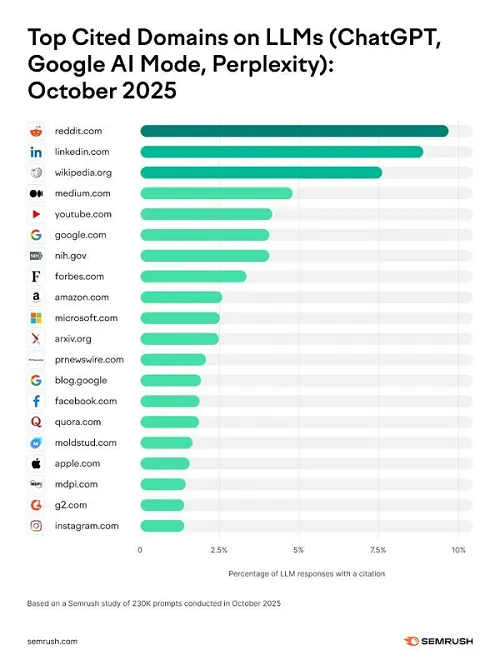
As you can see in this listing, compiled by SEMRush, which is based on a study of 230,000 prompts across ChatGPT, Google AI, and Perplexity conducted in October 2025, LinkedIn is now only trailing Reddit in terms of overall citations in chatbot responses.
That’s also backed up by another study conducted by Spotlight, which shows that AI tools like ChatGPT and Perplexity are citing LinkedIn sources up to 5x times more often this year.
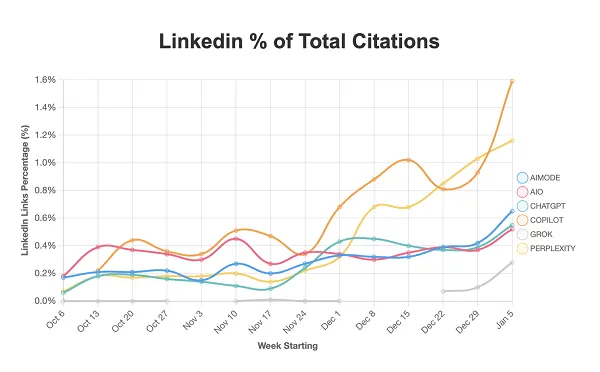
As per Spotlight’s Michael Hermon:
“In the last three months, data from Spotlight’s extensive database shows that ChatGPT cites LinkedIn 4.2 times more, Perplexity 5.7 times more, and the average across all LLMs is about 4 to 5 times the usual rate. Of the total 19,202 LinkedIn sources cited, over 15,000 come from LinkedIn Pulse articles specifically.”
In other words, AI chatbots are putting more trust in LinkedIn, and in LinkedIn Pulse articles specifically, which points to this as another potential option to ensure that your brand and/or brand representatives show up in AI search responses, by posting articles direct to LinkedIn.
How exactly these systems are vetting which LinkedIn articles they use is unclear, but verifying your LinkedIn profile could also be an important factor, while ensuring that your career history is up to date could be another indicator of trust, leading to higher authority.
But maybe, in addition to Reddit, you now have another, accessible means to help guide AI chatbot responses in your niche, by sharing your expertise to LinkedIn, and getting involved in vertical-aligned communities.
So, not great news, but some additional insight to help you supplement your declining referrals, through the sources most commonly being cited by AI tools.