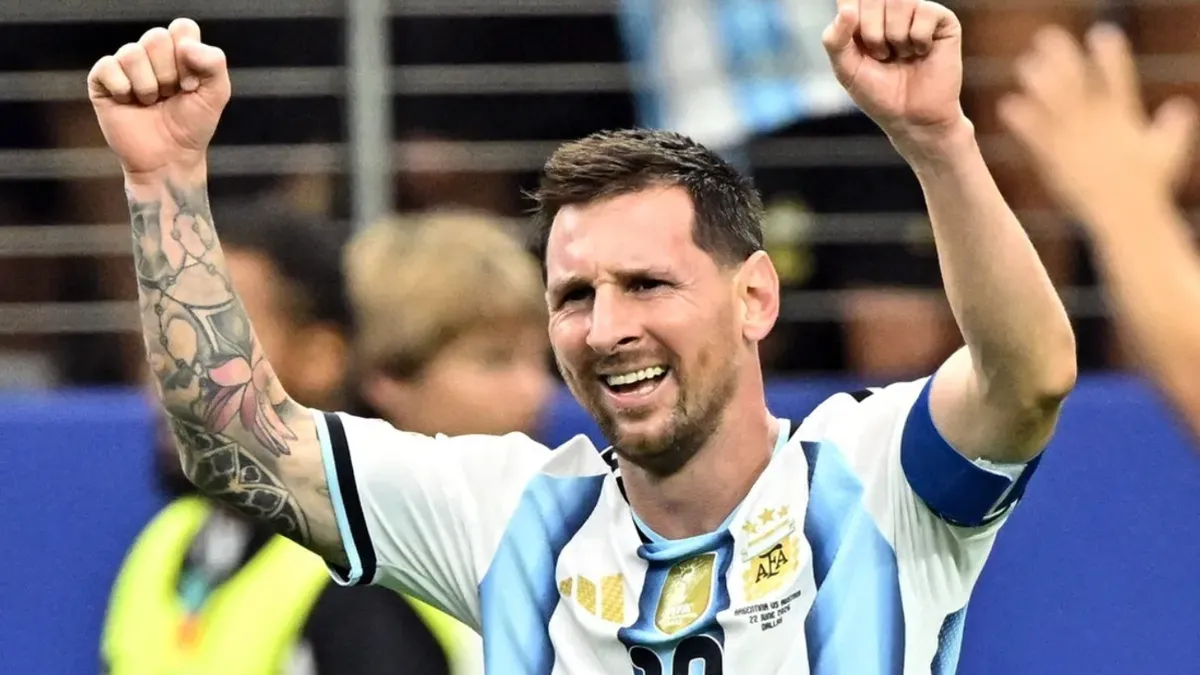
Earlier this week, Argentina’s Lionel Messi added the new title of World Cup Goals King to his CV.
By the end of the tournament, it could be Kylian Mbappe holding that honor. Down the line, Erling Haaland and Vinicius Junior are young enough to get in the mix. And if everything goes right, the teenage Lamine Yamal has the time and talent to obliterate them all.
This is an amazing era for elite international goal-scorers. But maybe even more exciting, the convergence of those talents could be symbolic of a World Cup that is ushering in a new era of international competition, one that comes closer to the increasingly attack-oriented model that defines the modern club game.
Under the influence of rapidly improving data, modern soccer at the highest levels has become predicated on pressure and transition.
For sure, it’s not the aesthetic preference of every soccer critic.
Listen closely enough, and you’ll hear the cries of someone in Brazil whining that Carlo Ancelotti’s Selecao rejected the Jogo Bonito in favor of a modern devotion to backpressing that proved critical in their emphatic 3-0 win over Scotland on Wednesday night.
But for the average neutral, it’s hard to deny how much more compelling the club game has become as a result of data that shows the benefits of a higher octane approach.
You can see this in the UEFA Champions League, where goals per game have risen from 2.65 in 2015-16 to 3.45 in 2025-26.
Or you can see it in which teams are and aren’t succeeding at the international level.
Arguably, no side has fallen further than Italy, a nation whose footballing identity is most irrationally opposed to the ongoing tactical revolution.
Similarly, teams like Ecuador and Paraguay, who rode cynical tactics to success in South American qualifying, have so far been exposed by teams with more time to build attacking chemistry.
Yes, some teams have still succeeded out of a low block. But the Ghanas and Cape Verdes of the world have only done so when they could muster at least some threat of a vertical counterattack.
And now, with many of the same managers who orchestrated that rise in attacking play now coaching at this World Cup, goals are up here as well. If the rate of roughly 3.0 goals per game continues, it would be the highest scoring edition since 17-year-old Pele and Brazil dazzled their way to their first championship in Sweden in 1958.
The greatest attacking players are also staying great longer.
At 41, Ronaldo may come with baggage, but he’s still the best finisher on his Portugal team. At 32, Harry Kane’s career is only middle-aged when it would’ve been considered in its twilight era a generation ago.
And the engrossing all-time scoring chase is only possible because Messi is still playing at age 39, and arguably better at a World Cup than he ever has before.
There’s still a lot of time for this World Cup to go sideways. The knockout stages have a way of bringing out the worst conservative instincts in coaches. Oppressive summer weather could become more of a factor as June turns to July, and as more of the kickoffs fall before sunset to appease European TV audiences.
And there’s always the danger for off-the-field controversies to grow louder once the competitive field shrinks.
But on the evidence so far, this tournament has shown that the future of the game on the field is arguably the brightest it’s ever been. And whether it’s Messi or Mbappe who finishes on top of the all-time World Cup scoring chart this summer, you get the sense neither one will stay there for all that long.