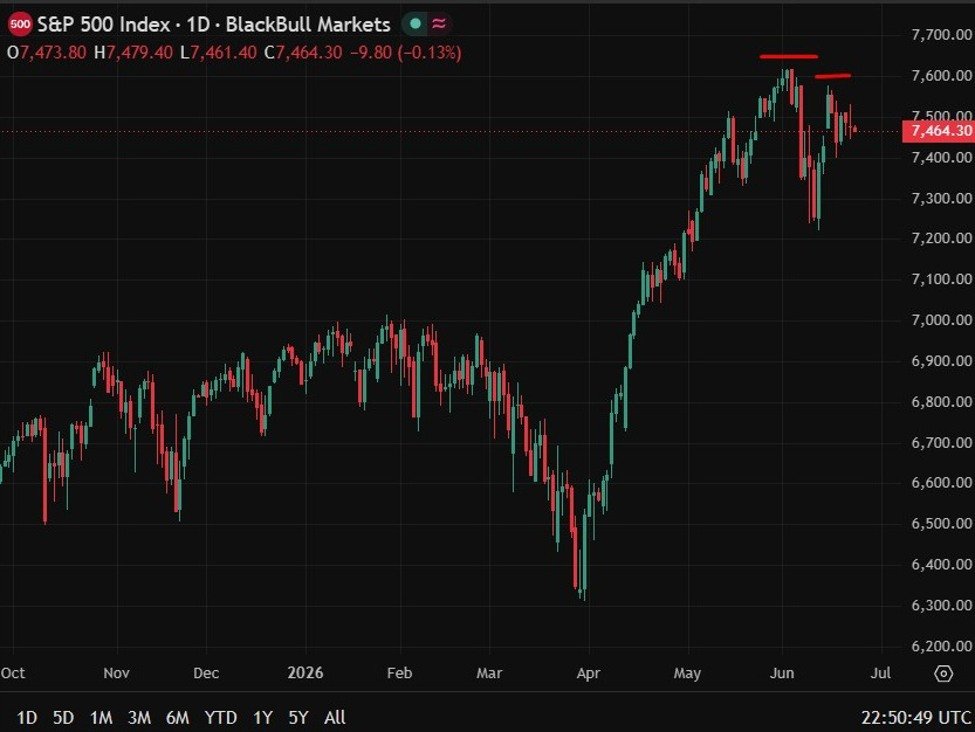
Wilson’s liquidity warning is the most actionable element for traders: with the Reserve Management Program down roughly 75% from its peak and Treasury buybacks cut by half, the balance sheet tailwind that supported equities through much of the cycle is fading fast. Accelerating lending growth compounds the problem by absorbing capital from the real economy simultaneously, creating a pincer effect on market liquidity that Wilson sees persisting into July. The bear-flattening of the yield curve and dollar strength seen after last week’s FOMC are consistent with his framework, and he reads precious metals selling off as a further confirmation that Warsh’s credibility trade is working. Equity bulls will take comfort from his longer-term constructive view, but the near-term message is clear: the earnings-led bull market’s next leg higher has to wait for the current liquidity headwind to clear.
Morgan Stanley CIO Mike Wilson warns equity markets face choppy, corrective near-term price action as Fed liquidity support fades, while backing Warsh’s inflation-first credibility push.
Summary:
- Morgan Stanley CIO and Chief US Equity Strategist Mike Wilson said last week’s FOMC meeting under Chair Kevin Warsh was a good and necessary first step toward rebuilding Fed credibility, despite stocks weakening and the yield curve bear-flattening in response, according to the firm’s Thoughts on the Market podcast recorded June 22
- Wilson said the S&P 500-to-gold ratio has risen close to 40% since Warsh’s nomination in February, which he characterised as a powerful market vote of confidence in the new chair’s ability to restore policy discipline, per the podcast
- The Morgan Stanley strategist identified liquidity, not rate hikes, as the primary near-term risk for equities, noting the Reserve Management Program is down roughly 75% from its peak and Treasury buybacks have been cut by 50%, per the podcast
- Wilson warned that accelerating lending growth is compounding the liquidity squeeze, as the real economy absorbs more capital simultaneously with the reduction in balance sheet support, according to the podcast
- He said he expects choppy and potentially corrective equity price action into July, with the earnings-led bull market’s next leg higher delayed until the liquidity headwind clears, per the podcast
- Wilson expressed support for Warsh’s move away from excessive forward guidance, arguing markets should react to incoming data rather than trying to anticipate Fed communications, according to the podcast
Morgan Stanley’s chief investment officer Mike Wilson has delivered a cautiously hawkish read on Kevin Warsh’s first Federal Reserve meeting, arguing that the market discomfort it produced was by design and that the more pressing risk for equities in the weeks ahead is a liquidity squeeze rather than the prospect of imminent rate hikes.
Speaking on the firm’s Thoughts on the Market podcast, Wilson said the reaction to last week’s FOMC meeting, in which stocks weakened, the yield curve bear-flattened, the dollar strengthened and precious metals sold off, should be read as a healthy and necessary first step rather than a policy misstep. In his framing, credibility cannot be built without occasionally doing something markets do not immediately welcome, and Warsh’s emphasis on the inflation mandate at the expense of the kind of hand-holding investors have grown accustomed to over the past five years was precisely that kind of signal.
Wilson had backed the Warsh appointment from the moment it was announced in February, arguing at the time that the nomination was the right call if the goal was to restore market confidence in the Fed’s ability to keep inflation disciplined without destabilising the dollar. He pointed to the S&P 500-to-gold ratio, which he said has risen close to 40% since the nomination, as evidence that investors are extending Warsh that benefit of the doubt.
But Wilson’s more immediate concern is liquidity. He noted that the Reserve Management Program is down roughly 75% from its peak, that Treasury buybacks have been reduced by approximately half, and that lending growth is simultaneously accelerating as the real economy draws more heavily on available capital. That combination, he argued, amounts to a tightening of financial conditions that his work suggests could remain a headwind for equities into July.
On the question of Fed communication, Wilson was supportive of Warsh’s apparent move away from extensive forward guidance, a practice he has long argued distorts the signal that market prices are supposed to provide. When investors spend most of their energy trying to anticipate what the Fed will say next rather than reacting to economic data, he contended, the central bank ends up impairing the very market intelligence it should be learning from.
His bottom line on the near-term equity outlook was measured but cautious. He expects markets to test Warsh’s resolve, as they typically do with a new chair, and believes the Fed will tolerate a degree of short-term pain in the service of longer-term credibility. The point at which that calculus shifts, in Wilson’s view, is when stress in funding markets, credit markets or bond volatility forces the Fed’s hand and prompts a loosening of financial conditions. Until that moment arrives, he sees the path for stocks as choppy and potentially corrective, with the next leg of the earnings-led bull market still ahead but not yet within reach.