Lorenzo Salgado Araujo’s journey began southwest of Mexico City, in rural San Antonio del Rosario, where he was the ninth of 12 children.
It was Mr. Salgado Araujo’s brother Julian, the fourth born, who first felt the pull of America, he said in an interview with The New York Times. So he made his way north to the border sometime in the 1980s, he said. Wading across the Tijuana River, he entered the United States illegally and eventually made his way to Los Angeles.
A few years later, when Lorenzo was about 17, he followed, crossing the border illegally and eventually finding work in construction in Houston, where he built a business and where, his family said, he had been seeking to put himself on a path to legal status.
On July 7, Mr. Salgado Araujo, 52, headed to work like he would any other day, wearing a baseball cap, carrying his coffee and a cooler packed with lunch prepared by his wife.
Just before 7 a.m., he was fatally shot in his van by an immigration agent who had stopped the vehicle during an enforcement operation. Almost immediately, questions emerged over how the encounter had escalated. In initial statements, homeland security officials said that Mr. Salgado Araujo had tried to use his vehicle as a weapon.
The deadly confrontation has set off protests in Houston, prompted investigations by local and federal officials and renewed national focus on President Trump’s mass deportation campaign.
On Monday, Sean Teare, the district attorney for Harris County, which includes Houston, said his office was pursuing its own investigation into the shooting and reiterated that the federal government was not cooperating and had not shared the identity of the agents involved.
A spokeswoman for the Department of Homeland Security, which includes Immigration and Customs Enforcement, said that Mr. Salgado Araujo was not the target of the operation.
That revelation has intensified the outcry, and the story of his life — and death — has highlighted how intertwined undocumented immigrants have become with the economies of fast-growing communities across the Sunbelt.
That is as apparent in Houston as anywhere. For decades, the city has relied upon an informal economy of unauthorized laborers, many of them Latino, who have helped drive its construction boom, laying brick, framing houses and shingling roofs.
Mr. Salgado Araujo’s journey from rural Mexico to Houston’s East End was a 35-year pursuit of the American dream that he hoped would culminate in a legal status.
After returning to Mexico to marry, Mr. Salgado Araujo headed back to Texas with his wife, drawn by plentiful jobs and prospects for a better life. Mr. Salgado Araujo’s brother Julian was able to obtain legal status through a sweeping 1986 immigration law signed by President Ronald Reagan. But Mr. Salgado Araujo did not.
Still, he was able to thrive in Houston. One in four Harris County residents is foreign-born, making Houston one of the most diverse cities in the country, and the undocumented labor force makes up more than 20 percent of the metro area’s construction industry, according to U.S. census and union estimates.
The big home builders rarely hire such men directly, contracting the work out to crews made up of undocumented workers; an arrangement that, immigration and labor lawyers say, helps shield the industry from enforcement.
In Houston’s East End, Mr. Salgado Araujo raised three U.S.-born children with his wife. The neighborhood is one of the city’s oldest Hispanic communities and took on its identity as people fled the Mexican Revolution. It continued to thrive in recent decades as more Mexicans and other Latinos headed north in search of jobs pouring concrete and painting homes.
Mr. Salgado Araujo worked on construction crews and later organized his own specializing in wood framing. In time, he built a house for his family.
“He prided himself in his work that you know, he built the homes that people bought for their families to put over their heads, and he saved up so much money to be able to build a house of his dreams,” said his son Ronaldo Salgado, 29.
At home, Mr. Salgado Araujo liked to joke around and to drive his older brother wild with constant singing and “chiflidos,” the high-pitched whistling the men learned to signal each other on job sites. Friends and family often came around for carne asadas and birthday parties. He would do push-ups in the park and loved to dance to cumbia music.
He and his brother Julian liked to trade barbs over soccer teams. Mr. Salgado Araujo favored Chivas. His brother, like much of the rest of the family, supported the rival Mexican team América.
Mr. Salgado Araujo was always aware of how he stood out as an immigrant in this nation, his son said.
“He was much darker skin, and it’s something that he took very personally, that people judged him by the color of his skin,” Mr. Salgado told a packed vigil for his father over the weekend. But he would not let that define him or his family, his son said. “He always said like, I’m not stupid., I’m a badass.”
In a series of news briefings and public events, Mr. Salgado described how he came to learn about his father’s fate.
On the day he was killed, Mr. Salgado Araujo woke up at dawn and patted his dog on his head as he hopped in his white work van to head to pick up three other workers.
Ronaldo Salgado, his oldest son, recalled that his mother called him around 7 a.m. to let him know that “something bad had happened.”
“We didn’t know what,” he said. “All we knew is that it was ICE related.”
Ronaldo Salgado sped to his father’s construction site, about an hour north of Houston. But he didn’t find his father’s work van or evidence that he had reached the site. Using information from Facebook posts eventually led him to the scene of the shooting. It was another online post that delivered the news he had been dreading.
In it, he heard the agonizing sounds of a man in pain. “I recognized him immediately, not from his appearance, but from his voice, crying for help as he lay on the street, bleeding out,” he recalled in tears.
His father was taken to Ben Taub Hospital, the same hospital where he and his younger brother, Lorenzo Salgado Jr., were born.
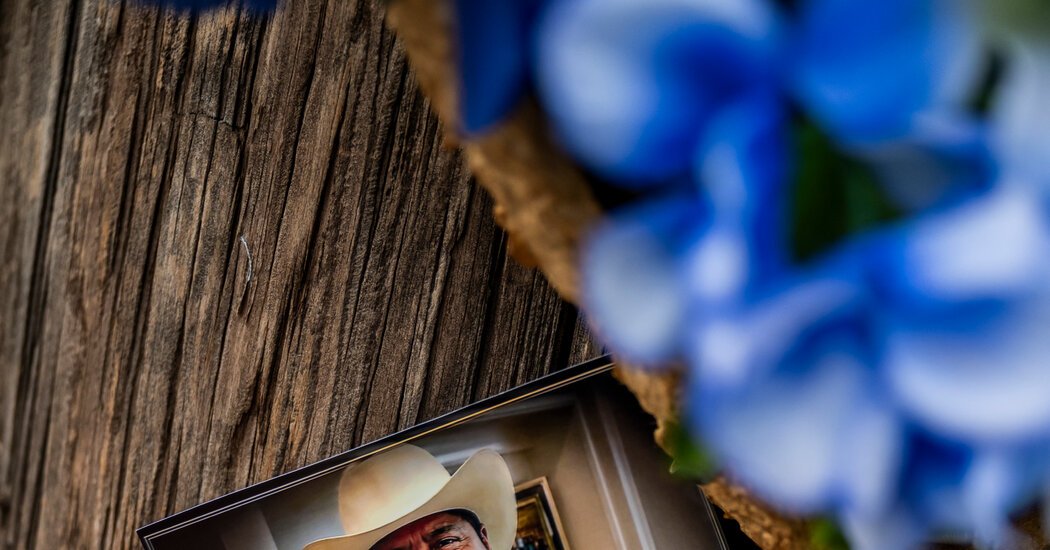
At the memorial site where he was killed, flowers, Mexican veladoras and photos of the Virgin de Guadalupe are piled against wooden-panel homes. Construction workers this week have been stopping to pay their respects. One man in a bright yellow and orange lowrider blasted a ballad inspired by the life and killing of Mr. Salgado Araujo.
Mr. Salgado Araujo’s nephew, Joan Salgado, 20, removed his dark shades as he tried to subdue a wave of emotion. He remembered working on his uncle’s crew and his lessons, such as to “do things right the first time or you’ll only have to do more work.”
He said he had been on the phone with Mr. Salgado Araujo’s wife. “There were no words, only tears,” he said.
Georgia Gee contributed research.