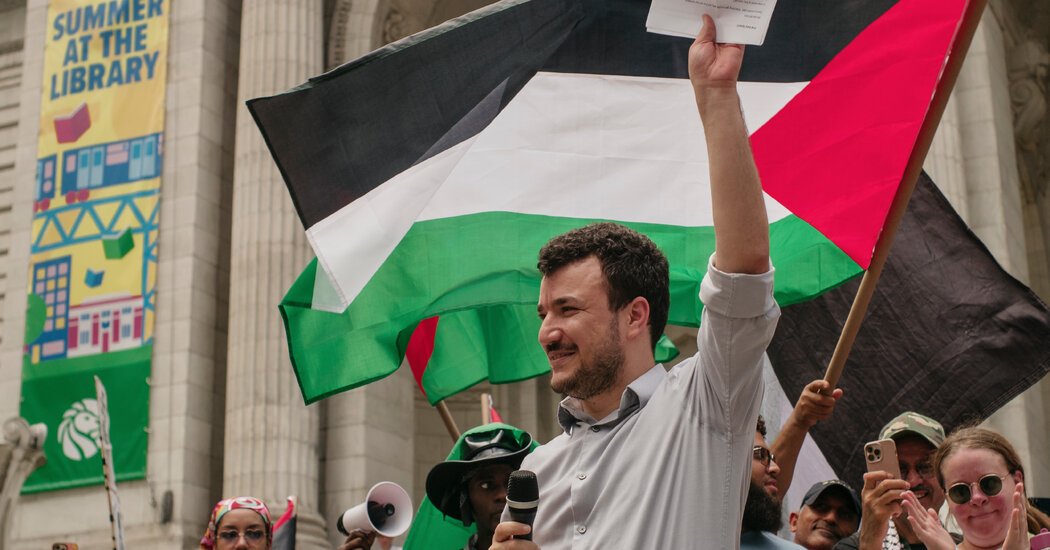
Mahmoud Khalil, the Columbia University protester who became the face of President Trump’s campus crackdown, filed a lawsuit on Tuesday accusing administration officials, pro-Israel groups and a conservative think tank of colluding to suppress his constitutional rights.
The suit, filed in Manhattan federal court, yokes together a number of different actors: the Heritage Foundation, several top Trump officials and two groups that targeted campus protesters, Canary Mission and Betar.
Mr. Khalil will seek to convince a judge that the defendants coordinated to a degree that amounted to a conspiracy. His lawyers argue that there was a direct line leading from a Heritage Foundation plan to dismantle pro-Palestinian activism to the targeting of activists, like Mr. Khalil, by Canary Mission and Betar, which led to their arrests and detention by the Trump administration.
The White House did not comment on the lawsuit. Instead it reiterated its past accusations against Mr. Khalil, who it said was “given the privilege of coming to America to study on a student visa he obtained by fraud and misrepresentation.”
“As we have always maintained, the Executive Branch has the lawful authority to take actions that will protect the public and to ensure the integrity of our immigration system,” said Abigail Jackson, a White House spokeswoman. Mr. Khalil has said that those allegations are baseless.
The Heritage Foundation declined to comment. Betar and Canary Mission did not immediately respond to requests for comment.
The lawsuit is a long-shot attempt to hinder the administration’s effort to deport Mr. Khalil, a green card holder who was a leader in the student protest movement at Columbia and whom the administration has accused of propagating antisemitism to the detriment of American foreign policy aims.
Mr. Khalil, who has argued that criticism of Israel is not inherently antisemitic, was held in detention for several months in 2025. The administration has declared he can be deported, and he is expected to appeal to the Supreme Court in an effort to prevent his expulsion later this summer.
If Mr. Khalil’s Tuesday lawsuit is entertained by a judge, it could yield more public information about any coordination between private actors and a presidential administration that has dealt harshly with pro-Palestinian demonstrators.
But ideological alignment does not amount to conspiracy, and Mr. Khalil would ultimately be required to show an explicit connection between the defendants, including a top aide to Mr. Trump, Stephen Miller, and two architects of the Heritage Foundation plan, Robert Greenway and Victoria Coates.
Mr. Greenway declined to comment. Ms. Coates did not immediately respond to a message seeking comment.
That plan, Project Esther, was created in the aftermath of the Hamas-led attack on Israel on Oct. 7, 2023. Casting all pro-Palestinian activists as Hamas supporters, it called for the ejection of foreign demonstrators from the United States.
Its authors wrote that their plan could be executed “when a willing Administration occupies the White House.” And last year, months into Mr. Trump’s campaign to detain and deport foreign-born protesters, its authors took a victory lap. Mr. Greenway, then a national security director at Heritage, said it was “no coincidence that we called for a series of actions to take place privately and publicly, and they are now happening.”
Mr. Khalil’s lawsuit is being brought under a statute enacted in 1871 to obstruct the activities of the Ku Klux Klan. The law prevents any person from conspiring to deprive a person of protection under the law. Mr. Khalil is asking for monetary damages in an amount to be determined at a civil trial and for a judge to declare that efforts to deport him are part of a conspiracy.
The law requires those suing to “provide some factual basis supporting a meeting of the minds, such that defendants entered into an agreement, express or tacit, to achieve the unlawful end.” That basis can be circumstantial, as is often the case in Mr. Khalil’s lawsuit. It will be up to a Manhattan judge to determine whether the lawsuit meets the standard that would require the government to produce more information.
“The government’s behavior in Khalil’s case stinks to high heaven,” said Stephen I. Vladeck, a Georgetown University law professor who has tracked the case closely. “Whether that opens the door to this kind of broad theory of civil liability is another question altogether. Courts will be worried about what kind of precedent it would set unless there are clear reasons Khalil’s case is not just factually unique but legally unique.”
Mr. Khalil’s lawsuit asserts that Ms. Coates and Mr. Greenway worked on Project Esther with Mr. Miller, who overlapped with them during the president’s first term. But no explicit connection between Mr. Miller and Project Esther has been reported. And while Mr. Khalil’s lawsuit names other top administration officials, including the acting attorney general, Todd Blanche, and Mr. Rubio, it was not clear exactly how he might show that they played an active role in any conspiracy.
Still, if Mr. Khalil’s lawsuit survives initial attempts to dismiss it, the defendants may be compelled to shed more light on the creation of Project Esther. Ms. Coates has said that there were numerous contributors, including some in government, who have gone unnamed.
“We had a lot of people who were involved who don’t care that they don’t get credit because they believe so strongly in the project,” she told The New York Times last year.
Katie J.M. Baker contributed reporting.