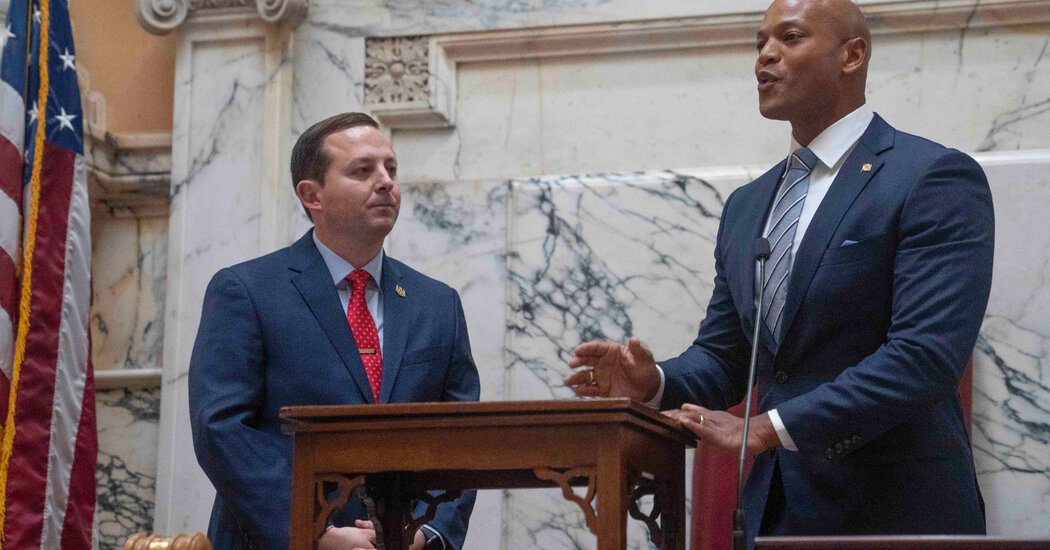
After months of disagreement, Maryland Democrats appear to be closer than ever to eliminating the state’s lone Republican-held congressional district in time for the 2028 cycle.
Bill Ferguson, the leader of the Maryland Senate and the face of Democratic opposition to redrawing maps this year, said in an interview with a local news outlet on Friday that the Supreme Court’s decision on the Voting Rights Act, which led to a scramble among Republican-led legislatures across the South to dismantle or dilute majority-Black, Democratic-controlled districts, forced him to change his calculus.
Mr. Ferguson for months had been at odds with Gov. Wes Moore, a Democrat who has been among the loudest champions of redrawing Maryland’s map ahead of the 2026 midterms to help Democrats fight a Republican flurry of partisan gerrymanders.
“Now, the rules have changed,” Mr. Ferguson said in a statement. “The Supreme Court gutted the Voting Rights Act, and Southern legislatures are already using that ruling to wipe out minority districts. Maryland must respond as the ground shifts under us.”
While there seems to be unsettled debate about the process, the likelihood of new maps in Maryland amounts to the latest signal that the redistricting wars of 2028 are shaping up to be just as fiercely contested as they have been this spring. Multiple states, including New York, Colorado and Georgia, have already started exploring the process of redistricting for the next cycle.
Mr. Ferguson wants to draft a ballot initiative to place in front of Maryland voters this November that would alter the state’s Constitution and, in his view, protect a new map from a court challenge. He hopes to convene the Maryland General Assembly after the June 23 primary.
Mr. Moore does not want to wait that long, according to a spokesman for his office. He would rather the legislature convene as soon as possible to enact a new map and then ask voters to approve it via referendum this November. He is also open to including a state constitutional amendment in that process, the spokesman said.
“I’m glad to hear the Senate president is willing to have a conversation about it,” Mr. Moore said at a news event on Friday. “I think it needs to include the maps.”
For Mr. Ferguson, even agreeing to the possibility of drawing new maps for 2028 represents a shift in attitude. At the height of the redistricting wars this spring, Mr. Ferguson’s opposition to redrawing Maryland’s maps ahead of this year’s elections flummoxed party leaders from Representative Hakeem Jeffries, the Democratic leader in the House, to Mr. Moore, who has grown a national profile during his time in Annapolis.
An amendment to the state Constitution would require votes from 29 of the state’s 34 Democratic state senators. It would then need to pass the House, where Democrats hold a supermajority. Any special session would need the blessing of Mr. Moore.
Mr. Ferguson first disclosed his change of heart to WYPR, an NPR affiliate in Baltimore.
While Mr. Ferguson appears to have shifted toward an eventual redrawing of the state’s maps, his reason for obstructing the 2026 push remains.
In public debates and private conversations over the past year, Mr. Ferguson repeatedly said that his central fear was that an 8-0 map could backfire in the courts. The state’s effort to draw a similar map in 2021 was knocked down by a state court the following year because of “constitutional failings” and a failure to keep similar communities together.
Mr. Ferguson argued that a map drawn this year could face a similar fate. In a worst-case scenario, he said, Maryland Democrats could find themselves in a similar position as Republicans in Utah, where a court took over drafting duties at the expense of partisan aims.
Both national Democrats and Mr. Moore have disagreed with that assessment, arguing that Maryland’s courts have never redrawn congressional districts on their own in the state’s 238-year history.
But Mr. Ferguson remains resolute in that conviction.
“That’s why I held the line on Maryland’s 7-1 map,” Mr. Ferguson said in a statement. “I wasn’t willing to gamble Democratic seats on a legal fight we could lose.”