It seems that Meta’s more relaxed approach to content moderation, which aligned with its moves to ingratiate itself with the Trump Administration, has led to more abuse and harassment of political representatives in the app.
Based on a new report from the Center for Countering Digital Hate, which assessed almost 8 million Facebook comments directed at members of Congress in the time before and after Meta’s moderation changes, abuse of political representatives has tripled since the update.
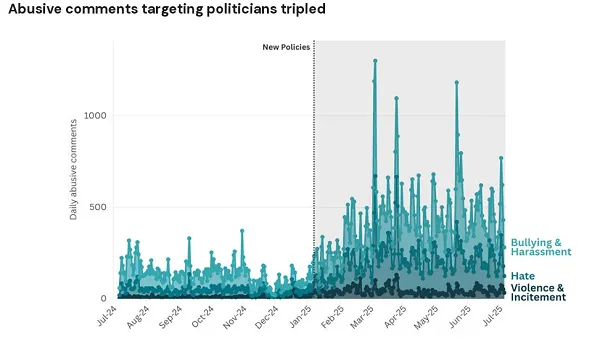
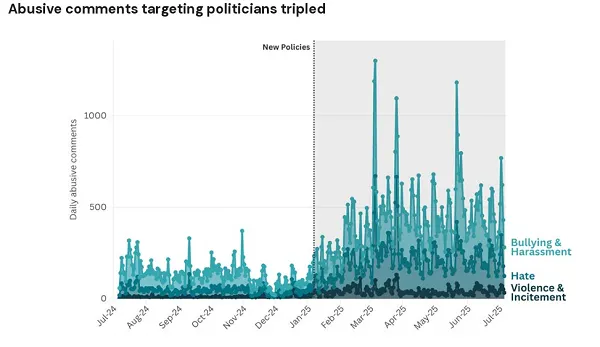
As shown in this image, abusive comments directed at U.S. politicians have increased significantly following Meta’s shift away from fact-checking in January 2025. That move was intended to allow for more free and open speech, which Meta said was in line with evolving community values.
Specifically, the CCDH report showed:
- Violent threats quadrupled, from 1,800 in the six months before the changes to 7,600 in the six months after.
- Hateful comments quadrupled, from 6,900 to 30,000.
- Harassment doubled, from 15,700 to 39,900.
The numbers suggest that Meta’s free speech-aligned changes had a major impact on discourse in the app, which has likely led to more political division and angst across the spectrum.
That’s because Facebook’s impact is still so significant. According to Pew Research, 38% of U.S. adults regularly get news content on Facebook.
As such, the increased angst and abuse in the app has no doubt had an impact on voting outcomes.
As various studies have shown, emotional response is the key to social media engagement. High arousal emotions such as anger and joy tend to drive the most responses, and therefore have the most reach and garner the most attention in social apps.
Some political figures have weaponized this, using hot takes, and picking at crowd concerns, in order to formulate populist policies that align with people’s fears, and spark ongoing debate.
The Trump era has been rife with division, and the CCDH data shows that Facebook in particular, is following suit, with more anger being funneled into social media feeds, and swaying political opinions.
Which is arguably representative of the most consequential media shift of our time. Algorithms now provide incentive for publishers to share partisan takes, with attention-grabbing commentators who are more likely to inspire hysteria than balanced discussion.
It’s the age of the algorithm, and it’s algorithms that define the media cycle, and thus, the political movements of the day. That’s why it is such a major concern that social platforms continue to prioritize angst, in order to drive more engagement.
But the incentives are clear. More anger means more attention, and more attention influences voter outcomes.
The latest data from the CDCC shows that, left unchecked, social platforms fuel political division, and drive the sectarianism that currently defines our fractured diplomatic landscape.