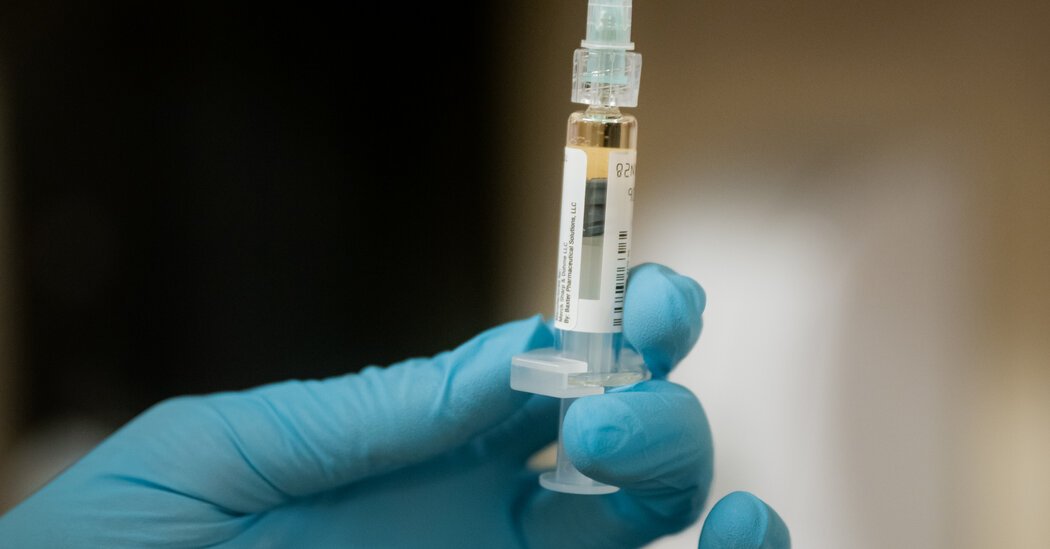
At a time when measles and other potentially deadly diseases are spreading, more American children are receiving exemptions allowing them to attend school without the routine childhood shots that can protect against those illnesses.
Roughly 4 percent of kindergartners in the United States were given a nonmedical exemption for at least one vaccine during the 2025-26 school year, a 18 percent jump from the previous year, according to new data released on Monday by the Centers for Disease Control and Prevention. That rise, the largest annual increase recorded in more than a decade, comes as a growing number of states look to loosen vaccine mandates or even do away with them entirely.
Exemption rates varied dramatically by state. While all states allow students to opt out of vaccine requirements for certain medical conditions, some also allow exemptions for religious or personal reasons.
.
In Utah, which has some of the most relaxed laws around school vaccine requirements, nearly 13 percent of kindergartners had a religious or personal exemption for at least one routine shot. The state is also in the midst of a monthslong measles outbreak that has infected more than 700 people. New York, which stopped allowing parents to opt out for religious reasons in 2019, reported no non-medical exemptions.
The new data has deepened concern among public health experts that American communities are losing the levels of immunity needed to protect against a number of highly contagious illnesses.
The findings were released a week after President Trump issued an executive order calling for children to get fewer vaccines. While the executive order cannot force states to change their vaccine policies, it was the latest in a series of actions by the administration that experts have warned are likely to undermine confidence in vaccine safety.
Vaccination rates among U.S. kindergartners dropped slightly during the 2025-2026 school year, falling by 0.1 percentage points from the previous year, according to the new data.
Even small dips in vaccination rates can leave the nation vulnerable to highly contagious diseases, like measles, said Dr. Sean O’Leary, a member of the infectious disease committee at the American Academy of Pediatrics. The country is in the midst of the worst year for measles in recent history, as the virus continues to spread through pockets of under-vaccinated people around the United States.
“Even though these drops in the last couple of years have been relatively small, they’re meaningful,” Dr. O’Leary said. “They are leading us to have diseases that we really should not see here in the U.S.”
In a statement, the Department of Health and Human Services said that the C.D.C. “continues to encourage parents to discuss vaccination options with their doctors.”
The gap between a large increase in exemptions, and only a minor decline in vaccinations, could be at least partially explained by the fact that there were fewer children this school year whose vaccination status was unknown.
During the pandemic, the share of children with missing records — meaning those who had neither a vaccination record nor an exemption on file — shot up. But more families now seem to be filing formal exemptions, leading the number to rise more dramatically than the vaccination rate has fallen.
Vaccination rates have been declining in the United States for years. They fell during the Covid-19 pandemic, as routine immunizations were disrupted and as mistrust in the medical establishment grew, and they have not yet rebounded.
Still, the new data show that childhood vaccination rates remain high overall: About 92 percent of kindergartners received routine vaccinations for diseases like measles, pertussis and polio.
“Despite everything we’ve seen around vaccines over the past several years, the large majority of parents continue to support vaccines and continue to vaccinate their children,” said Jason Schwartz, an associate professor of health policy at the Yale School of Public Health.
Public health researchers noted that while a vast majority of parents are still vaccinating their children, there are places within the United States where rates are far lower than 92 percent. That includes in places like Lancaster County, Pennsylvania and Spartanburg County, South Carolina — both at the center of large measles outbreaks this year.
The rise in exemptions from vaccine mandates is a dangerous trend, said Dr. Walter Orenstein, the former director of the National Immunization Program at the C.D.C.
Vaccine mandates also help protect children who cannot get vaccinated, and even those who have gotten the shots, Dr. Orenstein said, since no vaccine is 100 percent effective.
Many people have gone so long without encountering a vaccine-preventable disease like measles that they do not see the need to get immunized against it, he added.
“Vaccines are victims of their own success,” he said. “And we’re beginning to see that even more.”