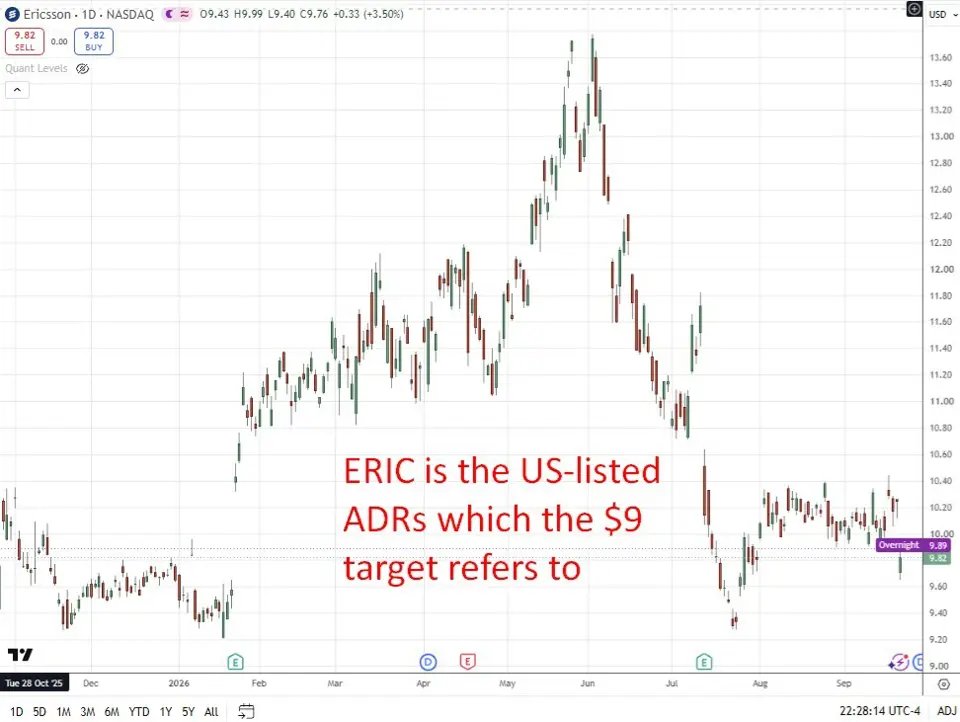
A price target set below the prevailing share price signals Morgan Stanley sees further downside rather than a mere pause, and its below-consensus margin forecasts point to the risk of broader earnings downgrades across the sector. The call reinforces the view that telecom operators are in no hurry to lift mobile network spending, a headwind for all radio equipment vendors, although Morgan Stanley’s stated preference for Nokia suggests it sees relative winners. Rising semiconductor costs add a theme that could spread to other hardware makers exposed to component inflation. Ericsson’s third-quarter results will be the next test of whether the margin squeeze is materialising.
—
Morgan Stanley thinks Ericsson’s best margin days are behind it, with North American growth fading and chip costs rising in a market going nowhere.
Summary:
- Morgan Stanley downgraded Ericsson to underweight from equal weight, cutting its Stockholm price target to SEK90 from SEK95 and its US ADR target to $9 from $11; the shares slid more than 3% to around SEK97
- The bank expects the mobile radio access network market to stay flat into 2027 as telecom operators keep capital spending tight
- Ericsson’s North American network revenues fell about 5% year on year in the second quarter after several years of strong growth; the Americas make up about 35% of group sales
- Morgan Stanley forecasts gross margins falling by about 100 basis points a year to 2028, against a consensus of broadly flat, citing project mix and rising semiconductor costs
- It cut its 2027 operating profit and earnings per share estimates by 5% and 6%, and said it prefers Nokia among telecom equipment makers
Shares in Swedish telecoms equipment maker Ericsson slid more than 3% on Tuesday after Morgan Stanley downgraded the stock to underweight from equal weight, warning that falling North American revenues and margins past their peak could weigh on earnings.
Morgan Stanley cut its price target on the Stockholm-listed shares to SEK90 from SEK95, below the level of around SEK97 at which the stock was trading after the move, and lowered its target for the US-listed shares to $9 from $11. The larger cut to the US target partly reflected unfavourable currency movements since the bank’s previous update.
At the heart of the call is a subdued outlook for Ericsson’s core business. Morgan Stanley expects the global market for mobile radio access network equipment, the base-station gear that connects mobile phones to networks, to remain flat into 2027 as telecom operators hold back on mobile capital spending.
North America, which had been a bright spot, is losing momentum. Ericsson’s network revenues from the region fell by about 5% year on year in the second quarter, following several years of strong growth driven by market share gains, including a major contract with AT&T in 2024. The Americas account for roughly 35% of group revenue.
Margins are the second concern. Ericsson’s networks division has delivered gross margins of around 50% over the past year, but the company’s third-quarter guidance points to a range of 48% to 50% as some projects move into lower-margin rollout phases. Morgan Stanley said rising input costs, particularly for semiconductors, are expected to become a bigger headwind in 2027. The bank forecasts gross margins falling by about 100 basis points a year through 2028, compared with a market consensus of broadly flat margins, and cut its 2027 estimates for operating profit and earnings per share by 5% and 6% respectively.
Valuation adds to the caution. The analysts noted Ericsson trades at 16 times earnings, above its five-year average of 14 times, and said they continue to prefer Nokia within the telecom equipment sector.
Morgan Stanley is not alone in its bearish stance. BofA has an underperform rating on Ericsson, having cut its target to SEK77 after the company’s second-quarter revenue miss and weaker-than-expected guidance.
Ericsson’s third-quarter results will be the next key test of whether the pressure on revenues and margins that Morgan Stanley anticipates is starting to show through.