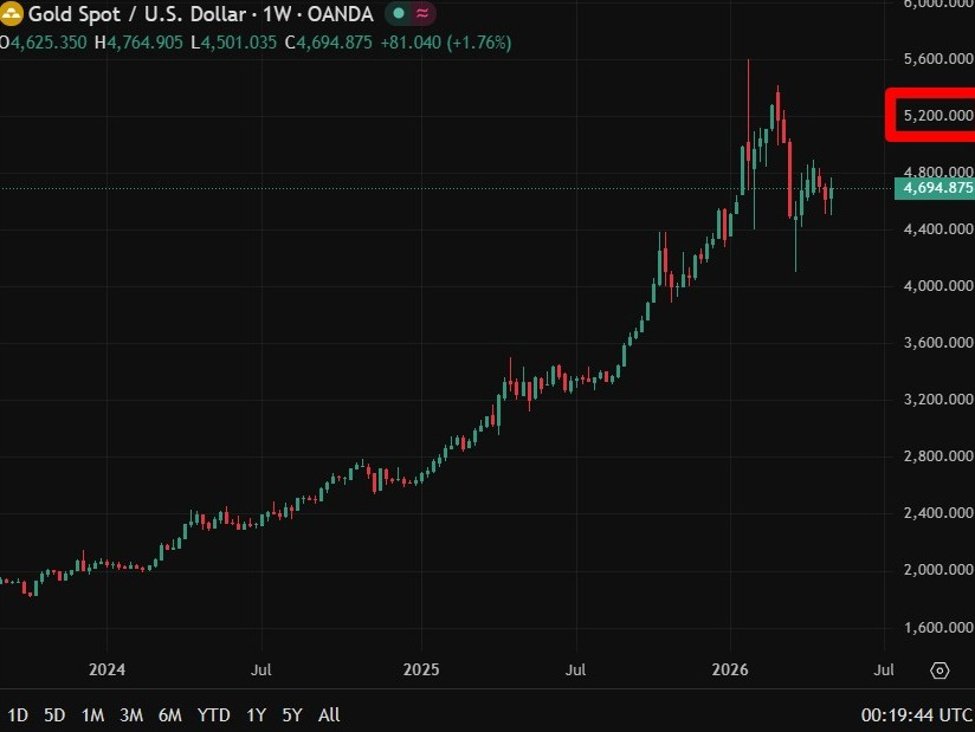
Morgan Stanley targets $5,200 gold this year, driven by ETF buying, China accumulation and 2027 Fed cuts, but warns the Iran conflict has exposed gold as a rates trade, not a safe haven.
Summary:
- Morgan Stanley has set a gold price target of $5,200 per ounce for later this year, driven by resumed central bank and ETF purchases and expectations of Federal Reserve rate cuts, per the bank’s research note
- Gold has fallen 14.5% since the Iran conflict began, underperforming the FTSE All-World, down 9%, and the S&P 500, down 7.8%, according to Morgan Stanley
- Morgan Stanley argues gold is reacting to rates rather than geopolitics, with higher oil prices feeding inflation fears, suppressing Fed cut expectations, lifting real yields and thereby weighing on the metal, per the note
- Central banks and ETFs paused or reversed gold purchases after the conflict began, with some selling aggressively, according to Morgan Stanley
- The bank’s bullish longer-term case rests on ETFs resuming purchases, China recommencing reserve accumulation, a weakening US dollar and expected Fed rate cuts of 25 basis points each in January and March 2027, per Morgan Stanley
- Morgan Stanley concludes that monetary policy has become more important for gold pricing than geopolitical events, describing the metal as increasingly a real rates trade rather than a fear trade, per the note
Gold has fallen sharply since the Iran conflict began, and Morgan Stanley argues that decline is not an anomaly but a signal: the metal’s oldest role as a safe haven in times of geopolitical stress has been eclipsed by its sensitivity to real interest rates, a shift with lasting implications for how investors should position around it.
Since the outbreak of the Iran conflict, gold has lost 14.5% of its value, a performance that places it below both global and US equities over the same period. The FTSE All-World has fallen 9% and the S&P 500 has declined 7.8%, meaning gold has not only failed to provide the protection investors traditionally expected of it but has actively underperformed the risk assets it was supposed to hedge against. Morgan Stanley’s analysis of that underperformance traces a direct line through the interest rate channel.
The bank’s reasoning runs as follows: elevated oil prices generated by the conflict have intensified inflation fears, which in turn have reduced market expectations for Federal Reserve rate cuts, pushing real yields higher. Higher real yields increase the opportunity cost of holding gold, which generates no income, and the metal has repriced accordingly. In Morgan Stanley’s framing, monetary policy has become a more powerful force for gold than war itself, a conclusion that breaks sharply with decades of conventional wisdom about the metal’s behaviour.
A secondary headwind has come from institutional buyers stepping back. Central banks and exchange-traded funds, which had been consistent and at times aggressive buyers of gold in the years prior, paused purchases after the conflict began, with some selling the metal outright. The removal of that structural bid amplified the rate-driven selloff and left gold without the floor that official sector buying had previously provided.
Despite all of that, Morgan Stanley remains bullish on the metal over the longer term and has set a price target of $5,200 per ounce for later this year. The bank’s constructive case rests on several developments it expects to materialise: ETFs have begun buying again, China has resumed accumulating gold reserves, the US dollar is weakening, and the Federal Reserve is expected to deliver two 25 basis point rate cuts, in January and March of 2027. Each of those factors, if they develop as Morgan Stanley anticipates, reduces the real yield headwind and restores the demand dynamics that drove gold’s multi-year rally before the conflict disrupted them.
The broader takeaway from the note is a structural one. Gold, Morgan Stanley argues, is no longer primarily a fear trade triggered by geopolitical events. It has become a real rates trade, one that responds to the monetary policy implications of those events rather than the events themselves. For investors who bought gold as insurance against exactly the kind of conflict now unfolding in the Gulf, that is a significant and uncomfortable reassessment.
—-
The reframing of gold as a real rates trade rather than a geopolitical hedge has significant implications for how energy and commodity desks should model the metal’s behaviour during the current Gulf conflict. If Morgan Stanley’s thesis holds, oil price spikes that stoke inflation fears and suppress Fed cut expectations will continue to weigh on gold even as the underlying geopolitical environment deteriorates, inverting the traditional safe haven logic that many traders still rely on.
The bank’s $5,200 target is contingent on a chain of events, including resumed ETF and central bank buying, a weakening dollar and Fed cuts in early 2027, that are far from guaranteed and sit in tension with a higher-for-longer rate environment. China’s resumption of reserve accumulation is the wildcard: if that buying proves sustained and broad-based, it could override the real yield headwind that has suppressed the metal since the conflict began. For now, gold’s 14.5% decline since the Iran conflict started is a data point that will force a rethink across desks that had positioned the metal as a hedge against exactly this kind of event.