Nike got a brisk reminder last week of how edgy marketing can easily blow up in a brand’s face.
The sneaker and apparel giant’s ad, at its store on Boston’s Newbury Street ahead of the city’s iconic marathon today, declared: “Runners Welcome. Walkers Tolerated.” It was a striking misreading of the culture of runners, and it came at a moment when Nike is trying to win serious runners back.
Nike had clearly wanted to tap into participants’ sense of pride for making it into a marathon notoriously difficult to qualify for, but the swipe at walkers or slower runners was panned online as mean-spirited at best. The language came off as at odds with the sport’s inclusive spirit, and for the vast majority of runners who don’t run fast enough to qualify for Boston or those who have reason to walk part of the 26.2-mile road race, it felt like a gratuitous slap in the face.
One runner participating in the “adaptive” division of the Boston Marathon, Robyn Michaud, took to Instagram to express dismay: “Due to a spinal cord injury I HAVE to take walk breaks. Even with a cyst in my spinal cord, I still regularly break 5 hours in Boston and plan to again this weekend. Thank you for TOLERATING me, @nike.”
And as any runner knows, there’s no shame in walking when necessary: Indeed, as a serious marathon runner myself, I can attest that I have walked parts of many of my marathons to take a short break, slowed down by fatigue or nausea, or hobbled by a tight hamstring.
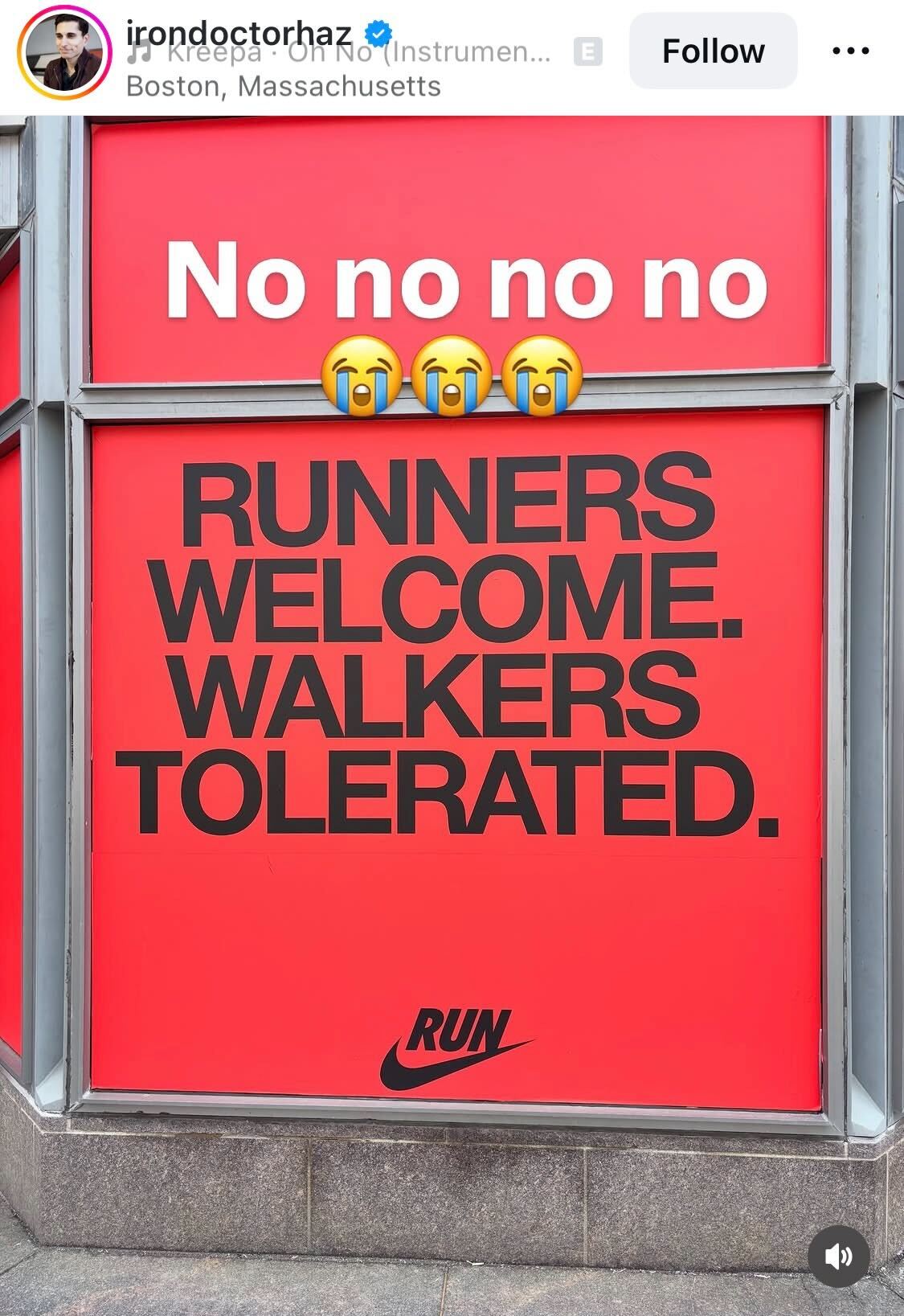
Image from Instagram
Nike took down the ad and apologized on Friday. “We want more people to feel welcome in running—no matter their pace, experience, or the distance,” the company told Runner’s World. “During race week in Boston, we put up a series of signs to encourage runners. One of them missed the mark.” The sign was later replaced by a “Boston will always remind you, movement is what matters” sign, according to Boston.com. Nike did not immediately respond to a request from Fortune for further comment.
Even as Nike came in for criticism in Boston and beyond, some dismissed the brouhaha as silly, given how exclusive the race is. The Boston Marathon, first held in 1897, is the world’s oldest annual marathon. For many marathoners, the race is the holy grail, and it’s a cherished event in the city. The 2013 bombing near the finish line on Boylston Street, which killed three spectators and injured hundreds, only deepened that bond—galvanizing residents around the defiant rallying cry “Boston Strong.”
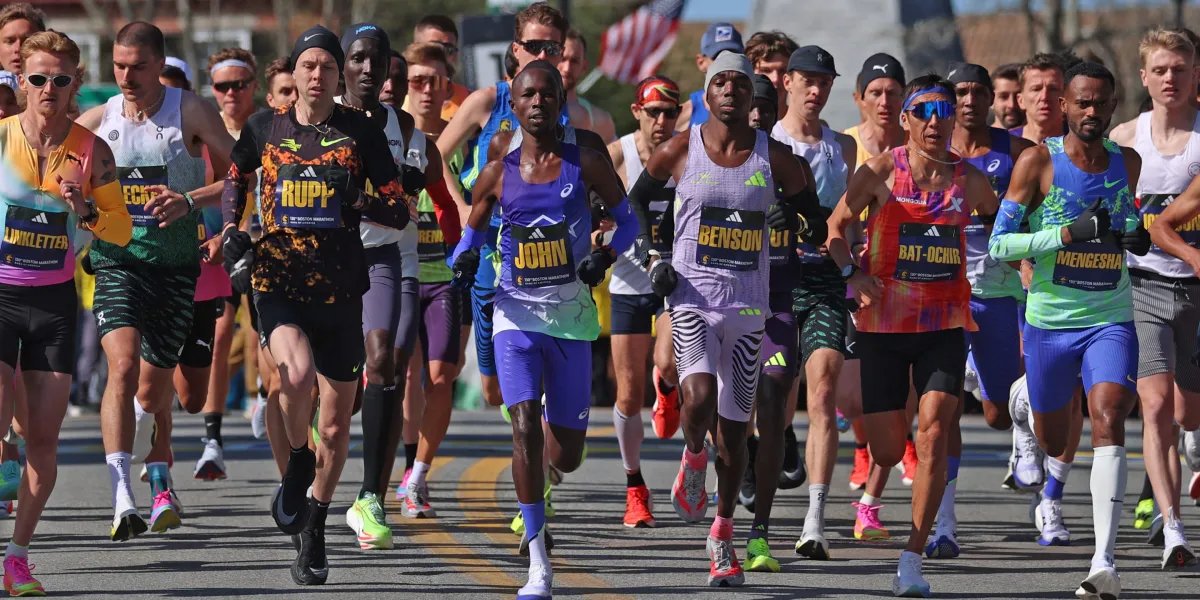
Demand for the race, capped at about 30,000 runners, has grown, and the marathon has become ever harder to get into, with qualifying times getting tighter. For instance, a man in his 20’s now needs to be able to run a marathon in 2 hours and 55 minutes to get into Boston, or 40 minutes faster than average for that gender and age group. A decade ago, a man that age would have gotten in at 10 minutes slower. (I have run 84 marathons and never qualified for Boston, though in my best race, I only missed it by two minutes. I did, however, once participate via a charity entry, as do about 10% of each year’s Boston participants.)
Nike’s crack about walking the race rubbed many runners the wrong way, even speedsters who have run Boston. Heartbreak Hill, the very difficult part of the course at Mile 20, has dashed many a runner’s hopes for a personal best. What’s more, many runners, fast ones included, favor the Galloway Run Walk Run method of mixing walking and running to stave off fatigue and stay strong longer—something Nike’s running experts undoubtedly are aware of, even if its marketing department is not.
The fumble highlights a deeper problem for Nike: It may still be the No.1 sneaker brand in the world and among casual runners, but it is not the preferred brand of runners, fast or not, who buy their shoes at specialty running stores. Indeed, among that cohort, Nike trails behind Brooks—the leader with 21% of the specialty running shoe market—as well as Hoka, New Balance, Asics, and Saucony, according to 2025 data from research group Circana. (Following the flap this week over Nike’s ad, Asics quickly put up a billboard in Boston declaring, “Runners. Walkers. All Welcome.”)
A few years ago, by its own admission, Nike had taken its eye off the critical running specialty market in favor of limited edition sneakers, allowing the likes of Hoka and On to swoop in, and Brooks to cement its lead. Since Elliott Hill, a long-time Nike executive, returned 18 months ago from retirement to become CEO, the company has re-prioritized running and begun to win back market share.
Last autumn, several Nike executives told Bloomberg that “Running is the heart of Nike.” It can ill-afford to risk insulting the athletes it needs to win back.