
Nvidia is facing a certified class action over alleged under‑disclosure of crypto mining revenue.
A Crypto Scandal Resurrects Just In Time For Holy Week
After years of grueling legal back and forth between the giant gaming company and the American courts, a U.S. federal judge has certified a securities-fraud class action against Nvidia and CEO Jensen Huang over alleged under‑disclosure of crypto mining revenue in 2017–2018, according to a Wednesday order from Judge Haywood S. Gilliam Jr. in a California federal court. A class certification means the case can move ahead on behalf of a broad group of shareholders (the plaintiffs), raising the legal and financial stakes for Nvidia.
Investors claim Nvidia hid how much of its “gaming” GPU sales were actually driven by cryptocurrency miners, creating “revenue gaps” between public guidance and internal reality.
A Recap Of The Legal Battle
In order to properly understand this development, we must first go back to almost a decade ago, when investors sued the American tech company for the first time in 2018. Back then, the investors argued that $1 billion in crypto-linked GPU sales were misclassified or downplayed, with internal emails suggesting management knew the stock was “held high” by these statements.
It is important to remember that this happened in the context of the 2017–2018 mining boom, when Ethereum and other coins sent demand for Nvidia GPUs surging. Despite this, the company publicly emphasized gaming as the main growth driver.
The extent of Nvidia’s risk only became clear on November 2018, when CFO Colette Kress acknowledged that gaming revenue had fallen “short of expectations” because excess inventory built up during the crypto boom was taking longer than anticipated to clear. Gaming GPU prices were slower than expected to return to normal after the “sharp crypto falloff”, she claimed.
This disclosure not only triggered a roughly 28–29% share price crash, but also forward, in 2022, a $5.5 million SEC fine over inadequate crypto-mining disclosures in fiscal 2018, which the company already paid. Bitcoinist covered the story back then.
The lawsuit was first thrown out in 2021, then brought back to life on appeal, withstanding Nvidia’s unsuccessful attempt to get the U.S. Supreme Court to shut it down, and is now advancing as a certified class action.
And Now What?
Today, plaintiffs contend that a large portion of Nvidia’s crypto-fueled sales actually ran through its GeForce gaming GPUs, with most of that income booked under the gaming division, leaving the company heavily exposed to the boom‑and‑bust swings of the crypto market. Despite that, Nvidia had long insisted that the bulk of mining-related demand was captured in a distinct line item rather than in its main gaming segment and that crypto mining was a minor contributor to its overall business.
The judge highlighted an internal email from an Nvidia vice president, describing it as especially revealing:
The Court also notes that internal company emails support its conclusion here. Just before the November 2018 disclosure, NVIDIA’s then-VP of Investor Relations and Strategic Finance opined in response to a question from Huang that one reason “the market isn’t pricing in a bigger miss” following news that AMD had one or two quarters of post-crypto channel inventory was in part “because of comments we’ve made on . . . ring-fencing the crypto impact in OEM”
The newly certified class includes investors who purchased Nvidia shares between August 10, 2017 and November 15, 2018. A case management conference is set for April 21, when the judge is expected to lay out how the litigation will proceed.
It is notable that one of NVIDIA’s own VPs expressed the view that its stock price remained high because of the same types of earlier comments that Plaintiffs are pointing to, and the Court cannot conclude that there was no price impact in the face of such evidence.
For NVDA stock traders, a live, certified class action injects headline risk into one of the market’s most crowded AI plays, and any adverse ruling or settlement could weigh on multiples in a risk‑off tape. For crypto and mining‑adjacent names, the case is a reminder that opaque revenue accounting around mining cycles can come back years later, potentially tightening disclosure standards just as the sector eyes the next bull run.
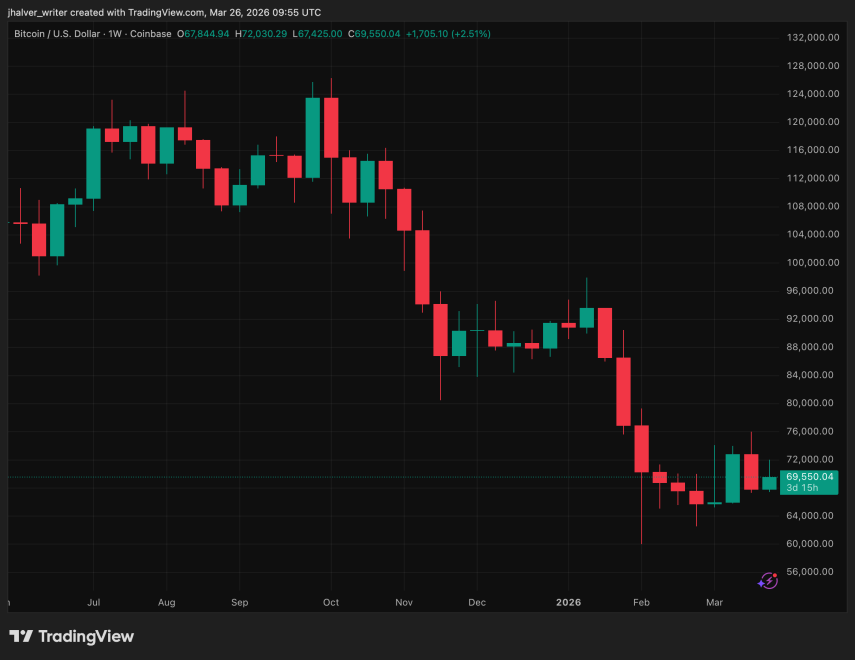
BTC’s price drops slightly after reaching $71k yesterday, trading for around $69k today. Source: BTCUSD on Tradingview
Cover image from Perplexity, BTCUSD chart from Tradingview
Editorial Process for bitcoinist is centered on delivering thoroughly researched, accurate, and unbiased content. We uphold strict sourcing standards, and each page undergoes diligent review by our team of top technology experts and seasoned editors. This process ensures the integrity, relevance, and value of our content for our readers.