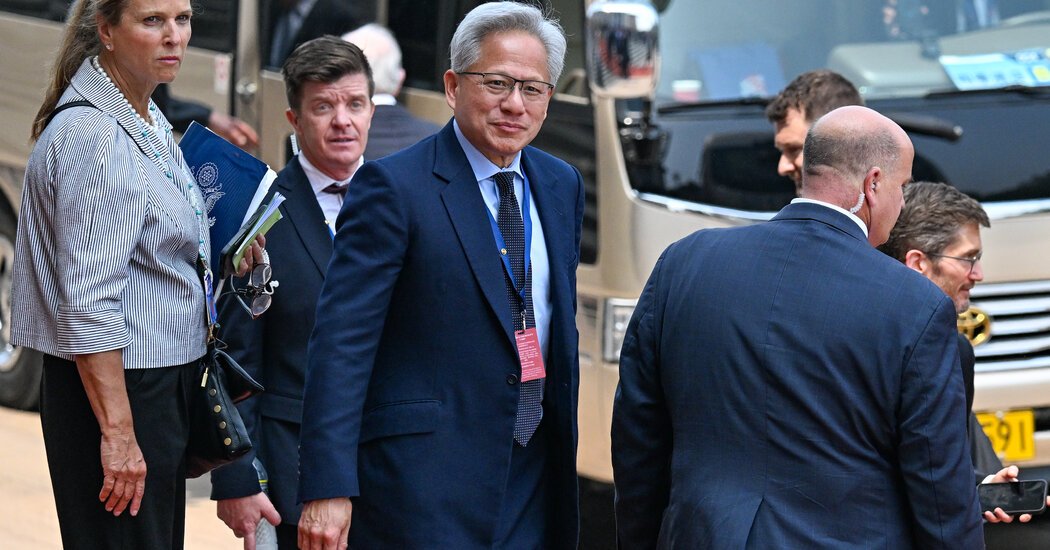
When Jensen Huang, Nvidia’s chief executive, joined the group of American business leaders traveling with President Trump to Beijing at the last minute this week, many took it as a sign that progress was in store for the company’s long-stalled sales in China.
But as the summit between Mr. Trump and Xi Jinping, China’s top leader, wrapped up on Friday, the fate of Nvidia’s artificial intelligence chips in China was no clearer than it had been before.
Even Jamieson Greer, the U.S. trade representative, seemed uncertain about Nvidia’s future in China, saying in an interview with Bloomberg News on Friday that it was up to Beijing whether Chinese companies would make more purchases from the American chip giant.
Last December, President Trump approved Nvidia, the world’s leading chip maker, to sell one of its most powerful A.I. chips, the H200, to China. But since then, the Chinese government has yet to greenlight any purchases, and no H200s have been sold.
Instead, Beijing has pushed Chinese companies to rely on homegrown technology from chipmakers such as Huawei.
Just before Mr. Trump met with Mr. Xi, China reached a milestone in its long-running quest for technological self-sufficiency. The Chinese start-up DeepSeek said for the first time that its latest artificial intelligence model had been optimized to run on Huawei chips.
Mr. Huang had long warned that this shift was coming. Soon, China’s A.I. companies will rely on Chinese hardware rather than American technology, eroding U.S. influence over A.I. development in China, he has predicted.
U.S. officials did not seem to push the issue during their trip to China this week.
The decision on whether to buy the H200 “is going to be a sovereign decision for China,” Mr. Greer said in the interview. “Obviously we think it could be helpful to them in the long run, but they’ll just have to make their decision on that.”
For years, Washington has used export controls to slow China’s progress in advanced technologies like A.I., and analysts had expected Chinese officials to air their frustration with those restrictions this week.
Despite Mr. Huang’s presence in Beijing, Mr. Greer said, the two sides had not discussed chip export controls at the meeting.
China was firmly committed to producing advanced chips at home and views the U.S. tech industry as a threat to that effort, he said.
“If we are ahead of the game, like we are on A.I. chips, sometimes they feel that can stop their own growth,” he said.