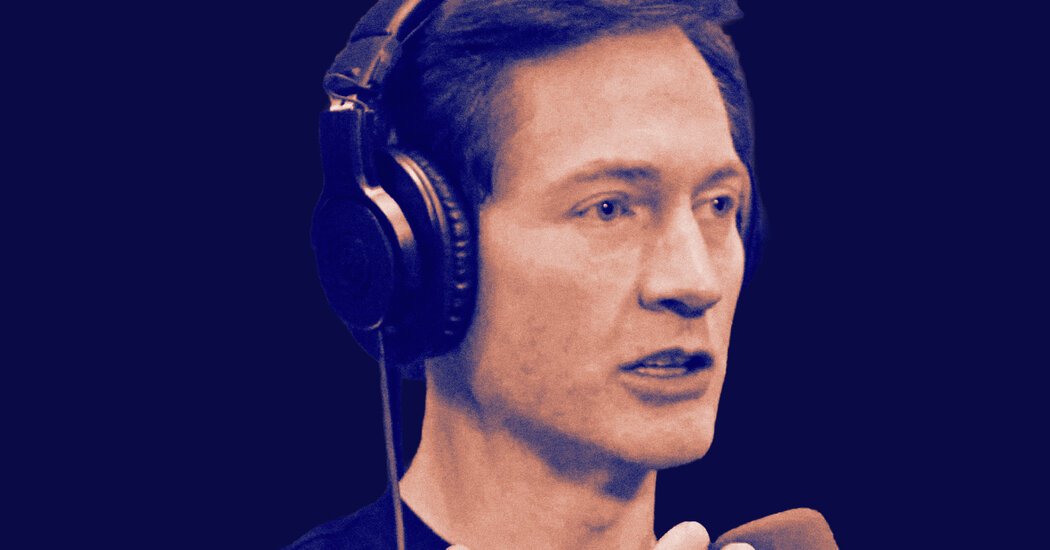
For my final episode as host of “Interesting Times,” I wanted a fitting finale — a conversation that encapsulates the ambition of this show: examining how seemingly radical ideas are steadily entering the mainstream of American politics, technology and culture. Few ideas are as radical as the hope of dramatic life extension and the quest to live forever.
My guest today thinks he can outrun death. After selling his tech company for hundreds of millions of dollars and experiencing a profound religious crisis, Bryan Johnson has turned his own body into the ultimate science project, centered on an explicit mission: Don’t Die.
But why does Johnson want to live forever, and what lessons can his algorithmically driven lifestyle bring to the rest of us?
It’s been an honor hosting this podcast and navigating these strange waters with you. “Interesting Times” will be back with new episodes and new hosts in the fall.
Below is an edited transcript of an episode of “Interesting Times.” We recommend listening to it in its original form for the full effect. You can do so using the player above or on the NYTimes app, Apple, Spotify, Amazon Music, YouTube, iHeartRadio or wherever you get your podcasts.
Ross Douthat: Bryan Johnson, welcome to “Interesting Times.”
Bryan Johnson: I’m glad to be here. Thank you for having me.
Douthat: I’m very glad to have you. You have the dubious distinction, or maybe the extreme honor, of being the guest for my last episode as host of this show.
And I think this conversation, I’m hoping, is a fitting finale because one thing we’ve been trying to do on “Interesting Times” is to explore how I think what seemed to a lot of people like strange and radical ideas have been entering more into the mainstream of American politics, culture and technology, and so on.
One of those radical ideas that has come up more than once in this show’s run is the hope of dramatic life extension.
Douthat: It’s part of the pitch for artificial intelligence’s potential benefits, and it is now your life’s work. It’s very explicitly: Don’t Die. And you have made yourself a personal guinea pig, in fact, for all kinds of potentially life-extending treatments, and even taking what some, though certainly not me, might call a T.M.I. approach to everything that’s happening with your own body.
You’re an internet character. There’s some mockery out there, maybe, but I take you to be extremely sincere about this. And so I just wanted to start with your motivation.
Why do you, Bryan Johnson, want to fight and maybe abolish death?
Johnson: I was building my brain interface company a couple of years back. I was working with this esteemed professor, and we were trying to define intelligence.
He had a definition that I thought was really interesting, which is that intelligence is to know what to do next. And right now, in this moment, it’s a tectonic shift in terms of: What will become of the human race? What will become of each of us, individually? What do we aspire to?
Those are the questions I’m really trying to tackle. In this moment, as we remap our imagination as a species, what do we do next?
My conclusion is we are now at peak human knowledge. Also we’re potentially at peak ignorance with what A.I. will unleash.
There’s never been a time when there’s been a stronger juxtaposition between what we know and what we may not know. And in all that contemplation, I say the only thing I can truly trust in this moment is: I don’t want to die right now.
So this is not about immortality. It’s not about trying to live a million years. It’s to say the one thing I can say with certainty is: I don’t want to die right now. And I think that’s true for almost everybody.
Douthat: I want to get into some of the philosophical ramifications of this view, but can we talk biographically for a minute?
I think most people would say: Of course, I don’t want to die. But there’s a difference between having that sense or sensibility and taking the study and remaking of the human body — or your own body, in this case — as a mission.
What was going on in your life when you decided that this should be your mission?
Johnson: It goes back to when I was 21 years old. I returned from working as a missionary in Ecuador. I had lived in mud huts, on dirt floors, and I understood the depths of poverty. I was struck by the opulence of the United States and the conditions where I was in Ecuador.
In that moment, I said: I don’t know what I want to do with my life other than I want to do something useful for mankind.
And so I said: I’ll become an entrepreneur. I’ll make a whole bunch of money by age 30. Then, with money, I’ll do something interesting — a very common thing people hear.
So I did that. I sold my company, Braintree Venmo, for $800 million. I made a few hundred million dollars. And at that point, it was: OK, now I’ve done that. What do I do?
The irony was I was absolutely broken. I had burned myself out. I was raising three young kids. I was separating from my religion. I was chronically depressed. I was getting a divorce. And I just sold my company and lost my identity as a professional.
Even though I had $300 million in my bank account, it didn’t matter — I was absolutely broken as a person. So I had to rebuild myself.
I set out to ask all the basic questions: Who am I? What do I care about? What do I want to do?
Then I read this book called “Zero: The Biography of a Dangerous Idea.” I learned about the history of zero, how it has disrupted everything in history — physics and math and art and religion and philosophy — and I wondered: What is the zero in this moment? What is the thing that is hiding in plain sight that is so obvious but that no one is doing?
I thought about that question for several years, and then I did a second thought experiment that really did it for me. I imagined being present in the year 2500. There I am, conversing with whoever that is — human or A.I., or some combination of human and A.I. They’re reflecting on the early 21st century, and they say: We’re so grateful for Homo sapiens that existed in the 21st century because they did blank.
In a few hundred years, they will compress our century into two or three or four sentences. So I thought that compression ——
Douthat: Most of them will be about podcasting, I’m confident.
Johnson: [Laughs.] Unquestionably.
I thought they’d say two things. One is that’s when Homo sapiens gave birth to superintelligence, and that’s when they figured out they’d no longer die.
And I thought: That’s it. That’s the moment where it flips, where humans go from the inevitability of death to: Don’t Die. And that’s going to become my purpose for existence.
Douthat: You were a missionary. You were a member of the Church of Jesus Christ of Latter-day Saints, right?
Johnson: That’s right.
Douthat: Why did you lose your religious faith?
Johnson: I read a book called “Rough Stone Rolling.”
Douthat: Oh, yeah. A biography of Joseph Smith.
Johnson: That’s right. And I learned about the history of the church. When you’re raised in the church, you’re given a version of events that are obviously very favorable to the church’s disposition. Then when you learn the true history, you need to square with the new reality.
Like all things, humans are messy. History is messy. Once I started learning more, I thought: I just can’t quite make sense of this. And so, in my mid-20s, I read that book, and it just broke for me.
I still stayed in the religion because I was married to someone who was in there, my children were in the religion, my entire family was. It took me a while to get out, but, yeah, my faith broke in my mid-20s.
Douthat: Did it make you an atheist or just a non-Mormon?
Johnson: A non-Mormon.
Douthat: Just for my guidance, what’s your current position on God?
Johnson: [Laughs.] I’m excitingly undecided.
Douthat: OK. Good. We’ll see where we end up at the end of the conversation.
Let’s talk about what you actually decided to do once you realized that this was going to be the hinge of the 21st century.
Your project is called Project Blueprint. Blueprints show you how something should be built or structured. What are you trying to show with this project, with the work that you undertake?
Johnson: After that thought experiment of the 25th century, it was clear to me that we basically needed to build a new philosophy, a new value system, new ethics, new morals, new incentive systems.
My co-founder and I, Kate Tolo, decided to make this a project, and we said: We will make my body the philosophy.
If you look throughout time, the first story ever written was Gilgamesh, a story basically about life and death and eternal life. Over the centuries, there have been different archetypes that represent the grappling of the human race with the questions: What does it mean to live and die? And is there an afterlife?
A new archetype needs to exist that represents the quest to try to continue existence in this physical body through the means of science and technology, and there wasn’t an archetype that filled that role.
What we designed is, first, from a scientific perspective, I’m a cluster of trillions of cells, so we’re going to measure every one of those cells, as possible, including doing blood draws and imaging and measuring my body every way possible. Then we’re going to use scientific evidence and say: How do we either slow down my speed of aging and/or reverse it?
Basically, we have done a robust scientific project. We are performance artists trying to convey a new philosophy. Bryan Johnson is the first Don’t Die Homo sapien prototype — the first Homo sapien that tried to incorporate that.
Douthat: But by “archetype,” you mean a positive archetype? Immortality is associated with anyone from Dracula to Dorian Gray, let’s say. So you’re trying to make yourself an admirable archetype, right? Someone who people look at and say: This is not a bargain with the devil or something where I’m going to have a portrait that ages while I stay young. This is something that I would want to identify with.
Johnson: Not necessarily.
Douthat: OK.
Johnson: I am willing to shave off good and bad, desirable and undesirable. People make these connections all the time: It’s Dorian Gray, it’s Dracula, it’s Prometheus.
Basically, I say yes to all of it. The play here is that this is a fun game for everyone. You have people who are watching me, wanting to learn from me. You have people who want me to fail, and they want to laugh. You have this whole mixture ——
Douthat: [Laughs.] People betting against you. Yep.
Johnson: Yeah. There’s an intense interest in me failing. And you know what? That’s great. I support their viewpoints. I understand their viewpoints. I think irony is in their favor.
But I think the value is that it’s a group conversation and a group journey. For those who hate me, those who love me, it’s all the same.
Douthat: How is your cause advanced through the haters?
Johnson: Whether it’s love or hate, it’s raw energy.
Douthat: OK. Tell me about the process then for listeners and viewers who are not fully familiar with the Bryan Johnson experience. In a typical day, what are you doing to defeat death?
Johnson: OK. I’ll give a couple of quick examples. I went to bed at 8 p.m., on the dot, and I’m extremely precise about my sleep because it’s the No. 1 thing I focus on. I’ve built my entire life around sleep.
Last night I nearly got five hours of restorative sleep. My resting heart rate was 40 beats per minute. My heart rate variability, H.R.V., was 13 percent higher. So my body got full restoration to clean out the garbage and to rebuild my body.
I woke up at 4 a.m. In the first hour, I get light in my eyes right when I wake up to say: Hey, body, I’m waking up. I then eat breakfast, which is protein powder. It’s hemp and pea protein, berries, nuts, seeds, extra virgin olive oil.
I then work out for an hour. I’m currently training to dunk a basketball. I then do 20 minutes of sauna. I then do some intermittent hypoxia and/or hyperoxia training, and then I have my first meal of the day.
Every single day, I do some version of that.
Douthat: The powder doesn’t count as a meal?
Johnson: [Laughs.] It does. I guess that’s my first real meal. You’re right.
Douthat: OK.
Johnson: By the way, every calorie fights for its life. I have extremely precise nutrition — every calorie gets in there. And that’s how my entire life is built.
So I’m doing this with you now. I’ve got some doctor appointments later this afternoon. I’ll do more measurements. But my entire life is regimented structure. This gives rise to people saying I live in a cage. That’s partially true. Also I’m a living experiment.
I’ll give you some quick examples for those who are unfamiliar. We try to measure everything. For example, I’m 48 years old, but my left ear is age 64 based upon some hearing loss I had as a kid listening to music too loud and shooting guns. So I’ve gotten hearing aids to try to correct for the deficiencies.
We aged the gums in my mouth — what’s the recession, etc.? Some data sets are very robust, some are emergent. We just take whatever data we have.
Douthat: My lower gums are ancient. I won’t show them to you.
Johnson: Do you know the measurement?
Douthat: No, no. I just can see them in the mirror, and they’ve clearly aged more rapidly than the rest of my mouth. This is just a rough estimate based on trips to the bathroom.
Johnson: [Laughs.] Yeah.
We spent several months rejuvenating my gums because I have bruxism, which means I grind my teeth at night. I did that for about 20 years before I had a dentist saying: Hey, this is a problem. You need a mouth guard of this type.
The grinding caused my gums to recede and my pocket depth to increase. So we did a bunch of therapies where we restored my gums to roughly early 20s age. My left ear, we’ve made zero progress.
Sometimes you find a deficiency like where you’re older than your chronological age, and you can do something about it. Sometimes you can’t do anything about it. That’s why it matters so much to measure. You’re trying to find the oldest, highest-risk part of your body that creates the highest risk of all-cause mortality.
Douthat: You mentioned superintelligence earlier. You’ve sort of undertaken this project over a period where A.I. has become the focus of so much hope and fear and interest about measurement and analysis and everything else.
How are you using A.I. right now?
Johnson: This project would be stalled without A.I. We’ve acquired 1.5 billion data points. It’s impossible for any doctor to keep that in their memory, so we have built an A.I. system where we ingest all my data — my genome and my proteome — and every measurement we do, all my wearables. You name it, we do it.
Then we’re trying to make sense of it. The A.I. has been phenomenal in terms of identifying patterns we can’t pick up through manual processes.
The idea behind what I’m trying to do is: Cars drive themselves. Software now writes itself, to a certain degree. The next is health. Health is going to write itself, which means if I can measure my body and feed data to A.I., A.I. will know better what to do than me or my doctors.
I’m building my autonomous self. I’m building a self-driving body so it just automatically takes care of itself more robustly than I can.
Douthat: OK, but just to push on that analogy for a minute, as you describe your day, your body is not just taking care of itself while you go about your daily business. Your daily business is this project, and you are a wealthy entrepreneur, and — we’ll get into this in a minute — you’re also making money from this project. This is your business, so it’s not a passive thing where you’ve just trained your body to drive itself the way that a Waymo might drive you around San Francisco.
What’s the takeaway for someone who works a 9-to-5 job, during which maybe they can eat the protein powder or something, but otherwise, they’re not going to be dunking a basketball at 2 p.m. Pacific?
Johnson: [Laughs.] Yeah. So two things on this. One is there are some parts of the project that are autonomous. For example, the bed I sleep in automatically adjusts temperature according to my body. It changes my temperature profile about 32 times per night, making sure I stay in deep sleep and REM sleep and I avoid wake events.
So yes, there are some advanced features where I get real-time data, real-time measurement and real-time adjustment. But you’re right that I’m basically in analog world. As much as I want A.I. to run my life, I have to physically take those actions. I have to buy food.
I totally agree with you, and we’re trying to ——
Douthat: I mean, you can get DoorDash.
Johnson: [Laughs.] Yeah.
Douthat: I’m also interested watching you because I spent a certain period of my own life treating myself as a guinea pig. I had a very severe chronic illness that had basically totally ruined my life for a period of a couple of years. Let’s just say there was insufficient medical data on how you would ideally treat it.
So I treated myself, to use the language of studies, as an N of 1. I was just trying things — things that people had recommended, things that had some science behind them. But this was an all-consuming process at a lot of times.
First of all, I was always treating it as a provisional thing to get me back to health. That was sort of how I understood it. In the end, it got me there — or close enough to there — so that I no longer live like that.
Second, I didn’t imagine that the things I was doing were going to be generalizable. If other people had the same illness, I would give them advice and compare notes and so on, but it just seemed so clear that whatever was going on in my own body was very, very idiosyncratic.
When I look at what you’re doing, I’m curious about two things. First, this is an open-ended thing. There’s no point where you’re like: OK, now I can relax and stop trying all these things.
Because you’re not trying to attain health. You’re trying not to die, and that’s an ongoing process.
Second, I really don’t completely understand how you think you can reasonably generalize from, again, one body, one set of measurements and monitoring and so on, to a wider population. Scientific studies are not based on one person’s experience.
You can take either one of those questions — or you can react in any way to that you want.
Johnson: You can think of this in the idea that capitalism means you learn how to make money. You learn the skill sets of how to make money. People do that in a variety of ways, but you’re choosing: I’m going to choose to devote 10 hours of my day to make money. Or: I’m going to choose to spend blank hours of my day trying not to die.
It’s really the exact same thing, and people don’t quite understand that. Right now we know how much coffee costs, and we know what it means when the bank account balance gets below $100. But we have no accounting ledger for life and death.
You don’t know what it costs you to stay up all night. You don’t know what it costs you to be 40 pounds overweight. You can look at some rough data tables, but we don’t have an accounting system. You don’t see your bank account balance change that frequently.
What I’m trying to do is be a prototype, an archetype, to say: There’s a new way of thinking and a new way of being that has this. The way I try to compress this for people is I say: Look, I understand health is complicated. Your life is complicated. Everything you have going on, it’s stressful.
And so I try to say: Focus on one thing. That is your resting heart rate before bed. If somebody focuses on that single biomarker, it helps them wrestle the bad cultural habits we have as a society, which means we go to bed way too late, inconsistently. We have our screens on our faces up until bedtime. We eat way too late. We have snacks.
That one thing really wrestles the majority of bad habits, and once a person can wrestle their sleep, then all of these positive things happen. So I do try to say: Of course I’m the outlier, but I can simplify this into basics.
Douthat: So you’re doing 100 things, and you’re saying that the person who watches you can do two of those things?
Johnson: That’s right.
Douthat: But you’re also selling products, right?
Johnson: That’s right.
Douthat: What do you sell?
Johnson: Everything I put into my body, I make available so other people can do if they choose.
Douthat: And is everything you’re putting into your body chosen based on some kind of scientific research or background?
Johnson: Exactly. Yeah.
Douthat: OK. So you’re basically selling products. You’re not saying: I, Bryan Johnson, have run studies on these things.
But you’re saying: I, Bryan Johnson, have looked at studies on these things, and they’ve persuaded me that I should be willing to ingest them.
Johnson: Exactly. And I need to be very clear: I am not doing this to make money.
I started this project, and I needed this ——
Douthat: Can I raise an eyebrow at that? And have one note of skepticism?
Johnson: Please. You can raise two if you like.
Douthat: OK. But really, you’re not trying to make money?
Johnson: Absolutely not. My premise is: I already have plenty of money. I don’t need any more money. And, in fact, if I wanted to make money, there are probably 10 to 20 businesses I would start way before this one.
The business that I’m in sucks. Low margin, pain in the [expletive], terrible logistics. It is not the business I would build. And sometimes I really regret having done it. My life would be so much simpler by not having to spend time on this business.
But basically, whether you believe me or not, I’m genuinely trying to do people a favor in doing this.
Douthat: Do you pull products? Are you constantly pulling things in and out, taking things for a while and saying: Oh, that didn’t have any effect on the biomarker, and so I’ll stop taking it? What are you adding and subtracting?
Johnson: Mostly therapies. When you measure the body and you say: OK, the biological age is blank. Can you reverse it? Then what therapies can you do?
And so we went down the list of the best therapies with the best evidence of showing age reversal, and we’ve done those. We did a hyperbaric oxygen therapy. We’ve done sauna. We did I.H.H.T.
Douthat: What’s the best? Again, let’s say I’m the person who says: Bryan, I can only do one thing out of your list of therapies. I’m a busy man. I’ve got a lot of kids. I have a podcast. I’m changing jobs. What do I do?
Johnson: Sauna. I would do dry sauna — that’s not wet, not infrared. Dry sauna between 175 degrees Fahrenheit and 212 degrees Fahrenheit for 20 minutes. And I’d do it about four to five times per week.
For you, because you’re a man, I would suggest you put ice on your boys, because otherwise it has negative effects on your fertility. So be sure they’re cold.
Douthat: I have five children. Honestly, Bryan, I’m not superworried about that specific issue.
What about reversal? You talked about the idea that you’re looking for things that actually reverse the age of an organ or a part of your body. What’s something that you’ve done that you think has the most promise for that?
Johnson: We’ve seen several. Hyperbaric oxygen therapy was one of the most efficacious therapies we’ve ever done. The difficulty is that you need to be in this chamber for 90 minutes for 60 sessions in 90 days, so it’s a huge time commitment.
Douthat: That’s a commitment.
Johnson: It’s a huge one. It’s just not practical for people to do it. But we saw benefits in skin health, telomeres, microbiome, brain. We saw it across the board.
Douthat: Again, in any of these cases, you’re one person. Are you assuming that somewhere in your fan base there are people who are saying: Oh, this is really interesting that Bryan Johnson got these results. We’re going to set up a big controlled trial based on this?
Johnson: Yes.
Douthat: Again, to take this beyond your own experience, you need that kind of thing, right?
Johnson: Absolutely, yeah. I’ll give you an example where that has bridged. We did an experiment looking at psilocybin. People think about psilocybin either as an ancient medicine ceremony, or recently, for trials looking at PTSD and anxiety and things like that. We asked the question: Is psilocybin a longevity medicine?
We did the most quantified psychedelic psilocybin experience in history. We measured 250 biomarkers, and one of the things we found was there was this unique metabolic reset of my blood glucose. That was not in the literature before.
So in that sense, yes, there are several groups now who have petitioned, trying to get funding for a rigorous study to look at psilocybin more robustly as a longevity therapy. It would be a very big shift in how people think about this.
So we’ve had several wins like that, of reframing different topics in what we do. And again, it doesn’t answer it definitively, but it points in the direction of: Is this worthy of a study?
Douthat: Aspirationally, based on your knowledge right now, without some further dramatic breakthrough — just to put yourself in the hands of your haters for a minute — how many years of your life do you think you’re getting through this kind of regimen?
Johnson: Yeah, let’s actually amplify their argument and say the better argument for them is I’m shortening my life. Not only am I not doing myself good — let’s say I’m actually doing myself harm by intermingling with my body.
And you know what? I’m open to the criticism. Maybe that’s true. Maybe it’s better to just let my body do its thing without meddling.
We measure things as best we can. We try to look at all the data, and we say: How is my body doing? We look at hundreds of markers every month trying to say: Is it good or bad? But, ultimately, we don’t know.
So I think it’s really an open-ended question. This is early, early stages of science.
Douthat: I guess what I’m driving at is there’s a best-case scenario, where you do everything right, and the end result is you’re healthier in your 80s than you otherwise would be, and you avoid some disease you otherwise would get, and in the end, you get an extra one to seven years of life. And that’s a win for you and for everyone who ever watched you on a video.
But that’s not defeating death. That’s not: Don’t Die. Whereas actually defeating or, more realistically, postponing death, some people would say, is going to come from some big breakthrough that has nothing to do with the protein powder you take or anything. And everything that you do is going to look sort of like dieting advice before Ozempic.
What do you make of that argument? Does your work actually connect to the people who want to add not one to three but 50 to 75 years to human life spans?
Johnson: Yeah. I’m under no illusion that we don’t have the longevity drug that just makes death go away. But health is forgotten until it’s the only thing that matters.
I think your case is a good example that when you do have something wrong with you, it wrecks your life. And when you choose to do things that put you at risk of your life being wrecked, that’s bad.
Rarely is there harm in getting good sleep, in exercising, in deciding not to do bad things. So I’m presenting the case that, in this moment, this is more of a philosophical stance that you want to treat your body well, you want to be in a good condition. But under no illusion have we arrived yet.
Also, if we think that A.I. is going to progress at the speed it’s going to move in the coming years, on the time scale of 30 years, it’s a different reality 10 times over.
I don’t think that we need to see the life-extending drugs right now. We just need to see, as the coming years progress, that’s when I think the real drugs will come about. But right now, it’s choosing the lifestyle.
Douthat: OK. But here’s a little bit of what they call a motte-and-bailey argument here.
Yeah, everyone wants to be healthier. Nobody wants to have a preventable disease. But that’s different from Don’t Die. And you are, in fact, at the same time, talking about the vantage point of the 25th century and the idea that death itself can be vanquished.
Which is more important to you: the actual goal of defeating death or just the goal of adding three years to some people’s lives?
Johnson: I mean, it depends. My parents are in their 70s. For them, the way I think about their care — and I spend a lot of time caring for my parents — those three years matter a lot. I need progress in A.I. to move forward very fast for them.
For me, if my life expectancy is 80, then 33 years is a very long time, right now, for things to advance. So it’s less urgent for me, more urgent for my parents and then for people who have certain conditions.
Douthat: So the everyday health stuff is, in a way, targeted toward people who are already on the down slope of life, perhaps like myself. But I’m young yet. But for people your age and younger, it’s sort of a building block toward a potentially deathless future.
Two things have happened to you fairly recently. You were diagnosed with an autoimmune disease, and you fell in love. How did those change your perspective, if at all, on the life you’ve chosen?
Johnson: I’ll start with love first.
Douthat: Always a good idea.
Johnson: You know what? This is the happiest I have ever been in my entire life in a relationship. It is spectacular. I didn’t know to aspire to this. When I was a kid, I had in my mind that a practical, functional relationship is about as much as you can aspire to. Never this.
I am so grateful that she chose me and I can be with her. We have a fantastic time in life. I just can’t imagine doing life any other way.
So yes, I’m deeply in love. I feel deep companionship, and I’ve changed the way I speak to my children in encouraging them about what to aspire to in a relationship.
Douthat: Has it made you any less physically healthy?
Johnson: [Laughs.]
Douthat: I noticed you flew to Australia to visit her family. I know this was maybe a little bit tongue in cheek, but I think you published something about how much damage that air travel did to your body.
And look, I’ve flown a bunch in the last few months and been to Europe and the West Coast, and without having your biological monitoring on my body, I believe it.
So you sacrificed a tiny bit of your own potential immortality to fly to Australia to meet her parents. I’m just curious if there’s any more of that.
Do you feel like maybe you’re monitoring your body a tiny bit less intensely? I know that she is now involved in your work, and there are some not-safe-for-work sort of things that you have monitored that people can Google if they’re interested in. But has it at all changed your approach to your everyday monitoring to be over the moon in love with someone?
Johnson: To her credit, she unabashedly supports me. And it is not a situation where she tries to encourage me to lessen what I’m doing or become less intense. If anything, my bedtime comes up, and she’s like: Baby, it’s time.
Douthat: Time to go to bed.
Johnson: It’s 7:50. You got to get going.
And I’m on the couch, like: I can’t move.
Douthat: That’s love, then. I can’t deny it.
Tell me about your illness.
Johnson: Getting an incurable diagnosis is one of the best things that has ever happened to me. I am so excited about this. Over the past couple years, we’ve really tried to master the basics — how you sleep well and how you eat well and all those kinds of things.
Now I get to work on something incredibly exciting. In modern society, when you get a diagnosis, you usually just have to live with it. You have to concede to the disease and deal with the downward spiral of things getting worse, and medicine can’t do anything about it.
And now, just over the past 12 months, that has shifted. Individuals are now using A.I. and biotech to address their own diagnoses. Kate got diagnosed with endometriosis. I had my autoimmune gastritis.
The beautiful irony, and as a gift to my haters: Netflix did a documentary on us: “Don’t Die.” We came out gusto, with all this ambition, and one year later, we both have incurable diseases diagnosed.
What great irony. And we are going to cure both of them. We are down this path.
If I believe in Don’t Die, and if I want Don’t Die to be real, I must go through the gauntlet of getting diagnosed with an incurable disease or more. It’s just a rite of passage.
Douthat: It was going to happen eventually — so why not now?
Johnson: Exactly. Rite of passage. I have to do it. I’m ready to do it. I’ve never felt more ready to do it.
So I want this. I’m excited about it. It was a good gift of timing.
Douthat: I do want to get back into the philosophical a little bit. Again, there is a pretty clear distinction between the pursuit of cures for existing diseases and the quest to defeat death. Obviously, those blur into one another, but I still think there’s also a real philosophical distinction. You are on the we’re-defeating-death side of that distinction. I just want to talk a little bit about what that means to you.
A.I. has the potential to revolutionize human health and not just cure diseases but extend life spans by 50 or 75 years. Let’s say that happens, and you have the option — and presumably lots and lots of people take it — of living that long.
What do you get from the extra 50 to 100 years? What’s the case for it?
Johnson: It’s a similar scenario of us traveling back in time and asking that same question to Homo erectus. A million years ago, they have an ax in their hand, and you say to them: Tell me about the future of the species.
And they say: Well, you’re going to forage and hunt.
They’re not going to talk about the invisible world of the molecular or the invisible wavelengths in the air or magic devices in our hand or white pills you swallow that cure disease and make antibodies that cure infections.
I think that’s potentially the case right now — that we may be the equivalent of Homo erectus. We may be absolute cave men in our understanding of reality and our ability to experience reality.
So I don’t think any idea that I have of reality right now is a basis to think about that question. I am wide-open and curious about a frontier of possibility that is beyond my ability to imagine and articulate.
Douthat: OK. But I still would like you to articulate a little bit because you are evangelizing on behalf of this, not as a hypothetical but as a goal that human civilization should have. And saying: Well, I can’t tell you what will happen then, but it will just blow your mind — is, I think, an insufficient sales pitch.
Just as an example, right now, we have seasons of life as human beings. We have childhood. We have youth and young adulthood. We have a phase where lots of people become parents, as you and I both have. We have the stress of middle age, where some people start podcasts and other people turn themselves into living experiments in immortality. And then you have sort of a transition to old age, retirement and so on.
When you imagine this unimaginable world of extra life, is it a world where youth extends itself, and instead of people thinking: You have 15 years to find your vocation and find a mate — you have 50 years to do it?
Is it a world of incredibly long retirements? What is the optimal vision of what people, just in their own lives, are doing with that extra time? I’m curious.
Johnson: I’ll say two things. One is that the reason I give the Homo erectus example is that I think it’s actually more intelligent to sit in the unknown and the comfort of not knowing than it is to try to suppress the hyperventilation of not knowing.
When a topic of the future comes up and a person can’t immediately answer what they will do, how they would do it and how it will give them meaning, they begin hyperventilating. And I understand that instinct.
I give that example to say: I understand it’s challenging, that it really does create tension internally. Also you can breathe through and sit with the tension and be OK with not knowing. It’s OK.
Douthat: So you’re saying I should take my question to the sauna?
Johnson: [Laughs.] Yeah, with ice on the boys.
Douthat: With ice on the boys. Yep, I got that part.
Johnson: The second thing I would say is that I’ve traveled 48 years being a conscious person. And I’ve experienced what it’s like to be a child, to be a teenager, to fall in love, to have children, to get intoxicated with alcohol, to have a heartbreaking experience in life, to be betrayed, to have jealousy. I have this collection of experiences.
I’ve also done some psychedelics. I did the psilocybin. I’ve done 5-MeO-DMT. I’ve livestreamed both those things. I’ve done ketamine. I measured my brain with my brain interface company, Kernel.
Never, ever, in my past would I have been able to say, based upon my 40-plus years of experience, what reality would be like using a psychedelic, ever. The observation here is that I don’t know, and I’m really curious to understand: What is my conscious brain capable of that I’m not aware of?
And that question has me so excited about the future, so much more so than trying to map doing the same things we’ve done for thousands of years, just in different iterations.
And it may be the case ——
Douthat: Was it cooler to take psilocybin than to fall in love with Kate?
Johnson: They’re both magnificent. They’re different. And I would love to do both ——
Douthat: Will Kate listen to this podcast?
Johnson: She’s listening to it right now. She’s in the other room.
Douthat: Kate, I’m going to ask that question again for you. Which was better: Bryan’s taking psilocybin or falling in love with Kate?
You have another chance at that answer.
Johnson: Kate, come in here so I can see your face. [Laughs.]
Douthat: [Laughs.] One more try on the question.
Johnson: Yeah.
Douthat: I think there’s a correct answer to this question, Bryan.
Johnson: I’m looking at her right now, and gosh, she’s so beautiful, and she’s so sweet, and she’s amazing. And I would say they’re equal.
Douthat: OK.
Johnson: And Kate will support me in this.
Douthat: Kate is an amazing woman, No. 1. That’s my first comment. Your love for Bryan is a very, very impressive commitment to me.
Second, I just think there is a dystopian view of life extension.
Johnson: Yes.
Douthat: And I agree that, certainly, it can be based on a kind of freaked-out hyperventilation about the future. But it can also be based on extending from the world as we observe it today.
Just to take an example from this very podcast, a couple weeks ago I had on Sam Moyn, who is a law professor at Yale, who has written a book called “Gerontocracy in America.” This is a book about how, as people have lived longer and often been healthier late into life, they have ended up effectively maintaining power and influence and wealth in ways that have stunted the prospects for the next generation.
Again, that’s not a case of just projecting something out of our imaginations. That’s something that is concretely happening now.
Let’s say that your regimen enables you to live to 125. What would be your approach to your relationship with your children and grandchildren in terms of resources, inheritance, anything like that?
Johnson: I think there’s a question of what I would do, personally. Then there’s a question for society.
We’re seeing that imbalance is detrimental to societal health, and it needs to be corrected for. There’s a whole bunch of ways to do that, but over time, these imbalances work their way out.
I, personally, am not of the mentality where I’m trying to create superwealth for me and my generation. I’m not trying to hoard value. That’s not my goal in life.
Douthat: Right. But neither is it the goal of the people who, in Professor Moyn’s telling, are hoarding wealth now. They don’t see themselves as hoarders. They’re just people who have gotten extra years of their lives, and they feel good and don’t see why they shouldn’t stay in charge.
This is a very, very human impulse. And it just seems like it’s one that would become more powerful if people were given an extra 30 or 40 years of life.
Johnson: I 100 percent agree. It’s a risk. Also I’m confident that society will sort it out.
Douthat: Do you want to go back to earlier stages of your life?
Johnson: Yes.
Douthat: Interesting. Say more.
Johnson: When I did 5-MeO-DMT, I live-streamed it. That next morning ——
Douthat: You want to go back to that livestreaming? No, sorry — go on.
Johnson: Well, that following morning, I woke up, and I had butterflies in my stomach like I had when I was 10 years old. I was excited about the hotel room I was in. I was excited about getting coffee for Kate. I ran down the hallway, knocked on her door, and she was like: What is going on? I was like: I am so happy to see you. Here’s your coffee.
And then I ran up and down the hallway because I was so energized, and I wanted to get a workout in before we had to take a flight. I felt like a kid.
When you wake up as an adult, you just have clouds over your head. You’ve got all these problems to deal with and this drama, and it’s just heavy. But it was like the clouds parted, and I had blue sky. It was unbelievable.
Then, over the weeks, it faded. The barnacles started accumulating again. I felt like an adult, and I had the same weighty things on me.
But I had not felt like a kid for more than 35 years, and I had that brief moment in time. It was spectacular.
As adults, we forget about it. It’s very hard to go back in time and really remember what it felt like to be a kid or to fall in love for the first time.
Life is so spectacular — all the different stages we have. But, yeah, that moment really brought me back to my senses — that life is amazing.
And so much about how we view it is the configuration of our brain. How big is the barnacle load? How much trauma do you have built up? How weighed down are you in your brain?
Douthat: I can appreciate what you’re saying, obviously, as I wake up as a middle-aged man with many barnacles on my brain. At the same time, it seems like some of this also sort of depends on how you feel about how your 20s went. Or your 30s.
In your own self-narration, you worked yourself into the ground making money, and your marriage failed, and your religious connections failed, and so on.
Now you’re doing a reset, and you’re in love, and you want to feel youthful again. That makes sense to me, completely.
I’m just curious, again, looking into the future, how many times you can do that and have it feel like a new thing that’s worth doing versus something where — I mean, there are a lot of people who blow up their lives in pursuit of that feeling. People who betray spouses and betray children.
The pursuit of that feeling can obviously be a spur to very, very bad human behavior, as well. And again, I apologize for being sort of incomplete in my imaginings. It’s just very easy for me to imagine how people, given this extra time, get stuck in cycles and don’t advance and don’t progress.
Also a vision of a future where everybody gets an extra 50 years and they spend it blowing their minds on hallucinogenic drugs sounds really stupid to me, if I’m going to be totally honest with you. I say this having never taken hallucinogenic drugs, so it may be that this is, again, a failure of my own imagination.
I am much more impressed, and I mean this sincerely, when you tell me about the insane regimen that you’ve built for yourself in the real world than when you tell me about the mind-blowing things that you experienced taking hallucinogens, I guess.
Johnson: Yeah. Using a point you made earlier on dietary protocols: What was available to somebody who was obese before? What could you do?
And then imagine telling them about GLP-1s: You’re going to take an injection or a pill, and it’s going to basically just take you to normal. That’s a miracle. That’s a modern-day miracle. It’s biblical.
You and I could do a brainstorming exercise and say: In five years, with the power of A.I., is it possible you take a pill and it cleans your brain, up to where you feel like you’re in your early 20s? The speed of your brain processing, your disposition on your life — bright eyed, bushy tailed.
And the way you would be on a podcast, maybe your questions would be very different. The way you approach your guests may be different. These are not unimaginable scenarios.
Douthat: But in that scenario, you would have to be assuming that this magical pill strips away the barnacles but leaves whatever accumulation of wisdom that you’ve found.
There are a lot of ways in which I would never say that I want to roll back the clock. Because I think there are sets of things that I’ve learned and experienced that have changed me — and yes, made me older, biologically and mentally.
But certainly, when you handed me that pill, I would want to read the fine print. I wouldn’t want to become my 24-year-old self in this body. Although I certainly would like — actually, I get a lot of sleep. [Laughs.] I sleep well. But there are other aspects of being 24, obviously, that would be desirable.
The body itself — let’s take a couple more sort of speculative points and then end. Among A.I. people who I talk to, there are people who are into the idea that A.I. is going to cure disease and lead to radical life extension. And then there are a lot of people who are committed to the idea that the point is to get the mind to escape the body.
These are different varieties of transhumanism, I guess. But the idea of the singularity that people talk about starts in a way with the idea that, eventually, we’re going to merge mind with machine and escape embodiment.
I’m curious if that appeals to you as someone whose quest for long life is very, very embodied. Whatever someone might say in criticism of you, they can’t say that your head is in the clouds. You’re in your body. You’re thinking about your body.
What do you make about the aspiration to have immortality without the body?
Johnson: First, the founders of all the big A.I. companies are personal friends, and they see that big things are coming.
What I’m trying to say — and I’m answering your question, just in an indirect path — is that in this moment, whether you’re imagining we are going to live in our bodies forever, whether we’re going to upload ourselves, whether there’s some kind of hybrid, the only conversation happening right now on a planetary scale is a value question.
Right now, the ultimate values we have as a species is power, wealth, status. We will pursue those three objectives at any cost, including our own life. We will trade our conscious existence to achieve those three things. We are willing to trade our Earth’s health for those three things.
And so the Don’t Die philosophy is: Don’t die individually, don’t kill each other, don’t kill the Earth and align A.I. with Don’t Die.
This is a philosophy not trying to solve for human needs, it’s trying to solve for intelligence itself on planet Earth in this moment where, if you believe in the Fermi paradox, are we at a self-destructive stage as a species? Will we survive this moment? Will the human race go forward?
I’m trying to say the pinnacle of existence, the absolute highest expression of virtue, is that intelligent life chooses to preserve intelligent life above all other objectives.
Douthat: Somebody once said, “Greater love hath no man than this, that he lay down his life for his friends.” I feel like there’s a big part of human existence on this planet that is not devoted to optimizing power, wealth and money but is devoted to sacrifice for others.
And historically, the central part of that sacrifice has been a willingness to not always die but to take risks of death so that others might live. We do that even in our cosseted upper middle class existence — or my cosseted upper middle class existence.
We do that all the time. That’s what women do when they bear children. It’s what men do when they go to war. Women go to war now, too, obviously, but that once was a division of labor.
And why would you take the risk of pregnancy if you’re trying to never die? Well, maybe we’ll have artificial wombs.
I know there can be a technological answer to all these things, but it just seems to me like Don’t Die as a centering philosophy very strongly risks losing all of the benefits that human beings have gained from being willing to die.
What are you willing to die for, Bryan?
Johnson: It’s no surprise that the inevitability of death is the hardest existential question that humanity has always faced. And it makes sense that if you have that exist for tens of thousands of years, humans are going to create elegant explanations on why death is a virtue, why it is something that one should justify.
Douthat: I want to be clear: I don’t think that death is good. I’m against death, but I think being willing to die is good.
Johnson: Exactly. And what I’m saying is that is a philosophy that is built in reaction to addressing this uncomfortable reality that death is inevitable. This is a reconfiguration of our psyche at the deepest possible level, and it’s unimaginable that every value we hold in esteem is now in question.
What I’m saying is there is a future where Don’t Die is intuitive and natural and common sense, and we look back at our stage and are like: Those guys were barbarians, coming up with these stories about why sacrificial death was good for society.
It takes a leap in imagination to imagine this, but look back through history, and it has always been the case that these ideas are wacky, and they run counter to all the common norms and intuitions of the status quo. Don’t Die is a gigantic leap as a philosophical statement of: We value existence above all other virtues.
Douthat: Right. OK. I’m just going to end with a line in C.S. Lewis’s Narnia books. This is in the same zone as Dracula and Dorian Gray and all the others that you’re trying to either offer an alternative to or not. So someone claims immortality in that story, and Lewis says they “find their heart’s desire and find despair.”
I have sympathy for your heart’s desire. I am a Christian. I believe in God. I want to live forever, too — in some form.
And the Christian promise is itself a little bit like the singularity — spirits surviving bodies — and it’s a little bit like physical life extension. Christians believe in the Resurrection, so they believe that you’ll be reunited with embodied existence.
But really crucial to the Christian vision is the idea that this includes a kind of purification — a transformation, purgation — so that the self that lives forever is also set free of all the things that make us unhappy here and now, the personal hells that we can create.
And again, forgive me the psychoanalysis, but you started out by saying you got into this because your life was destroyed. You were depressed and miserable and unhappy. And so you found a purpose.
But I just want to know: Suppose this purpose was fulfilled. I give you bodily immortality, and you don’t have to monitor your glucose levels to get it. Would you want to live forever alone with yourself?
Johnson: I’ll go back to this experience I had with the psychedelic 5-MeO-DMT.
Douthat: OK.
Johnson: It was, without question, the most potent experience of my existence. I did a very large dose, 27 milligrams, and my experience in doing that was it basically takes you on a journey to understand the incomprehensible preciousness of existence.
And you’re met with a decision. You can either say yes and journey into that incomprehensible state, or you can panic and say: I don’t know. Or: I don’t have control.
And if you say no and you panic, it’s a bad outcome. It is an excruciating experience to be trapped in that state when you’re panicking and want to claw back control.
I said yes, and I think it was the first time in my life I was physically, spiritually, mentally ready for that. I said yes to existence in a deeper, more comprehensive way than I ever thought possible.
And even though that experience has now been over several months, it will not leave my mind that the greatest truth is an uncompromising, never-ending, unqualified yes to existence.
Douthat: Good. But what if the message of that and the reason that it has stayed with you is that your current life is lived in an everyday constant quest for what? Control.
Your project is about controlling the body. What if the psychedelic was trying to tell you that the uncompromising yes to existence also includes accepting not only suffering but death — and not pretending that you’re going to micromanage your way through it?
Isn’t that a possible interpretation?
Johnson: I think what’s going to happen is, just as A.I. has built autonomous self-driving cars and self-driving software, we will have autonomous health. Eventually, we’ll have little nanobots running through our bloodstream, making corrections to genes ——
Douthat: So you can let go at that point? You just have to hang on a little while?
Johnson: We are inevitably headed toward that, where it will be autonomous. It will happen at speeds and scales that are beyond our capacities.
Now I don’t know when this is going to happen, but it is inevitable to happen if we hang out as a species, and we continue to have an orderly society. And in that moment, everything changes.
Yes, you have to roll with my thought experiments. You do have to accept a few basic premises on the speed of technological development, on what we’re actually capable of.
But yes, I believe we’re walking toward autonomous health.
Douthat: Right. You have to accept the premise that eventually we can have this kind of control without having the downsides of obsessive control.
Johnson: And in that moment, you release control. You let go.
It’s a job to do this now, but eventually it won’t be. And to be clear, Don’t Die is friendly toward Christians and Muslims and Jews and every religion. Don’t Die does not say anybody is wrong.
And being a Christian — great. We’re both in agreement. Neither you nor I want to die right now.
Douthat: Respectfully, Bryan, the affirmation is appreciated. But in the end, we’ll find out.
Bryan Johnson, thank you for joining me.
Johnson: Thank you for having me.
Thoughts? Email us at interestingtimes@nytimes.com.
This episode of “Interesting Times” was produced by Sophia Alvarez Boyd, Victoria Chamberlin and Raina Raskin. It was edited by Jordana Hochman. Mixing and engineering by Pat McCusker. Cinematography by Marina King and Brandon Don Heath. Video editing by Dani Dillon and Julian Hackney. The supervising editor is Jan Kobal. The postproduction manager is Mike Puretz. Original music by Isaac Jones and Pat McCusker. Fact-checking by Kate Sinclair, Mary Marge Locker, Julie Beer and Michelle Harris. Audience strategy by Shannon Busta, Kristin Lin and Andrea Betanzos. The executive producer is Jordana Hochman. The director of Opinion Video is Jonah M. Kessel. The deputy director of Opinion Shows is Alison Bruzek. The director of Opinion Shows is Annie-Rose Strasser. The head of Opinion is Kathleen Kingsbury.
The Times is committed to publishing a diversity of letters to the editor. We’d like to hear what you think about this or any of our articles. Here are some tips. And here’s our email: letters@nytimes.com.
Follow the New York Times Opinion section on Facebook, Instagram, TikTok, Bluesky, WhatsApp and Threads.