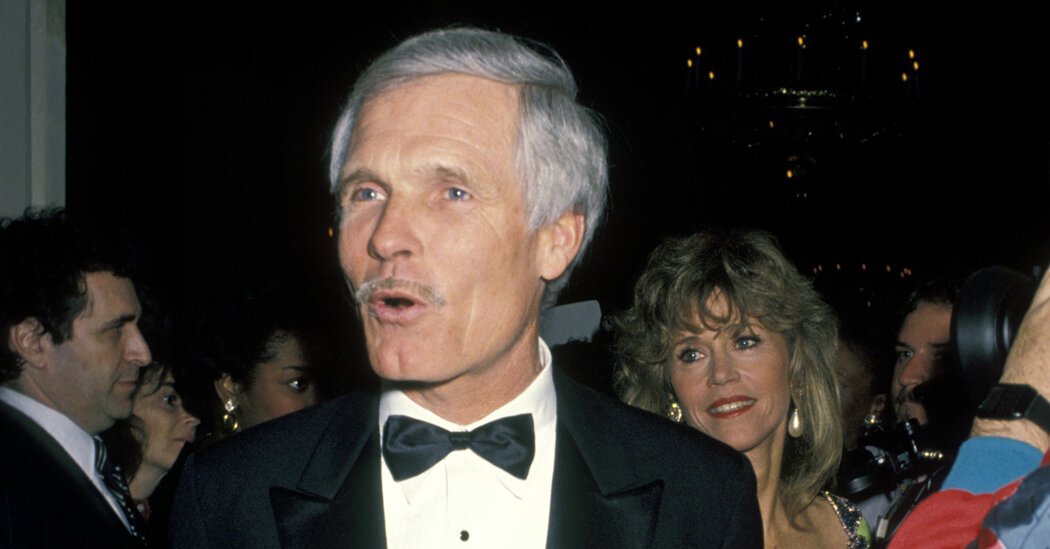
A woman I knew dated Ted Turner. (Before Jane.) I was fascinated. Did that kinetic kingpin ever sleep? Did “the Mouth of the South” churn with bulletins 24 hours a day, like his amazing creation, CNN?
Ted rested sometimes, she assured me. But he was a character, she said, recounting the story of the first time she visited Turner at his home in Georgia.
As she got out of the car and walked toward the door, Turner swept out to greet her. He was dressed like Rhett Butler and was playing the music from “Gone With the Wind.” He scooped her up in his arms and carried her inside.
Turner was, as his third wife, Jane Fonda, said in a tribute when he died at 87 on Wednesday, a “deeply romantic, swashbuckling pirate.”
His idol was the ultimate cinematic swashbuckler, Clark Gable’s Rhett Butler. (Turner named one of his sons Rhett.)
“Ted bought MGM so he could own ‘Gone With the Wind,’” Fonda told me in a 2020 interview. “I mean, ‘Gone With the Wind’ — he lives by that. ‘The land is the only thing that matters, Scarlett. The land is the only thing that lasts!’ That’s why he owns two million acres, because of Scarlett O’Hara.”
When Turner created Turner Classic Movies in 1994 — I will always love him for that — he introduced it with his favorite movie, the same way he introduced the TNT network six years earlier.
“He recited lines from ‘Gone With the Wind’ a lot,” Fonda recalled. “He was obsessed with Scarlett O’Hara. You know the painting from the movie, the great big painting with Scarlett? He owned it.”
I asked Fonda if he had ever cosplayed as Rhett with her, and she laughed.
“No,” she said. “However, one day when we were driving to one of his ranches in his Jeep over the bumpy roads and my brother and his wife were with us, he suddenly stopped the car and got out and pulled me out and grabbed me in his arms and sang, ‘Don’t Fence Me In.’”
Turner was a wild man. He was known for giving friends tours of his Flying D ranch in Montana, pointing out all the places that he had made love with Fonda over the years.
He once told me how, during an earlier marriage, his doctor had advised him and his wife to cut back on drinking and confine themselves to one cocktail a day. “I stopped on the way home and bought the biggest glasses I could find,” he said, roaring with laughter.
He had stumbles, of course, as he pursued his supercalifragilisticexpialidocious dreams. He roiled Hollywood royalty when he colorized some of the old black-and-white classics, like “Casablanca,” “42nd Street” and Frank Capra’s “It’s a Wonderful Life.”
I covered a congressional hearing on the blasphemy in 1987 where Woody Allen and Ginger Rogers showed up to vociferously object. Allen called the practice “sinful” and Rogers read a statement from Jimmy Stewart charging that the colorization of “It’s a Wonderful Life” had turned the movie into “a bath of Easter egg dye.”
Turner himself was so colorful that he probably couldn’t imagine life, or art, confined to black and white. But he backed off. Turner created TCM, a cherished cable channel dedicated to film preservation, after acquiring the MGM film library. (By the way, Woody Allen and Ginger Rogers are ubiquitous on TCM in glorious black and white.)
Despite his sins — including philandering, bigoted remarks and public misbehavior — his flair, imagination and tenacity (he named one of his champion yachts “Tenacious”) were irresistible.
I love the story about how, when he first conjured CNN, he often slept on the sofa in his office in Atlanta to get the unlikely enterprise going, wandering into the newsroom in his bathrobe and eating out of vending machines or in the cafeteria.
The first all-news, round-the-clock channel began to click during the Persian Gulf war of 1991. During the bombing of Baghdad, President George H.W. Bush groused, “I learn more from CNN than I do from the C.I.A.”
Unlike today’s greedy and soulless tech billionaires, Turner had fun being rich. The lords of the cloud aren’t swashbucklers; they just are buckling to President Trump.
Even though his father’s crippling debts in his billboard business helped drive him to suicide, Turner never seemed to worry about skydiving into debt. He bought the Atlanta Braves, promoting the team with wet T-shirt contests, and later he taught Hanoi Jane how to do the tomahawk chop. (His right-wing politics had mellowed by then and so had he, once he began taking lithium.)
He learned to sail and became “Captain Outrageous,” the dashing winner of the America’s Cup race in 1977 with his yacht “Courageous.” (The man was so competitive that when his first wife was beating him in a yacht race, he rammed his boat into hers. The marriage ended shortly thereafter.)
He was generous — another quality missing from many modern plutocrats. In 1996, at his friend Tom Brokaw’s urging, I called Turner to write a column on a pet peeve of his: the parsimony of fellow billionaires like Bill Gates and Warren Buffett.
Turner had, two years earlier, forked over $200 million to charity. He told me that he empathized with the fear of giving away so much money that you would fall off the Forbes 400 list of wealthiest Americans.
But he challenged his peers — or “ol’ skinflints,” as he called them — to shut down that fear and open up their purse strings.
He suggested a list focused on who did the giving rather than the having, proposing an “Ebenezer Scrooge Prize” to embarrass stingy billionaires and a “Heart of Gold Award” to honor the biggest givers.
“Scrooge felt a lot happier when he saved Tiny Tim and bought the turkey for the poor family, right?” he said. The column I wrote spurred Michael Kinsley, then the editor of Slate, a pioneering online magazine, to start the Slate 60, a list of the most generous philanthropists. The following year, he donated $1 billion to the U.N.
I actually got to meet the voracious visionary once at a dinner at Brokaw’s apartment in New York. He came with Fonda and brought everyone Braves caps.
He told us that he had thought of a way to win his rivalry with Rupert Murdoch. The two moguls both bought baseball teams — Murdoch’s Fox Group acquired the Los Angeles Dodgers in 1998 — and forged powerhouse media empires.
“I could get off my lithium, do away with Rupert, plead not guilty by virtue of insanity, get acquitted, and then get back on my meds,” he said with a big grin.
A couple of decades later, they ended up settling their feud more peaceably, over lunch at Ted’s Montana Grill in Manhattan.
Turner died of Lewy body dementia. My brother died of that, too, and it’s a horrible way to go.
But, oh, how Ted Turner lived!