Imagine that 10 acres of land in the middle of your city was unbound from the laws that limit housing construction. No zoning. No neighborly lawsuits. No reviews by the Department of You Can’t Build That or its sister agency, the Department of Slow Down.
It sounds like a wand-waving, deus ex machina solution to the housing crisis that is gripping North American cities. But it is happening right now, and in one of the most unlikely places imaginable: Vancouver, British Columbia.
Vancouver, a charming port city on the southwestern corner of the Canadian mainland, has the dubious distinction of being, by many measures, North America’s least affordable urban area. More than New York or Los Angeles, it is the place that has failed most spectacularly in the basic work of building enough housing.
It is also the host to a singular development. The Canadian government has returned 10 acres in the middle of Vancouver to the Squamish, the First Nation whose ancestors lived there. On that land, the Squamish are building the densest residential neighborhood in the country. It’s called Senakw, after a village that once stood in roughly the same place, and it will eventually include 6,000 homes in 11 towers. The first tenants moved in at the end of May.
Senakw, by itself, will make a modest dent in Vancouver’s housing crisis. The city estimates that it needs 83,000 new homes by 2033. Its importance, however, extends beyond the unit count. Senakw’s striking presence on the Vancouver skyline is a rebuke to the surrounding city, and a constant reminder that the thing preventing us from building is … us.
Cities have largely lost the power to say yes to construction. To prevent officials from acting against the public interest, we have drained them of the power to act in the public interest. Every decision can be appealed, every complaint must be heard, every objection weighed. We are so committed to fairness that we have lost sight of the unfairness of doing nothing.
Freed from Vancouver’s rules, the Squamish are providing the city’s residents with a chunk of the housing they so desperately need. Other cities ought to be taking notes.
The housing crisis gripping the United States and Canada is a story in two acts.
Older coastal cities such as Vancouver and New York imposed strict limits on housing construction beginning in the 1960s. Those cities still allowed shiny new skyscrapers in central areas, which obscured the fact that the rest of the residential landscape was frozen in time. People moved away, in their millions, to Sun Belt cities such as Dallas and Atlanta.
Then the second act: Home construction in the Sun Belt all but shut down during the 2008 financial crisis and never fully rebounded. In 2025, builders started just 78 percent of the number of homes that they had started in an average year in the decade before the crisis. Housing experts estimate that the United States needs two million to 5.5 million new homes. Canada has an even bigger problem relative to its population. Analysts estimate the country needs some 3.5 million new homes.
The rent is now too damn high pretty much everywhere. But the least affordable places remain those old coastal cities, and Vancouver has a bigger crisis than Los Angeles or Miami or New York. The only place on the continent that compares is Silicon Valley.
One way to judge the depth of a housing crisis is to compare the median household income to the median home price. It’s a measure of how many years of labor are required to buy a house, and anything more than three years is generally considered unhealthy. For the United States as a whole, the number in 2024 was 3.9 years. For the New York area, it was about 7.4 years. For Vancouver, it was 11.8 years.
In 2018, the provincial finance minister described Vancouver as a city of “seniors living out of their cars, families sharing one-bedroom apartments and young workers leaving our province because they saw no future here.” The situation has not improved.
Housing prices are high because many people want to live in Vancouver. It’s a beautiful city with a strong economy, and it has long been a destination for Chinese immigrants and investment. Geography also limits construction. There are mountains to the north, an ocean to the west and another country to the south.
The biggest problem, however, is that Vancouver is a city of single-family homes. It has a formidable downtown skyline but, seen from the sky, the vast majority of the land is devoted to houses with moats of grass.
“It’s an extraordinary misuse of land in a city where prices and rents are so high,” said Alex Hemingway, senior economist at BC Policy Solutions, a progressive Vancouver think tank.
Vancouver, like most cities, prioritized the interests of homeowners at the expense of everyone else — the workers struggling to afford housing, the people who might come if housing were more affordable, the homeowners’ children, who will have to move elsewhere.
It works hard to prevent the replacement of houses with apartment buildings. Sometimes it even replaces apartment buildings with houses. There is an eight-unit apartment building a few blocks from Senakw on the verge of falling down. Under the city’s land-use laws, however, it cannot be replaced by a new eight-unit apartment building. A developer has proposed building three mansions instead.
Kitsilano Indian Reserve No. 6 didn’t last long. In 1877, British Columbia told the Squamish that they could keep and live on roughly 80 acres of land on the southern bank of False Creek, across from what was then the southern edge of Vancouver. In 1913, the government relocated the remaining residents to less valuable land north of the city and burned their houses to make room for more Vancouver. The Kitsilano reserve became the neighborhood of Kitsilano, where homes now sell for millions of dollars.
Almost a century later, in 2002, a Canadian court ruled that the original land still belonged to the Squamish. This was not just a land acknowledgment. Canadians take the idea that something is owed to the First Nations rather more seriously than their neighbors to the south. The government agreed to pay the Squamish 92.5 million in Canadian dollars (about $66 million at today’s exchange rate) in compensation for the land beneath the neighborhood — and to return to the Squamish 10 acres that had been used by a defunct branch of the Canadian Pacific Railway.
The current generation of Squamish, raised on stories of the old Senakw village, now had the chance to build anew. They could have built single-family homes. They could have built office towers or a shopping mall. They ultimately decided to build a better version of Vancouver.
The decision was shaped by the youngest leader in the nation’s modern history, a 28-year-old named Khelsilem, who in 2017 led an election slate of nine candidates, the “new nine,” in a successful bid to take control of the Squamish nation’s governing council. A queer mural painter who taught himself to speak the Squamish language and then led an effort to revive its use, Khelsilem, who goes by one name, was both proudly Squamish and also very much at home in the city that sits on the tribe’s ancestral lands. Rather than viewing urban density as an environmental problem — as something to limit or to escape — he saw urban density as a solution for a wide range of environmental, economic and social challenges.
People living in cities use far less energy, per capita. They drive less; their apartments require less heat. Urban concentrations of people also are fertile ground for ideas to grow into businesses. Collaborators, workers and investors all are readily at hand. And cities facilitate social interactions. Young people flock to Vancouver to find themselves, and partners.
Developers seeking to work with the Squamish initially proposed a project that looked a lot like downtown Vancouver. The buildings were stumpy, with giant parking decks. It was as if the city’s builders could not imagine what it might mean to be free of the city’s restrictions. Khelsilem urged them to try again.
“We were breaking a glass ceiling, especially in terms of the scale of the development and showing what is possible when you’re not constrained by the land-use process,” he said.
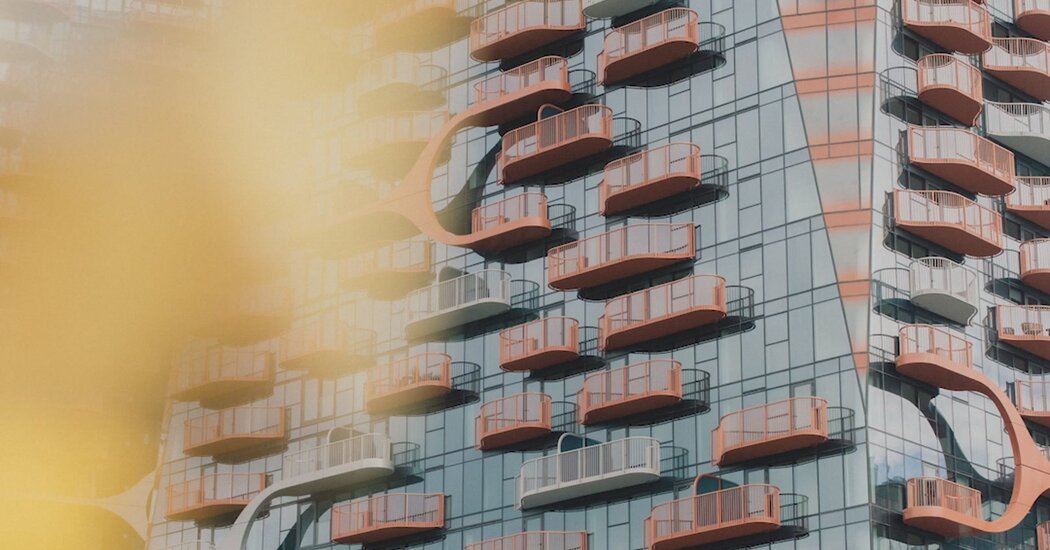
The result was a project with more than 6,000 housing units in towers as high as 58 stories — and only a few hundred parking spots. The first three towers have created a new skyline to the south of the city’s downtown, their profiles meant to evoke the mountains that rise to the north of the city. Some of the planned skyscrapers are designed to evoke long houses turned on end; others have decorative facades that evoke the salmon in the rivers. The project will also be carbon-neutral once completed, using a new system that will recover heat from the city’s sewer mains, which run beneath the buildings.
The reddish, textured faces of the buildings are visible from much of the city. It is a critique of Vancouver as it exists, and a vision of what it could be. Khelsilem calls it a manifesto.
“Our society is grappling with some challenges and we have an expression of what the solution is,” he said. “We think that building housing is part of the solution. We think net zero is part of the solution. We think a car-light development is part of the solution. We think building a sense of place and community is part of the solution. It’s us saying to the world that we want to be part of the solution.”
Most North American cities could use a Senakw. Or several Senakws.
The contrast between the striking new towers and the single-family homes in the adjacent Kits Point neighborhood offers an object lesson in just how large the gap has become between the existing fabric of our urban neighborhoods, and the cities that would emerge on the very same land if those homes — and rules — weren’t standing in the way.
Senakw “is literally what the market wants,” said Thomas Davidoff, a professor of real estate finance at the University of British Columbia who supports the project.
The tension, of course, is that the cities are governed in the interest of their homeowners, and those homeowners do not want their neighborhoods to change. They especially do not want skyscrapers next door. When plans for Senakw were unveiled, Gordon Price, a former member of Vancouver’s City Council, memorably insisted that the Squamish were taking revenge. “It’s basically, ‘You [expletive] us, now we [expletive] you,’” he told the CBC. He went on to complain that high-rises did not reflect “an Indigenous way of building.”
The slightly more sober-minded residents of the adjoining neighborhoods registered the more traditional objections. They said Senakw was too tall and too dense. They sent protest letters to Queen Elizabeth II. (In Canada, complaints about federal land are still addressed to the British sovereign.) They sued to prevent the city from signing an agreement to provide services. None of it worked. Senakw’s special legal status protected the project.
The takeaway for other cities is not that developers should have free rein to build skyscrapers. Senakw is subject to the laws of the Squamish. In designing the project, the nation’s leaders weighed most of the same concerns that Vancouver considers in permitting development. The final plans were approved, by a wide margin, in a national referendum held in December 2019.
The biggest difference is that the Squamish did not listen to the neighbors.
The nation’s leaders frankly acknowledge that money was their most important motivation. The project was a chance for the nation to participate in Vancouver’s pre-eminent industry: real estate development. That is exactly how the economy is supposed to work. To paraphrase Adam Smith, it is not from the benevolence of real estate developers that we expect our housing, but from their regard for their own self-interest. The Squamish are going to make a lot of money, and Vancouver is going to get a lot of new housing.
The first three buildings, which are now complete, contain 1,408 rental apartments. A few hundred units are subsidized for lower-income families, including 63 reserved specifically for members of the Squamish nation. The market-rate apartments will also help to make the city more affordable by easing pressure on the existing housing supply.
There are tentative signs that the city is heeding the lesson. Vancouver has moved to reduce its parking requirements and to allow larger buildings in some areas.
“Restrictive zoning has been pushing people farther and farther away from the communities that they love,” said Christine Boyle, a former Vancouver city councilor who is now housing minister for British Columbia. “Senakw is visibly a sign of Vancouver doing things differently.”
Of course, the new towers aren’t in Vancouver. They were built on land that is not Vancouver for people who haven’t been able to live in Vancouver. But less than three miles from Senakw sits a 90-acre parcel called the Jericho Lands. The land is owned by the Squamish in partnership with two other Vancouver-area First Nations, and they are proposing to build more than 13,000 homes, as well as offices and an elementary school.
The Jericho Lands are still part of the city and still subject to its laws. This time, the Squamish must ask for permission to build. Has Vancouver learned to say yes?