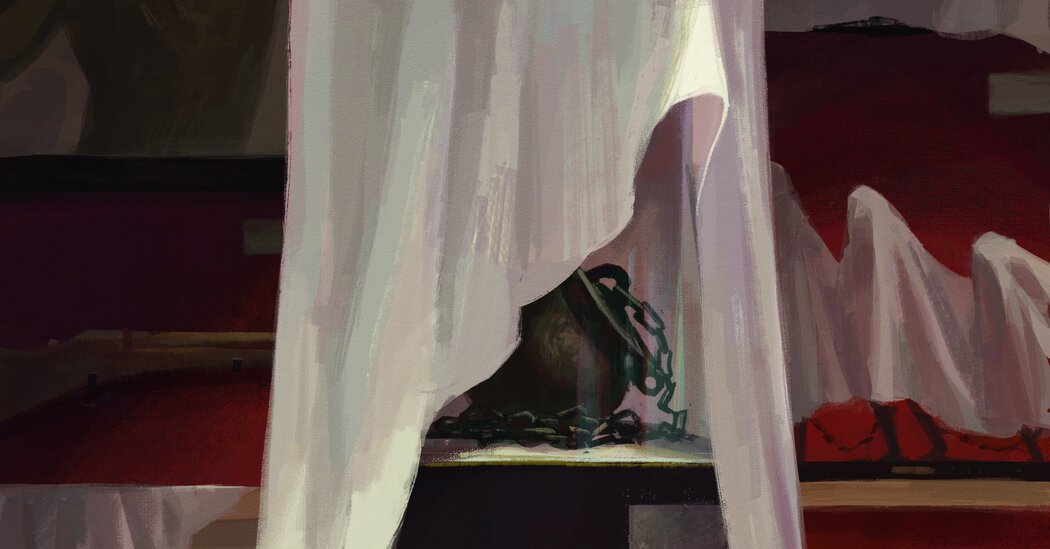
Stevenson has not received any federal or state funding for his sites. The Trump administration, therefore, cannot target them for defunding. But Montgomery exemplifies the conflict at the root of Trumpian memory politics.
I went to Montgomery with my wife, Lynne, and four of my former colleagues from Russia who now live in exile. After a few days there, we drove to Charlottesville, Va., the site of the 2017 Unite the Right rally, during which white supremacists flooded into town, ostensibly to defend a monument to the Confederate general Robert E. Lee, and counterprotesters showed up in droves to oppose their message. Trump — then in the first year of his first term — remarked that there had been “very fine people on both sides.” Today, a bald rectangular patch in an otherwise green lawn downtown is all that remains of the statue, which was removed four years after the rally. The city plans to install a sculpture of a baobab tree there, created from the melted bronze of Lee’s statue. But when I was there, I didn’t see any marker indicating what had happened. The result is a sort of memorial visible only to those who know what to look for, a perfect symbol of both what was and was not accomplished in the nation’s last attempt at a racial reckoning.
Another such symbol is Monticello, Thomas Jefferson’s residence and plantation just outside Charlottesville. All visitors of the house are required to sign up for a tour, a tightly scripted affair that, if you listen closely, bears the signs of numerous edits made over the years. The original narrative is one of progress — precisely the narrative that the Trump executive orders demand. Jefferson was a man of science and a lover of art; he brought progressive political ideas and maps and clocks and advanced engineering and neoclassical architecture and French food to Monticello. But this story is now interrupted repeatedly by inconvenient facts that used to be elided. Jefferson was a slave owner who fathered at least six children of Sally Hemings, an enslaved woman with whom he had a sexual relationship when she was a teenager and he was a middle-aged widower. There’s a separate tour about slavery at Monticello, but the main tour did not acknowledge the tension between the core story and these additional facts. Here is a juxtaposition that stayed with me: Jefferson’s daughter by his late wife lived in the house with him, as did her 11 children, whom she educated in keeping with Enlightenment ideals. The children Jefferson had with Hemings lived in the slave quarters and were put to work on the estate from a young age.
While my fellow exiles and I were traveling in the American South, the campaign against memory continued back in our homeland. Putin’s government had long since shuttered Memorial, an organization devoted to preserving the memory of Stalinist terror; in April of this year, the Russian Supreme Court declared Memorial an “extremist” organization. Two years ago, the government closed the Gulag Museum in Moscow. In June, it was reopened as the Memory Museum, telling the story of Nazi crimes against the Soviet people. The memory of Stalinist terror has once again been ordered obliterated.
Ilya Venyavkin, one of my traveling companions, is a historian of Stalinism. He observed that Stevenson’s project is, in a way, more ambitious than anything Russian memory activists had tried to do: It draws a direct narrative line from the past to the present. It makes the argument that the way we live now is shaped by the way our forebears organized society. This is exactly what can make the project of revisiting the past so vital: It’s not about the past. It’s about choosing our future. Do we want a future that challenges us to reckon with the truth and find ways — genuinely new and inventive ways — to deliver on the American promise, or a future that forecloses the possibility of conversation and change? I suppose there is a third option, too: a future of unease and confusion, of muddled stories like the one I heard at Monticello, of facts half known and truths half said.