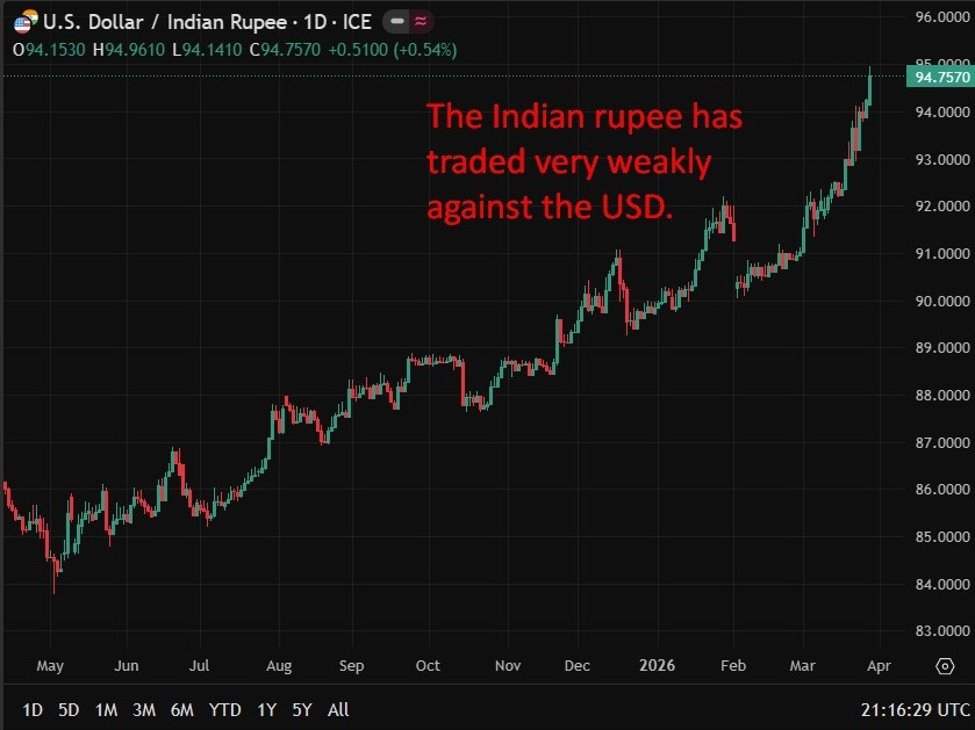
The RBI’s after-hours announcement of FX position caps is being viewed as a form of indirect intervention to support the rupee. While the policy forces short covering and limits speculative pressure, banks warn that rapid implementation could trigger disorderly unwinds and near-term volatility.
Summary:
- The Reserve Bank of India announced new FX position caps after Friday’s market close, signalling a reactive, intervention-style move to stabilise the rupee.
- Banks must cut net open rupee positions to $100m by April 10, effectively forcing short INR reduction and USD selling.
- The rupee hit a record low (94.84/USD), pressured by oil and foreign outflows tied to the Iran war.
- Banks are requesting a three-month transition, warning a rapid unwind could trigger disorderly flows and losses.
- Policy is INR supportive but execution-sensitive, with risk of short-term disruption as positions are adjusted.
Indian banks are pushing back against newly announced foreign exchange restrictions from the Reserve Bank of India, framing the move as a de facto intervention in currency markets that could trigger short-term disruption if implemented too quickly.
The RBI announced after the market close on Friday that banks must cap their net open rupee positions in the onshore deliverable market at $100 million by the end of each business day starting April 10. The timing of the announcement, outside trading hours,s ignals urgency and aligns with a broader effort to stabilise the rupee following its slide to a record low of 94.84 per U.S. dollar.
The currency has come under sustained pressure amid a surge in oil prices and heavy foreign portfolio outflows linked to the Iran war. As a major oil importer, India faces structurally higher U.S. dollar demand when energy prices rise, while capital outflows further amplify depreciation pressure.
Against this backdrop, the RBI’s move is being interpreted by market participants as a form of indirect FX intervention. By imposing strict limits on net open positions, the central bank is effectively forcing banks to reduce short rupee exposure. This creates mechanical demand for the rupee, particularly into daily closes, and constrains the ability of institutions to build large bearish positions. In practical terms, it acts as a cap on USD/INR upside by compelling banks to square positions and supply dollars back into the market.
However, banks warn that the speed of implementation could prove destabilising. Treasury officials from both domestic and foreign lenders have raised concerns that the short compliance window may trigger a disorderly unwinding of existing trades, particularly arbitrage strategies between the offshore non-deliverable forward (NDF) market and the onshore market. These positions are heavily concentrated in the one- to three-month tenor, meaning forced early exits could generate one-sided flows and mark-to-market losses.
Lenders have asked for a three-month transition period or permission to hold existing positions to maturity, arguing that a more gradual adjustment would allow exposures to roll off naturally and reduce the risk of abrupt market dislocation.
The situation underscores the RBI’s balancing act. While the policy is clearly aimed at defending the rupee and restoring orderly conditions, it introduces near-term execution risk. In essence, the central bank is tightening control over positioning rather than deploying reserves directly, but the effect is similar: limiting downside pressure on the currency.
For markets, the takeaway is twofold. The move signals a clear shift into defensive mode from the RBI, but also raises the likelihood of short-term volatility as positions are recalibrated. The policy may slow depreciation and compress speculative pressure, but the underlying drivers—oil prices and capital flows—remain firmly in place.
—
The RBI’s cap on net open positions effectively forces banks to reduce short INR exposure, creating consistent end-of-day demand for the currency as positions are squared. By limiting how large bearish bets can be, it dampens speculative pressure and curbs momentum-driven depreciation, particularly into the close. The move also indirectly increases USD supply in the onshore market, helping cap USD/INR upside. However, while this supports the rupee in the short term and smooths volatility, it does not address underlying pressures such as higher oil import costs and ongoing foreign outflows.