U.S. Secretary of State Marco Rubio outlined a framework aimed at ending hostilities and restoring stability in Lebanon. The proposal attempts to balance Israel’s security concerns with Lebanon’s sovereignty while addressing the longstanding issue of Hezbollah’s military infrastructure.
Rubio said:
- The framework establishes a clear and structured process to restore Lebanon’s sovereignty, disarm Hezbollah, and dismantle its military infrastructure.
- The agreement would enable Israel to return to its borders once the threat to its citizens has been removed.
- The agreement creates a trilateral military coordination group for Lebanon facilities by US
- US will remain fully engaged and committed significant resources, including an immediate $100 million in humanitarian assistance in coordination with the UN.
- Department of war is prepared to reimburse Lebanese Armed Forces with more than 30 million under existing authorities and appropriations
The Lebanese prime minister says Lebanon’s obligation under framework is to extend state authority through Armed Forces over all the territory.
Why the framework matters
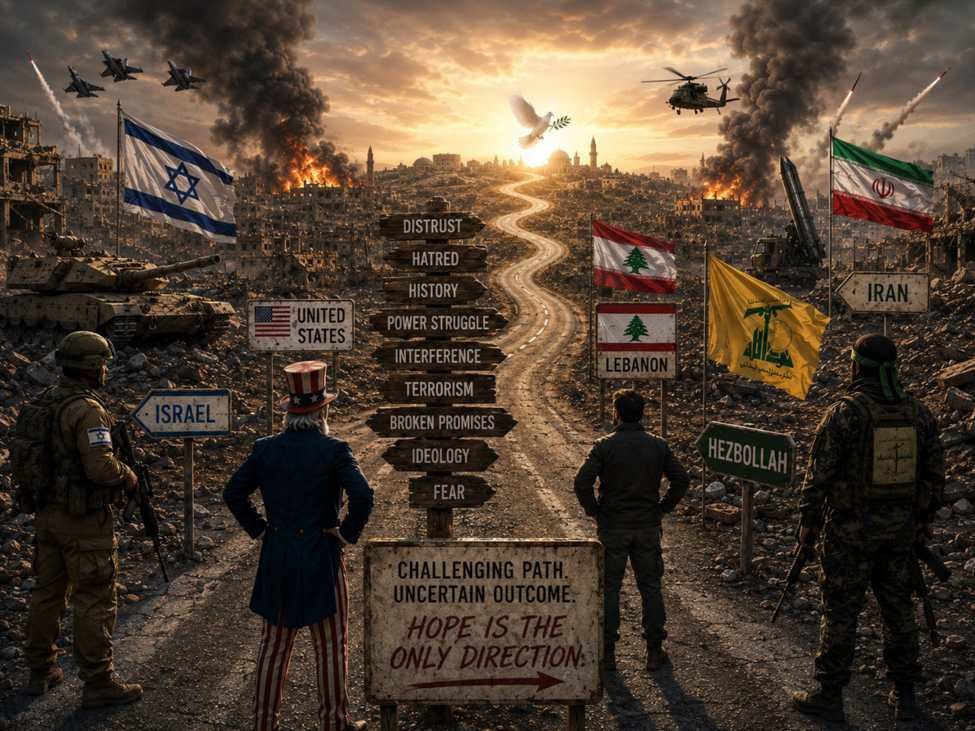
The proposal is one of the clearest indications yet that Washington is attempting to engineer a broader security arrangement between:
- Israel, which insists that Hezbollah’s military capabilities near its northern border must be dismantled before it can fully withdraw.
- Lebanon, which seeks to restore full sovereignty and avoid another devastating conflict.
- The United States, which is trying to broker a durable security arrangement while limiting the risk of a wider regional war.
- Iran, Hezbollah’s principal backer, whose influence over the group’s military and political decision-making remains a central issue.
The biggest obstacle to any agreement remains Hezbollah itself.
In recent comments, Hezbollah’s leadership has made clear that:
- The group does not view its weapons as negotiable absent broader guarantees.
- Hezbollah argues its armed presence remains necessary as a “resistance” force against Israel.
- The organization has signaled that it will not accept arrangements that it perceives as a surrender or an externally imposed disarmament.
This creates a direct conflict with Rubio’s framework, which explicitly calls for:
- The restoration of Lebanese state authority.
- The dismantling of Hezbollah’s military infrastructure.
- The eventual disarmament of the organization.
Israel’s concerns
From Israel’s perspective, any agreement must ensure:
- Hezbollah fighters and weapons are removed from areas near the border.
- Missile and drone threats against northern Israeli communities are eliminated.
- Security guarantees are enforceable and not merely temporary ceasefires.
Israel’s experience following previous agreements, including the implementation challenges surrounding UN Resolution 1701 after the 2006 war, has left policymakers skeptical of arrangements that lack robust enforcement mechanisms.
Iran’s role
Iran’s influence further complicates negotiations.
Tehran views Hezbollah as:
- A strategic deterrent against Israel.
- A critical component of its regional security architecture.
- An important source of influence in the Levant.
As a result, any effort to dismantle Hezbollah’s military capabilities could be viewed in Tehran as a reduction of Iranian regional leverage, making a negotiated settlement considerably more difficult.
There are a lot of dots that need to be connected with any number of actors causing the peace to unravel
What started as US and Isreal vs Iran, has turned into Israel vs Hezbollah, Israel vs Lebanon, US vs Lebanon, Iran vs US and Israel, Hezbollah vs Lebanon.