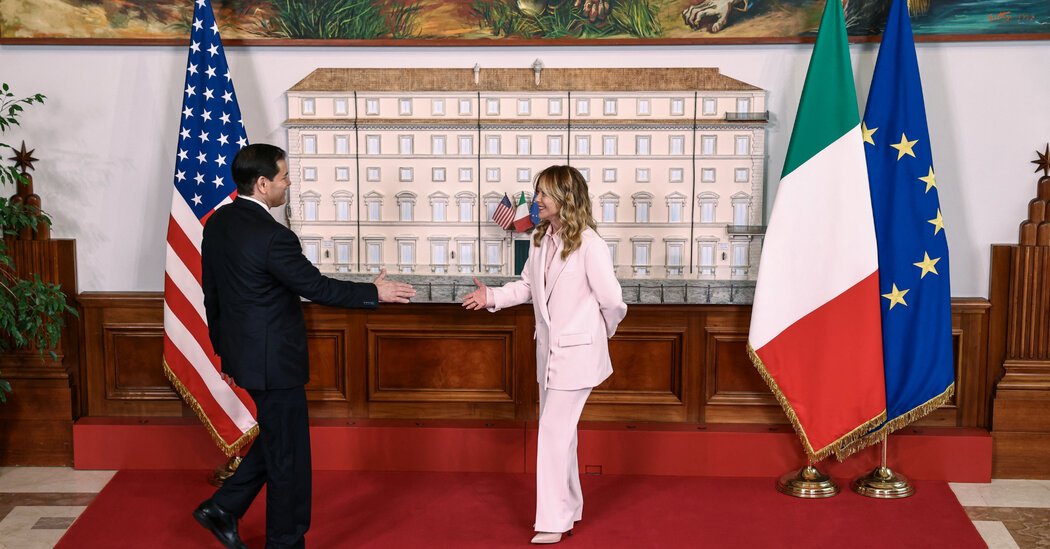
Secretary of State Marco Rubio met on Friday with Prime Minister Giorgia Meloni of Italy, after weeks of deteriorating relations between their governments over the war in Iran and President Trump’s attacks on Pope Leo XIV.
Mr. Rubio, who met with the pope on Thursday, visited Ms. Meloni at the prime minister’s official residence in central Rome, shortly after meeting Italy’s foreign minister, Antonio Tajani, at his ministry.
The discussions followed an unexpected rift between Mr. Trump and Ms. Meloni, who was considered, until the U.S. attacked Iran, to be among the president’s strongest allies in Europe.
With the war deeply unpopular in Italy, Ms. Meloni distanced herself from Mr. Trump and declined to participate in the American-led attacks. She then called Mr. Trump’s broadsides against the pope “unacceptable,” and the U.S. president, who had previously praised Ms. Meloni’s leadership, retorted that she was the one who was unacceptable. “I thought she was brave, but I was wrong,” he said in an interview with an Italian newspaper.
In a statement released as Mr. Rubio arrived at the foreign ministry on Friday morning, the Italian government said Mr. Tajani and Mr. Rubio would discuss “strengthening U.S.-Italian relations” along with the war in Iran, the crisis in the Strait of Hormuz, a cease-fire between Lebanon and Israel, the war in Ukraine, the transition in Venezuela, Cuba, and the procurement of critical minerals.
For months, Ms. Meloni’s previously vaunted friendship with Mr. Trump has become a liability for her in Italy. First, Ms. Meloni struggled to contain a growing backlash after Mr. Trump threatened tariffs on Italian agricultural products.
Then the fallout from the Iran war, which has pushed up energy prices across Europe, further turned the Italian public against the U.S. administration.
With polls showing most Italians opposed to the military campaign, Ms. Meloni made it clear that “we are not at war and we do not want to go to war.”
At the foreign ministry on Friday, Mr. Tajani gave Mr. Rubio a family tree tracing his Piedmontese heritage, though he did not, contrary to some initial reports, give him Italian citizenship, an honor previously bestowed on Argentine President Javier Milei.