
A stunning medical case is raising new questions about what may still be possible for patients suffering from advanced Alzheimer’s disease.
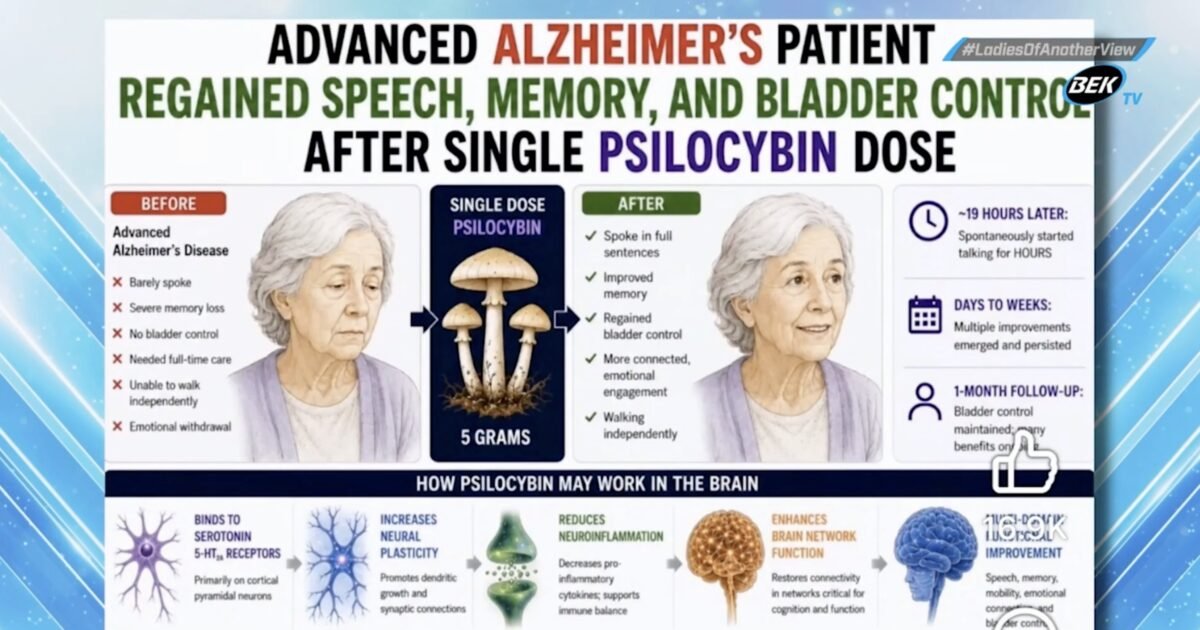
A Japanese-American woman in her 80s who had spent five years barely speaking, unable to walk on her own, and incontinent of urine started talking about her own life again roughly 19 hours after a single oral dose of psilocybin-containing mushrooms, according to a case report published May 28, 2026, in Frontiers in Neuroscience.
The paper, “Transient multidomain functional improvement in advanced Alzheimer’s disease following high-dose psilocybin-containing mushroom administration,” was written by Marcos Lago, Mariana Cerveira, and Joe Xavier Simonet of the Associação Cruz de Ankh in São Paulo, Brazil. It is one patient. It is not a randomized trial. The authors are explicit that the findings “do not imply disease reversal.”
The patient had a clinically diagnosed 10-year history of Alzheimer’s disease, including five years of marked hypofunction.
At baseline she spoke mostly in single syllables. She had chronic urinary incontinence, needed help to walk, could not dress herself, had a flat affect, trouble swallowing, and severe loss of spontaneous communication.
She lived under continuous family and caregiver supervision. Formal biomarker confirmation and advanced imaging were not available, and the authors note that a vascular or mixed contribution cannot be fully excluded.
With her son’s consent, she was given 5 grams of dried Enigma-strain Psilocybe cubensis by mouth. Importantly, that means 5 grams of mushrooms, not 5 grams of purified psilocybin.
The first stretch was rough. Clinicians suspected hyperthermia. She sweated heavily and dropped into a prolonged deep sleep-like state.
About 19 hours later, near 3:30 a.m., she woke on her own and began an autobiographical conversation that lasted roughly four hours. Her son reported memories and reflections nobody around her had heard her produce in years.
Over the following days the team documented changes across several domains, as reported in the Frontiers paper and summarized by New Scientist and Medical Xpress:
- Speech shifted from monosyllables to spontaneous conversation.
- Urinary continence returned after more than five years of incontinence, including overnight, with diapers remaining dry.
- She walked without assistance by day two.
- Within two to three days she was dressing herself and acting on her own initiative.
- She held eye contact, smiled back, recognized family, and retrieved contextual details, asking where a person had gone, recognizing a rented car.
One month later she was still continent and still functionally better than baseline, the authors report.
A second supervised session used 3 grams. During that session she was more verbally expressive, showed more facial expression and spontaneous humor, walked with more agility, and described surfing with her son on a peaceful island. In follow-up she was quoted saying, “It is pleasant to come here.”
No severe persistent adverse effects, prolonged agitation, significant cardiovascular instability, persistent psychosis, or delayed neurological deterioration were reported in follow-up.
The authors still warn that causality cannot be established, spontaneous fluctuations in dementia cannot be ruled out, and they had no standardized cognitive scales, EEG, sleep study, or imaging to pin the mechanism down.
They frame it as residual function that may still be reachable under certain neuromodulatory conditions, not plaques dissolving, not a cure.
The Gateway Pundit reported in April 2026 that President Trump signed an executive order directing the FDA to issue new guidance for clinical trials of psilocybin, ibogaine, LSD, and MDMA, with Joe Rogan present at the signing ceremony.
The order tasked NIH with supporting additional studies, aimed in particular at veterans and PTSD, while the drugs remain Schedule I outside approved research.
WATCH:
This is insane…
An advanced Alzheimer’s patient just REGAINED her memory, speech, mobility, AND bladder control after a SINGLE dose of psilocybin.
There are NO Alzheimer’s drugs capable of doing anything CLOSE to this. https://t.co/m8qzMrNsFk
— Nicolas Hulscher, MPH (@NicHulscher) October 1, 2026
Ad block users: Some site features may not work correctly while an ad blocker is enabled, because they break scripts and content this website depends on. If you can’t see comments below, for example, please disable your ad blocker.