
South Korea’s KB Financial has completed a Proof-of-Concept (PoC) for won-denominated stablecoin as lawmakers and experts push to advance the country’s digital asset framework.
KB Stablecoin Pilot Cuts Fees, Speeds Transfers
On Sunday, KB Financial Group, the parent company of South Korea’s largest bank, announced that it had completed a payment pilot for a won-denominated stablecoin, with electronic payments KG Inicis, Layer 1 blockchain platform Kaia, and digital asset solutions company OpenAsset as partners.
According to local news reports, the PoC integrated the entire financial process into a single workflow, from the issuance of a won-pegged stablecoin to offline payments, merchant settlements, and international remittances. The project allows customers to continue using financial services as before, while the internal settlement system has been migrated to blockchain.
Notably, the real-world payment model was deployed via offline kiosk transactions at a Hollys coffee shop. The system is engineered so that a consumer pays with a QR code without installing a digital wallet, and a blockchain smart contract is automatically executed at settlement.
For international money transfer verification, the model involved converting a won-pegged stablecoin into a dollar-denominated stablecoin using Kaia’s on-chain liquidity, then routing the funds through a local partner in Vietnam to the recipient’s actual bank account.
Unlike the traditional SWIFT method, the entire transfer process was completed within three minutes, and transaction fees were reduced by approximately 87% compared to previous methods, the report noted.
A KB Financial Group official affirmed that the company will work to “provide digital financial services closely integrated into daily life that customers can tangibly experience by combining financial infrastructure—based on proven stability and trust—with blockchain technology.”
The company also revealed that it plans to secure the necessary operational capabilities to launch its services immediately after South Korea’s digital asset legislation and regulations are established.
Digital Asset Act Faces Delay
Stablecoins have played a central role in the country’s digital transformation and dominated South Korea’s policy discussions over the past year. However, the long-awaited legislation set to address won-pegged token rules has been stalled for nearly six months.
For context, the second phase of the Virtual Asset User Protection Act, known as the Digital Assets Act, was initially expected to pass before the end of 2025, but a disagreement between South Korea’s Financial Services Commission (FSC) and the Bank of Korea (BOK) has delayed the framework since December.
The financial regulators have been unable to agree on the extent of banks’ role in the issuance of stablecoins, with the central bank pushing for a consortium of banks owning at least 51% of any issuer seeking approval in the country. The FSC, however, has raised concerns about the proposal, arguing that a majority stake for banks could reduce tech firms’ participation and limit market innovation.
In April, lawmakers urged the National Assembly to prioritize stablecoin legislation and approve the Digital Asset Act, warning that while politicians argue over governance structures, the global market is moving forward.
Similarly, Professor Ahn Soo-hyun of Hankuk University of Foreign Studies stated last week that while global financial leaders complete and revise crypto legislation, South Korea, which accounts for 10% of global digital asset transactions, “is falling behind.”
At a Korea Chamber of Commerce and Industry forum on digital assets, multiple lawmakers, regulators, and experts discussed the state of South Korea’s stablecoin framework, with some participants calling it a “critical juncture” for the country’s efforts to regulate the sector.
Meanwhile, Bank of Korea Deputy Governor Chang Cheong-soo stated, “I believe the won-pegged stablecoin could serve as a complementary and competitive payment method in future monetary systems, playing a role in virtual asset transactions and cross-border payments.”
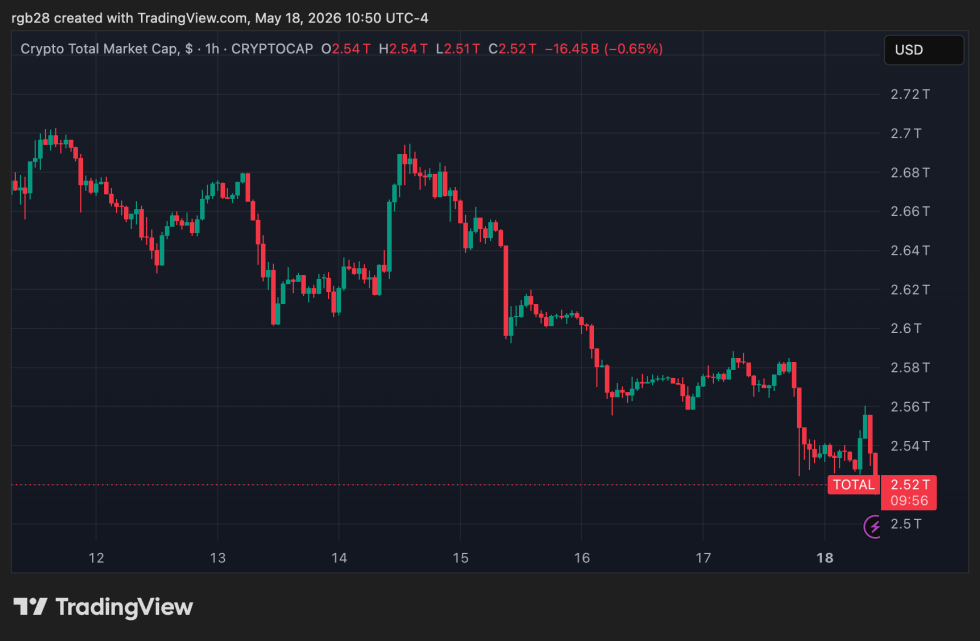
The total crypto market capitalization is at $2.52 trillion in the one-week chart. Source: TOTAL on TradingView
Featured Image from Unsplash.com, Chart from TradingView.com
Editorial Process for bitcoinist is centered on delivering thoroughly researched, accurate, and unbiased content. We uphold strict sourcing standards, and each page undergoes diligent review by our team of top technology experts and seasoned editors. This process ensures the integrity, relevance, and value of our content for our readers.