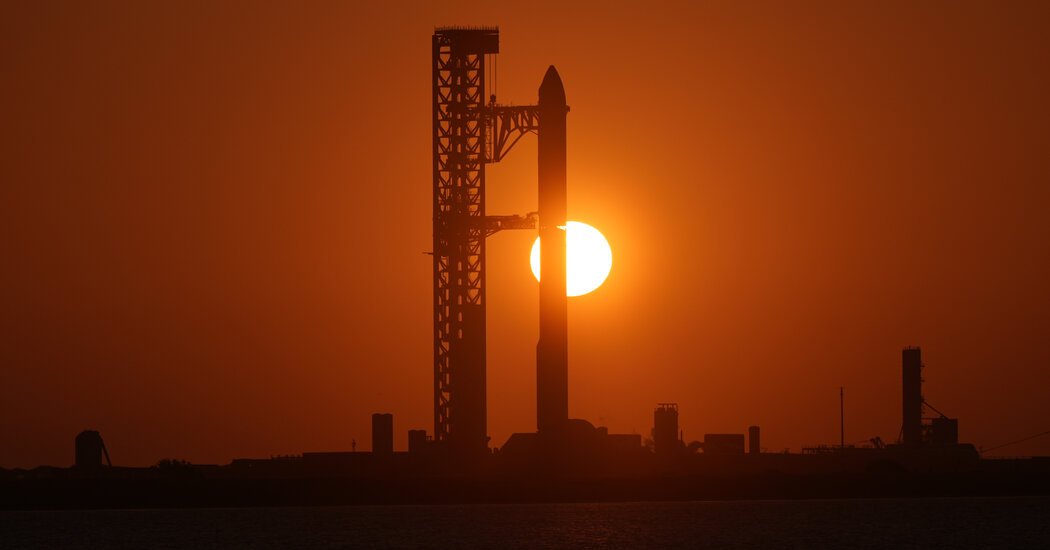
After a last-minute problem with the launch tower that derailed Thursday’s launch attempt, SpaceX’s Starship launched at 6:30 p.m. Eastern time on Friday from its Starbase site in southern Texas, outside Brownsville.
The upper-stage spacecraft successfully made it to space and is now coasting on a path that will lead to re-entry over the Indian Ocean at around 7:30 p.m. The rocket booster, known as Super Heavy, successfully performed its main task of pushing the upper-stage spacecraft to space. One of the 33 engines on the booster failed during the upward journey.
Subsequent engine burns needed to bring the Super Heavy back for a soft return did not work as expected, and video from the booster as it returned it to Earth showed it descending quickly and apparently crashing into the Gulf of Mexico.
On the upper-stage, one of the six engines did not work. The other engines fired longer than usual, and it was able to make it to space.
It is the 12th test flight of Starship and the first launch of a major new iteration of the vehicle, known as Version 3. SpaceX officials have described it as almost a different rocket, incorporating numerous changes designed to improve reliability and performance.
As it was coasting above Earth, Starship deployed 20 dummy versions of its next-generation Starlink satellites. In addition, two modified versions of the current Starlink satellites were also deployed, which included tests of upcoming technology and also cameras to capture pictures of Starship as it moves through space.
Because of the problems with the upper-stage, SpaceX skipped a planned relight of one of the engines. That is a maneuver that will be needed for future orbital missions to drop out of orbit.
The stakes are high for SpaceX, which aims to sell shares in an initial public offering as soon as next month, and for NASA, which plans to use Starship as a lunar lander to take astronauts to the surface of the moon in a couple of years.
How can I watch the flight?
SpaceX is providing live coverage of the test flight on its website, which you can watch in the player above.
What will happen during this test flight?
The flight plan largely repeats what the last test flight accomplished. After lifting off from Texas, it will travel halfway around the world, with its journey ending in the Indian Ocean a bit over an hour after launch.
“The flight test’s primary goal will be to demonstrate each of these new pieces in the flight environment for the first time,” SpaceX said on its website.
What is Starship?
Starship is the largest and most powerful rocket ever built. Mr. Musk has said that it will be fully reusable, with both stages returning to the launch site to be caught by giant mechanical arms.
If SpaceX pulls off this vision, Starship could revolutionize the space industry, enabling launches of bigger, heavier satellites and other cargo at lower costs.
The 40-foot-tall vehicle consists of an upper-stage spacecraft, also called Starship and often shortened to Ship, and a powerful booster stage with 33 engines, known as the Super Heavy.
Why hasn’t SpaceX launched any Starships since October?
SpaceX has been busy not only developing Version 3 of Starship, but also building a brand-new launchpad. That has taken longer than Mr. Musk anticipated. (About 11 weeks ago, in early March, he said the launch was about four weeks away.)
Five launches that took place last year were of the Version 2 Starship vehicle. SpaceX incorporated improvements from the first round of launches in 2023 and 2024.
In November 2024, during the sixth test flight of the first version of Starship, the upper-stage spacecraft survived re-entry over the Indian Ocean and slowed to a hover over the water as if it were landing.
SpaceX hoped that Version 2 would allow it to build on the successes of Version 1, including a demonstration of transferring oxygen and methane propellants from one Starship to another. Because it is so big and heavy, Starship burns up almost all of its propellants to reach orbit. Refueling is necessary before it can head to more distant destinations, like the moon.
But in January 2025, the seventh test flight, and the first of a Version 2 Starship, disintegrated as it headed into space.
The eighth test flight also failed. The ninth made it into space but disintegrated during re-entry. The 10th and 11th were successful but essentially just repeated what the Version 1 Starships had accomplished a year earlier.
SpaceX was aiming to launch on Tuesday, but an accident at Starbase may have contributed to pushing back the schedule by another couple of days.
On May 15, Jose Luis Bautista, a 25-year-old worker at Starbase, died after falling eight feet off a scaffold, Mary Esther Sorola, a justice of the peace for Cameron County, said in an interview.
The preliminary autopsy report indicated that he suffered from blunt force trauma from the fall, she said.
The federal Occupational Safety and Health Administration is investigating the incident. SpaceX did not respond to a request for comment.
What’s new with this version of Starship?
In a post on its website, SpaceX described a long list of improvements, including a new version of the company’s Raptor engines that is more streamlined in design and lighter but also more powerful. The plumbing, thermal protection and power systems around the engines in the Super Heavy booster have also been redesigned.
On the booster, there are now three larger grid fins, which help guide the booster during its re-entry through the atmosphere, instead of the four fins on earlier boosters.
On the upper-stage spacecraft, improvements include hardware that will be used for docking and for transferring propellants from one Starship to another.
Will this Starship go into orbit, finally?
By design, all of the Starship test flights so far have followed a suborbital trajectory. Although the rockets reached speeds essentially fast enough to enter orbit, they traveled along elliptical trajectories that intersected with Earth’s atmosphere. That way, if something went wrong, the rockets harmlessly burned up over the ocean.
This 12th test flight will also be suborbital. If that goes well, then the 13th could be the first to go into orbit around Earth.
Will SpaceX catch the booster this time?
The most thrilling breakthrough of the Version 2 Starship was during the fifth test flight, when the Super Heavy booster returned to Starbase and was caught in midair by two large mechanical arms on the launch tower. SpaceX repeated that feat during the seventh and eighth test flights.
On this test flight, however, the booster will not return to the launchpad. Instead, it will simulate a landing over the Gulf of Mexico about 20 miles offshore.
During a future test flight, SpaceX wants to catch not only the booster, but also the Starship’s upper-stage spacecraft after it returns from orbit.
Why is this important for NASA’s Artemis moon program?
NASA hired SpaceX to provide a version of Starship that is to take its astronauts from lunar orbit to the surface of the moon. However, with Starship’s development running behind schedule, NASA raised the possibility that it could switch to a lander from Blue Origin, the rocket company started by Jeff Bezos, the founder of Amazon.
In February, Jared Isaacman, the NASA administrator, announced an overhaul of the Artemis return-to-the-moon program. Instead of trying to land on the moon during Artemis III, that mission will now remain in orbit around Earth so that NASA can practice docking between the Orion spacecraft and one or both of the lunar landers.
NASA is now aiming for that first moon landing to occur in 2028, during its Artemis IV mission. But that schedule is very tight, with little time to investigate and fix problems if Starship suffers another major failure.
Why is this important for SpaceX?
SpaceX, which values itself at $1.25 trillion, is aiming to go public as early as June and could raise $50 billion to $75 billion, in what could be the largest I.P.O. of all time.
Part of that valuation is built on the idea that the company will expand manufacturing and artificial intelligence data centers to space and eventually fulfill Mr. Musk’s dream of sending people to Mars. Starship has been central to that vision, with the company stating in an update this month that changes to this next version of the rocket would allow for the deployment of “orbital data centers, and the ability to send people and cargo to the moon and Mars.”
On Wednesday, SpaceX revealed some of its financial figures and stated that it lost more than $4.9 billion last year. While much of that was because of its heavy spending on A.I., the company also lost $657 million from operations of its space segment, which encompasses its launch business.
Ryan Mac contributed reporting.