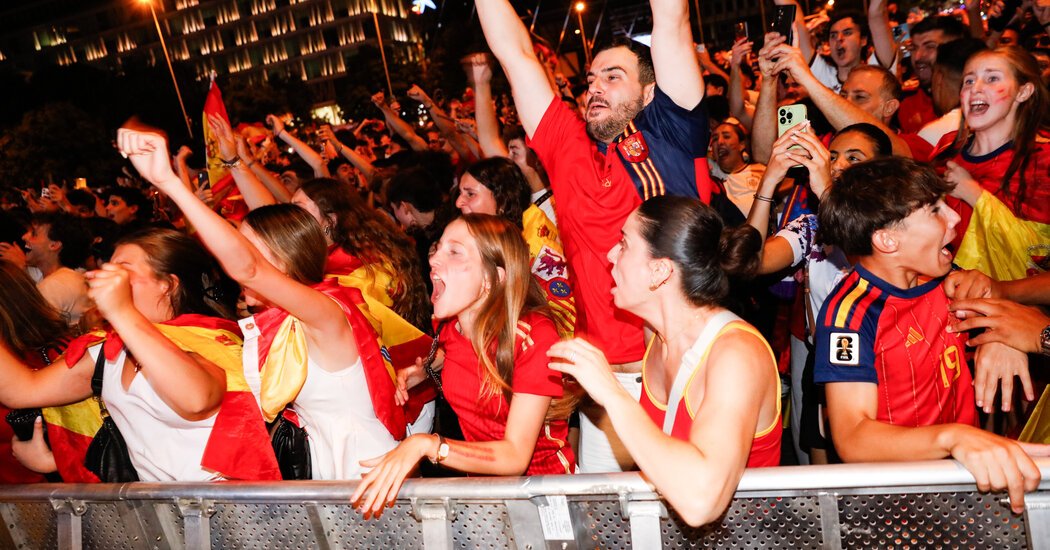
After Spain won the soccer World Cup, Lucía Sánchez joined a boisterous river of fans clad in red-and-yellow jerseys early on Monday in Madrid and took stock of the special time her country was enjoying.
“We’re in a good moment,” Ms. Sánchez, 22, said outside Madrid’s packed Plaza de Colón, as the nearby crowds sang “I am Spanish, Spanish, Spanish.” So many facets of life seemed to be going Spain’s way and “other countries realize that,” she said. “It all goes together.”
By winning the world championship, only three years after their female counterparts did the same, Spain’s men’s soccer team have bolstered the sense that — amid a broader cultural, economic and sports renaissance — something promising is happening in Spain, and that to be here now is to be in the right place, at the right time.
Spain has a housing crisis and its government is embattled with corruption scandals, dampening any unqualified triumphalism. Still, its strong economy is the envy of much of Europe and last year it accounted for more than 40 percent of the jobs created in the European Union. It is far ahead of much of the West in converting to renewable energy, attracting investors seeking to build data centers and other industries hoping to feed off its cheaper electricity.
In the cultural sphere, Spain is also firing on all cylinders. Spanish cinema has entered a new and more diverse era, spurring high praise abroad. Javier Ambrossi and Javier Calvo, a former couple known simply as Los Javis, won best-director honors in Cannes this year and received a 20-minute standing ovation, the second longest in the festival’s history. Rosalía, a Barcelona chanteuse, is helping to drive a shift away from English-language songs on Spotify, the music streaming platform.
Foreigners are visiting Spain in ever larger numbers — the government expects a record 100 million tourists this year — and the capital city of Madrid is booming with new restaurants, exhibits, expats and energy. One recent visitor was Pope Leo, who spent a feel-good week in Spain in June and congratulated the Madrid church on scoring a “spectacular goal” as his appearances drew huge crowds. That ended a long period in which the country had received no papal visits, and set off hopes among Spanish Catholics of a spiritual revival.
As other countries turn their backs on immigrants, Spain is also drawing attention, and praise from liberals, because of its government’s efforts to encourage immigration, though not everyone in Spain sees that as a positive. Some soccer crowds have joined in anti-Muslim chants; a former prime minister said France’s diverse team did not have “any French players.” But diversity — embraced by some Spaniards even if scorned by the far right — is increasingly reflected in the national men’s soccer team.
After Spain won, its star player, the 19-year-old Lamine Yamal, a Muslim born to parents from Morocco and Equatorial Guinea, made an Islamic prostration on the field while the defeated Argentine players scuffled with his teammates behind him. Nico Williams, who delivered the game-winning assist and who is also the child of African immigrants, celebrated by giving his gold medal to his Ghanaian-born mother, who crossed the Sahara to reach Spain.
Politically, too, Spain is a standout. Though at home Prime Minister Pedro Sánchez’s inner circle is embroiled in graft accusations, he has emerged as a global liberal darling for positioning the country as a left-wing island amid a right-wing tide.
He has stood up to President Trump over the war in Iran, as well as taking a different stance on migration and other issues. His government was an early and vocal supporter of Palestinian statehood and has long described Israel’s war in Gaza as a genocide, an accusation Israel rejects. (Prime Minister Benjamin Netanyahu of Israel said before the game that he was supporting Argentina.)
For once, the victory put Mr. Sànchez on the same page as the leader of Spain’s conservative opposition, Alberto Núñez Feijóo.
“We are the Champions!” Mr. Sánchez posted after the team won.
“So well deserved. WORLD CHAMPIONS!” Mr. Feijóo wrote on social media, alongside a picture of him in a Spain jersey celebrating in Plaza de Colón.
Public exhaustion with Mr. Sánchez led to a rare note of negativity in the aftermath of the game. The plaza and avenues around Madrid reverberated with unprompted cursing of Mr. Sánchez, which took the form of a soccer stadium chant. Even Ms. Sánchez, who called herself left-wing (and is not related to the prime minister) said she was not a fan.
But the prime minister was far away, attending the game in New Jersey, where he met briefly with Mr. Trump. The American president, who loves nothing more than a winner, has recently changed his tune about Spain. After signs that Spain would increase its military spending, Mr. Trump went from calling Spain a “horror show” run by “bad people” to “very generous.”
Mr. Trump was lustily booed by the Spaniards watching on screens in Madrid after he handed the cup to the team and then lingered awkwardly. The players waited for him to move off to the side before they raised the cup above their heads, but Mr. Trump managed to stay in the shot.
By that time, all of Spain, whether in its packed plazas or broad avenues, ancient cities or immigrant enclaves, was in full celebration mode for La Roja, as the team is nicknamed for its red jerseys.
Some fans, though, exuberant as they were, saw the victory as only a rare spot of good news from a country that could be doing much better.
“Spain doesn’t believe in Spain,” said María Griñón, 38, an airline worker from Estremadura, as she waved a flag and took pictures of celebrating fans in Madrid. She lamented youth unemployment — Spain’s rate is among the European Union’s highest — and a housing crisis exacerbated by high rents and low salaries. “Sports is the thing going well for us,” she said.
Yet for many, such problems were things that were easily forgotten on a night of joy. The jumbo screen in the Plaza de Colón blared “Kings of the world,” and fans climbed lampposts, streetlights, anything that would allow them to pump their fists higher in the air. In Valencia, the eastern coastal city with a love of fireworks, the sky exploded in colors.
“It is the happiest day of my life,” said Marc Sáez, 18, who watched with friends in Valencia before diving back into the crowd to celebrate.
Others there saw the victory as proof of how far the country had come. “We are just the best country in the world,” said Vicente Salavert, 19.
Carlos Barragán contributed reporting from Valencia, Spain.