📬 Would you prefer to receive this information in your email inbox every morning before the markets open in New York? Sign up here.
ONE BIG THING
Airbnb CEO targeted by hackers in AI slop attack
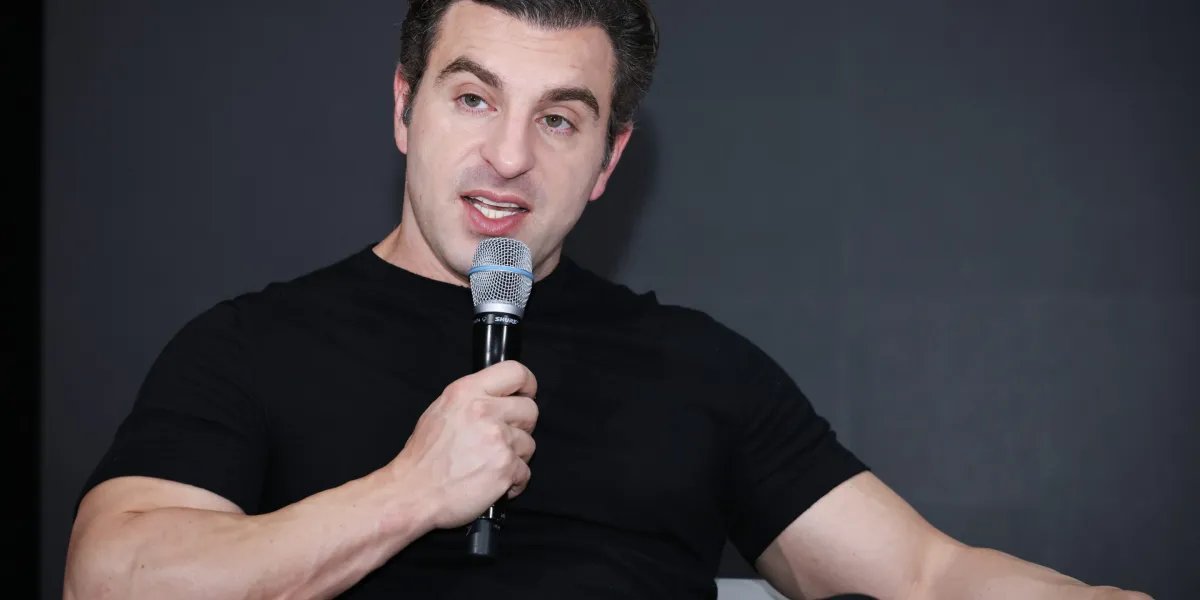
Airbnb cofounder and CEO Brian Chesky appears to have been the target of a cyberattack, a source with knowledge of the situation told Fortune’s Rachel Ventresca. On Monday, Chesky’s X account shared a multi-post thread setting out a bullish view on “real-world asset tokenization,” a term from the crypto world that describes converting traditional assets like stocks into digital tokens.
“I’ve been quietly keeping an eye on real-world asset tokenization for a while now,” the account wrote in the now-deleted series of tweets. “Most of it is noise. But underneath the noise, something real is happening.”
When Fortune analyzed Chesky’s thread through AI-detection tool Pangram, the system flagged it as 100% AI-generated. The posts have since been deleted. Airbnb declined to comment.
The hacked posts were flagged to X and escalated to platform security teams as a “high-profile compromise,” according to correspondence between Airbnb and X employees reviewed by Fortune. X secured the account on Tuesday evening, and Chesky was able to regain access to his account.
THE MARKETS
Tech stocks lead steep global sell-off
U.S. futures were down this morning before the open in New York, following a significant global sell-off across Asia and Europe. There are multiple factors at play, but the triggers included earnings calls from chipmaker TSMC and Netflix, which both disappointed traders. The former lost 2.63% today and the latter was down 9.24% overnight. The tech-heavy Nikkei 225 in Japan and South Korea’s KOSPI took huge steps down over the last 24 hours. The KOSPI (which is closed today) is particularly volatile because half its weight consists of just two stocks, Samsung and SK Hynix, and because the country has allowed retail investors to buy leveraged ETFs that magnify swings in trading.
In the U.S., chipmakers Intel, Micron, AMD, and Marvell all declined in overnight trading in addition to losing ground before yesterday’s close. Investors seem to regard the AI chip business as mostly overbought.
Not helping: The war, obviously. The price of oil stayed in the mid-$80s. “And in the background, fears about rate hikes and more persistent inflation are still there,” Deutsche Bank’s Jim Reid told clients this morning.
- S&P 500 futures were down 0.66% this morning. The index was down 0.51% yesterday.
- In Europe, the Stoxx 600 was down 0.7% in early trading, and the U.K.’s FTSE 100 was flat before lunch.
- Asia: South Korea’s KOSPI was down 6.37% yesterday; the index is closed today. Japan’s Nikkei 225 was down 4.03%. India’s Nifty 50 was up 1.22%. China’s CSI 300 was down 3.6%.
- Brent crude was $84 per barrel this morning.
- Bitcoin was $62.7K.
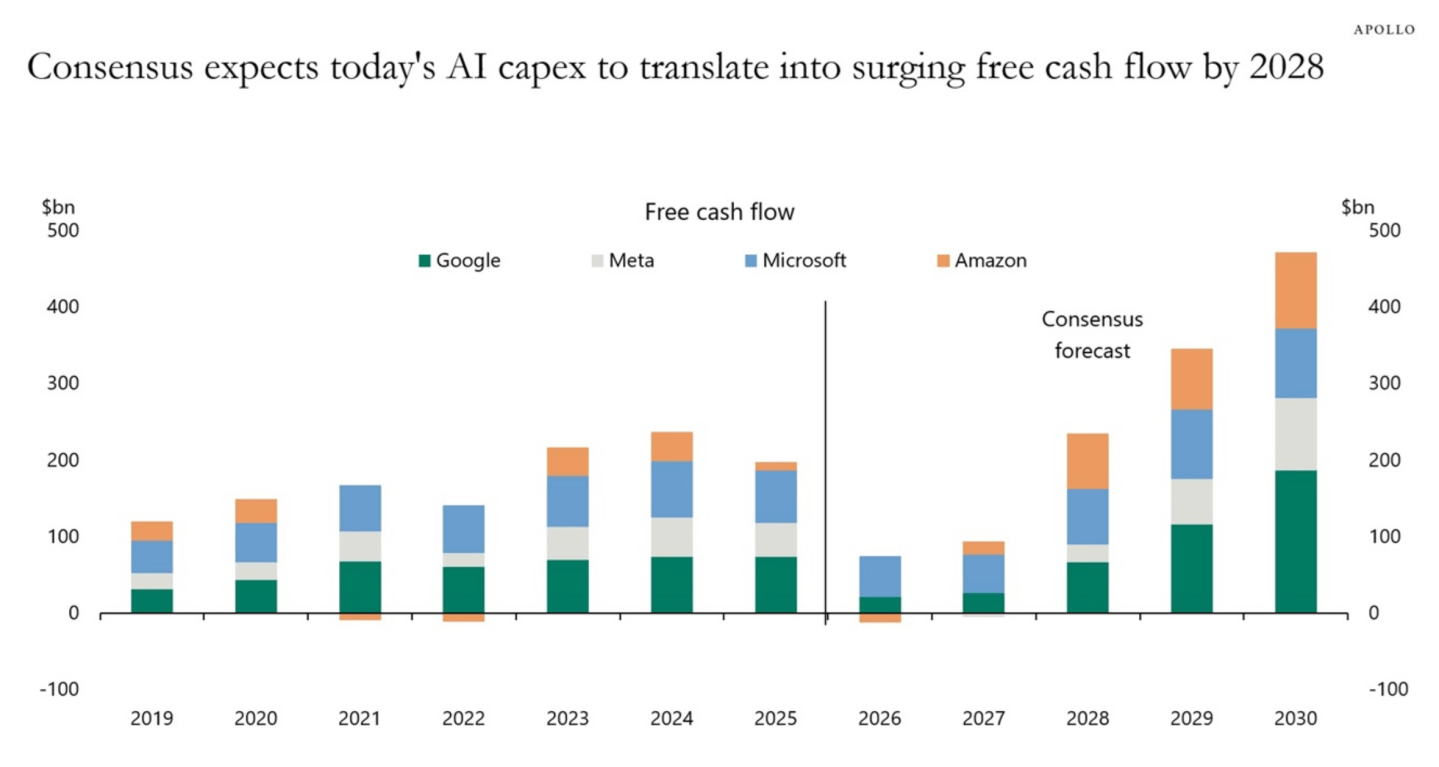
If the hyperscalers get their timing wrong, “it would risk tipping the economy into recession,” top analyst says
Apollo Global Management’s Torsten Sløk is worried that there might be an impending timeline mismatch between capex and free cash flow among the AI hyperscalers. If revenues from the various AI models are not as robust as expected—due to price competition from Chinese and open-source models—then disappointing earnings could drag down the entire stock market, he believes. And if the hyperscalers reduce their data center construction budgets, that could hobble economic growth—without IT-related capex, corporate investment in the U.S. would actually be negative right now.
“The bottom line is that AI has been the one thing holding up both the economy and markets, and with so much riding on so few names, a slower payoff wouldn’t just be a sector problem, it would risk tipping the economy into recession and the S&P 500 into a correction,” he says.
Don’t worry, the S&P 500 will add another 500 points, UBS says
UBS Wealth Management svp Charlie Anderson forecasts that the S&P 500 will hit 7,900 by the end of the year. The reason? Investors are paying closer attention to earnings results and less attention to the headlines. “We’ve gone from a market driven by macro headlines to one increasingly driven by micro fundamentals. That’s a healthier environment for long-term investors because it rewards companies executing well rather than simply benefiting from liquidity,” he said in an email.
MORE FROM FORTUNE
Kevin O’Leary claimed opposition to his Utah data center was fueled by Chinese money. Now he and Fox News are being sued for defamation – Marco Quiroz-Gutierrez
U.S. companies have finally gotten $71 billion in tariff refunds, but they’re using it to offset inflation caused by the Iran war – Sasha Rogelberg
How Apollo-owned Michaels turned two rivals’ bankruptcies into a growth strategy – Phil Wahba
Airbnb CEO Brian Chesky’s X account was hijacked in an AI slop hack pushing crypto tokenization – Rachel Ventresca
Moonshot’s Kimi K3 pushes Chinese AI into Fable-level territory – Nicholas Gordon
IRAN
U.S. extends bombing campaign in Iran to bridges, trains, and airports
The U.S. began bombing civilian infrastructure in Iran last night, the BBC reported, including bridges, a train station, a nuclear power plant, and an airport. Forces also targeted various coastal areas. Previously, the U.S. had targeted only Iran’s military and its political leadership.
Iran retaliated by targeting U.S. radar sites and targets in Oman, Kuwait, Bahrain, Syria, and Iraqi Kurdistan.
- Lurking in the background: The Bab al-Mandeb Strait. This is the other narrow sea passage on the Western side of the Arabian Peninsula that divides Saudi Arabia from Africa. Iran may allow the Houthis, its proxy terror group in Yemen, to harass shipping in that strait and effectively close it too, Al Jazeera’s Tehran-based reporter said this morning.
CHART OF THE DAY
Government debt is bigger today than it was in the Great Financial Crisis—and it’s getting bigger
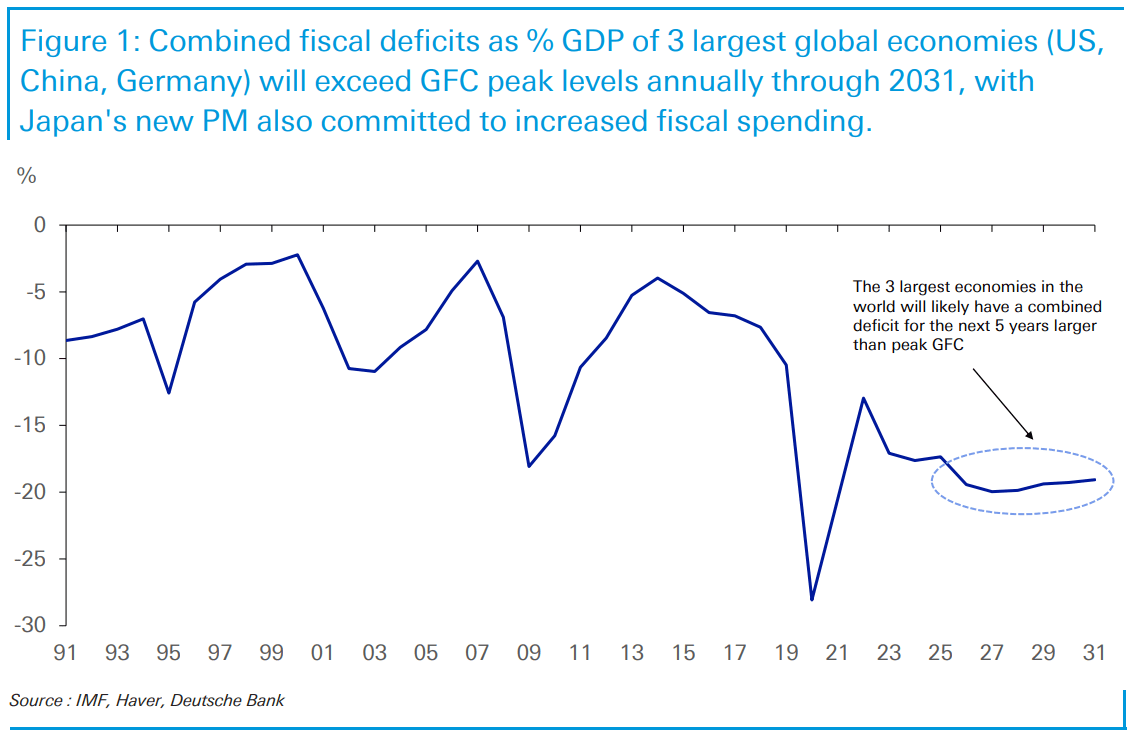
The combined deficits of the U.S., China, and Germany are bigger today than they were at the worst point of the Great Financial Crisis, according to the Deutsche Bank Research Institute. “After years of ever-larger deficits, we’ve become conditioned to numbers that would once have seemed extraordinary. What would have been unimaginable in 2008-09 now barely raises an eyebrow, with numbers previously unseen outside major wars or big recessions,” Deutsche Bank’s Jim Reid says.
NUMBER OF THE DAY
$200 billion
The projected profits of Samsung in 2026, “roughly the same as the combined earnings of all listed companies in India,” according to Herald van der Linde, HSBC’s head of equity strategy/Asia Pacific.
THE FRONT PAGES TODAY
Hotel group Accor hired law firm to investigate conduct of CEO Bazin – FT
World’s largest olive oil company says market has ‘definitively’ entered new phase – CNBC
Trump alleges vast conspiracy to commit and cover up election fraud – Axios
The Inside Story of IBM’s Shocking Profit Warning – WSJ
Trump to Cut US Stays for China Journalists, Risking Retaliation – Bloomberg
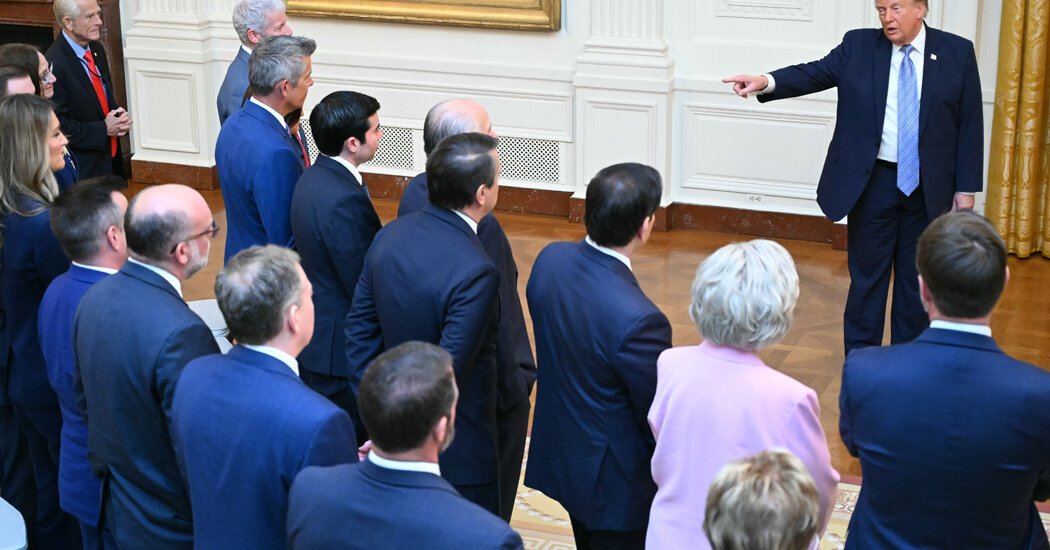
In Prime Time, Trump Criticizes Networks For Not Carrying His Speech – NYT
ONE MORE THING
Congress might be about to stop the clock—literally
The twice-yearly changing of the clocks in the U.S. could be a thing of the past if legislation currently in Congress that calls for permanent daylight time makes it through. But as annoying as some find the back-and-forth of the time shift in the spring and the fall, it doesn’t necessarily mean sticking to one would go over well. America has tried it before, in the 1970s, and it didn’t last, the AP reports.
The bill would keep America on “spring forward” time, which would generate permanently darker mornings but lighter evenings.
Congress tried this same plan in a trial period from January 1974 to April 1975. It lasted until October, when it was repealed after public outcry: “I had to get up for school and it was like it was midnight,” said Kevin Birth, a professor of anthropology at Queens College who remembers it vividly. “It was just pitch black and it remained pitch black into the school day.”