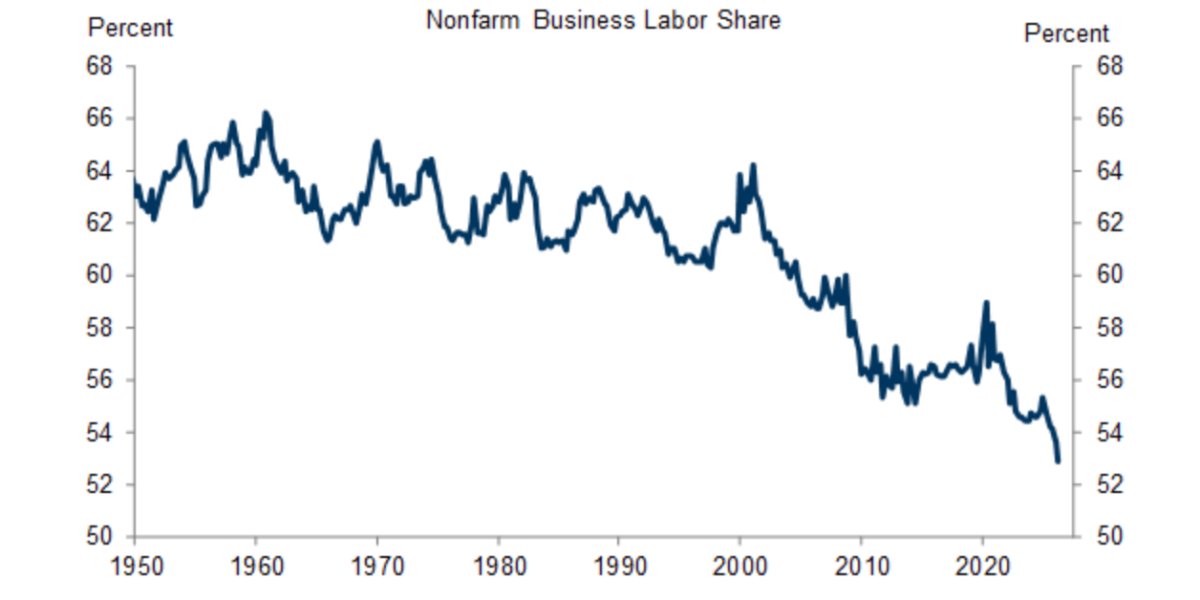
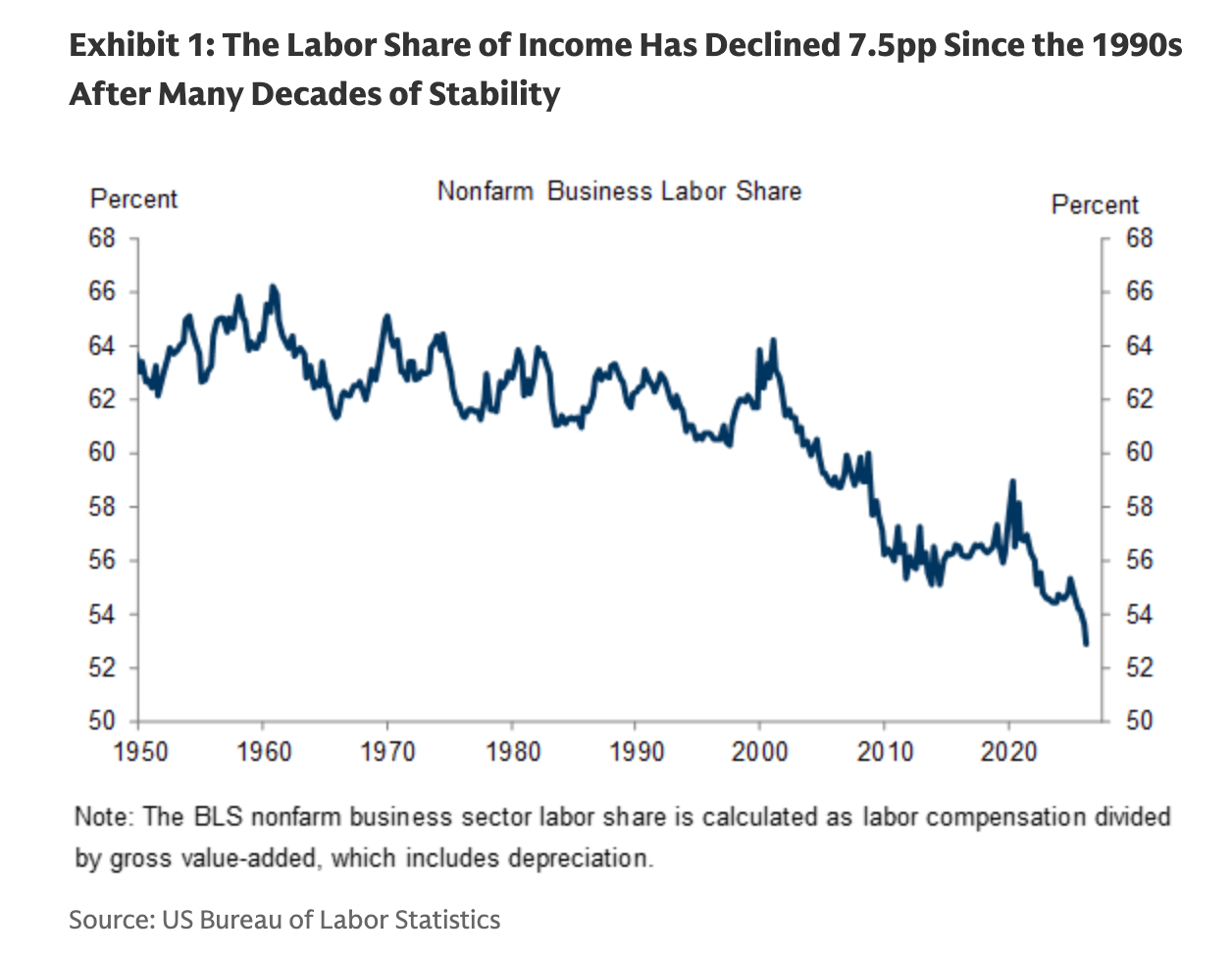
Workers have been taking home a shrinking slice of the American economy for more than three decades, and the headline number is stark: the labor share of income in the nonfarm business sector has fallen roughly 7.5 percentage points since the 1990s, according to Bureau of Labor Statistics data cited in a September 15 Goldman Sachs research note. That decline has accelerated into record territory this year — BLS data released in early September put labor’s share of nonfarm business output at just 52.8% to 52.9% in the second quarter of 2026, the lowest reading since the agency began tracking the measure in 1947.
But according to Goldman economist Abhay Duggirala, much of that decline is not what it appears to be. In a report titled “What Explains the Decline in the Labor Share of Income?,” Duggirala estimates that roughly 40% of the 7.5-point drop reflects measurement quirks in how the government counts wages and profits — not an actual transfer of income from workers to capital owners. The remaining 60%, or about 4.5 percentage points, is real, Goldman concludes, and it traces mostly to rising corporate markups, automation and the decades-long erosion of workers’ bargaining power.
Goldman’s report is also another key piece of evidence in answering a question gripping the 2020s: is the American middle class actually shrinking? The answer, this new data suggests, is yes — but not for the reason most people assume. A wave of cutting-edge economic research — from federal data on income shares to original surveys on how Americans actually spend and feel about their money — is complicating the simple “shrinking middle class” narrative and replacing it with something more unsettling: a picture of an America that has grown genuinely wealthier by nearly every historical measure, yet is struggling to feel it, recognize it, or convert it into the kind of security and status that used to come standard with a paycheck.
The 40% isn’t what it looks like
Goldman’s case for discounting nearly half the decline rests on three accounting distortions, each tied to a real economic shift but not to money actually moving from paychecks to profits.
The first is a tax-driven relabeling of income. Research by economist Matthew Smith and coauthors found that the 1986 Tax Reform Act, which raised the relative tax burden on C-corporations, pushed a wave of business owners into pass-through structures like S-corporations and partnerships. Income that once showed up as wages now gets reported as business profits instead — the same dollars, filed under a different label.
This is precisely the mechanism at the center of economists Eric Zwick and Owen Zidar’s research —and book — on what they call “everywhere millionaires”: pass-through business owners, not celebrity billionaires, who have driven the lion’s share of the growth in top-1% income, aided by tax policy like the now-permanent pass-through deduction that keeps tilting the system toward owner income over wage income. Zwick told Fortune the tax code “places a lot more burden on salaried/wage-rate workers than other types,” pushing activity out of the W-2 bucket at both ends of the income scale: into pass-through business income at the top, and into contract and part-time work at the bottom.
The second distortion involves depreciation. The BLS labor-share measure divides labor compensation by gross value-added, a figure that includes depreciation costs. As computers, software, and other short-lived capital goods have become a bigger share of the economy’s capital stock, the overall depreciation rate has climbed — mechanically dragging down the labor share even though rising depreciation doesn’t mean capital owners are pocketing more net income.
The third is equity compensation. The BLS only counts stock-based pay when it vests or is exercised, not when it’s granted, so the official wage data understates what high earners actually receive as their compensation increasingly shifts toward equity. Some of what looks like capital income is still labor income, just paid in stock, but it overwhelmingly flows to people positioned to get stock benefits, and those aren’t people from traditional middle-class backgrounds.
The remaining 60%, another 4.5 points, reflects genuine structural change, according to Goldman: rising markups tied to “superstar” firms, automation reducing the need for labor, and weakened worker bargaining power from de-unionization and employer concentration. The wealthiest 10% of American households hold the vast majority of corporate equities and mutual fund shares, according to Federal Reserve data, meaning the “superstar firm” profits Goldman credits with driving much of the shift accrue overwhelmingly to a narrow slice of already-wealthy shareholders, not to the broader workforce whose labor share is shrinking. So what does this mean for the supposedly shrinking middle class?
The shrinking and growing middle class
In January, the Congressional Budget Office found the top 1%’s share of income before taxes and transfers doubled between 1979 and 2022, while the middle three income quintiles’ after-tax share fell 6 percentage points over the same period — a straightforward hollowing-out story, driven largely by capital gains concentrating at the very top. But other research complicated that picture.
In April, an American Enterprise Institute report by economists Stephen Rose and Scott Winship found the opposite: the “shrinking” middle class wasn’t falling behind; it was moving up, with the upper-middle-class share of families tripling from 10% to 31% between 1979 and 2024 and median family income rising 52% over the same period. Buried inside that optimistic report was the uncomfortable admission that the combined income share of the upper-middle class and the wealthy surged from 28% of all family income in 1979 to 68% by 2024, with the top 1% roughly doubling its share. Winship’s own verdict, delivered to Fortune: “broad prosperity, unequally shared.”
That is Goldman’s 4.5-point residual, expressed in income-distribution terms rather than labor-share accounting. Where Goldman finds superstar firms capturing rising markups, the same phenomenon also shows up as what Ritholtz Wealth Management’s Nick Maggiulli calls the “upper-middle-class trap” — a cohort earning $200,000 to $400,000 who are “working more and relaxing less to buy products and services of declining quality,” driven into a “financial arms race” for scarce positional goods like elite school zones and premium travel as the ranks of the affluent have swelled. The people winning that arms race are disproportionately the same households whose portfolios are capturing the capital side of Goldman’s ledger — high earners who both draw a salary and hold meaningful equity, as opposed to workers whose only stake in the economy is their paycheck.
Automation, Goldman’s second structural driver, shows as an accelerant rather than a side effect: AI usage climbs from 9% among earners below $30,000 to 34% among those earning over $100,000, forcing high earners into what Maggiulli calls a “Red Queen” dynamic — adopting AI defensively just to avoid falling behind competitors who use it offensively. Goldman’s own note makes the same prediction in blunter terms: “if AI continues to automate many additional tasks,” the labor share “will likely continue to decline.” Whoever owns the companies deploying that automation stands to capture the resulting productivity gains as profit; the workers displaced by it do not share proportionally, because they generally don’t own equity in the firms replacing them.
The disagreement across all of this reporting isn’t really about the data — it’s about which yardstick determines whether that fact constitutes decline. Even by Goldman’s own accounting, a 4.5-percentage-point shift from labor to capital since the 1990s is a real, ongoing redistribution of who benefits from economic growth. The labor share has fallen to its lowest level in nearly 80 years of record-keeping, and Goldman’s own analysts expect AI to push that number lower still — a prediction that lines up precisely with what Maggiulli, Bradley and this magazine’s own reporting have been describing. The households positioned to benefit from that shift are overwhelmingly the ones that already hold the capital being rewarded; the households living on a paycheck are the ones absorbing the difference.
For this story, Fortune journalists used generative AI as a research tool. An editor verified the information’s accuracy before publishing.