In a recent season of “Clarkson’s Farm,” the British TV personality and back-to-the-lander Jeremy Clarkson buys a pub in rural England. Under Clarkson’s shambling yet enthusiastic guidance, the battered old boozer emerges with a new name (the Farmer’s Dog) and a menu of thoughtfully updated British classics made from seasonal, locally sourced ingredients: Lancashire hotpot, gammon steak with bubble and squeak, and pressed ham with piccalilli. And then, amid this abundance of signals that the Farmer’s Dog is a serious dining destination devoted to the highest ideas of ham, comes the exclamation point. Clarkson hangs a kind of house manifesto on the wall:
“Eat at a local restaurant tonight. Get the cream sauce. Have a cold pint at 4 o’clock in a mostly empty bar. Go somewhere you’ve never been. Listen to someone you think may have nothing in common with you. Order the steak rare. Eat an oyster. Have a Negroni. Have two. Be open to a world where you may not understand or agree with the person next to you, but have a drink with them anyways. Eat slowly. Tip your server. Check in on your friends. Check in on yourself. Enjoy the ride.”
Appended to this passage is the name of its author, the god of dining himself: Anthony Bourdain.
More than eight years after he took his own life in a hotel in France, Bourdain is ragingly alive, and his legend — or, rather, his cult — only grows stronger with time, across multiple fronts. There are the TV shows; there are the books; the anniversary editions of the books, the posthumous travel guides; the photographic anthologies and the documentaries; the memoirs of the assistants; the biographies both authorized and unauthorized; the slop anthologies collecting his vital insights into snackable form.
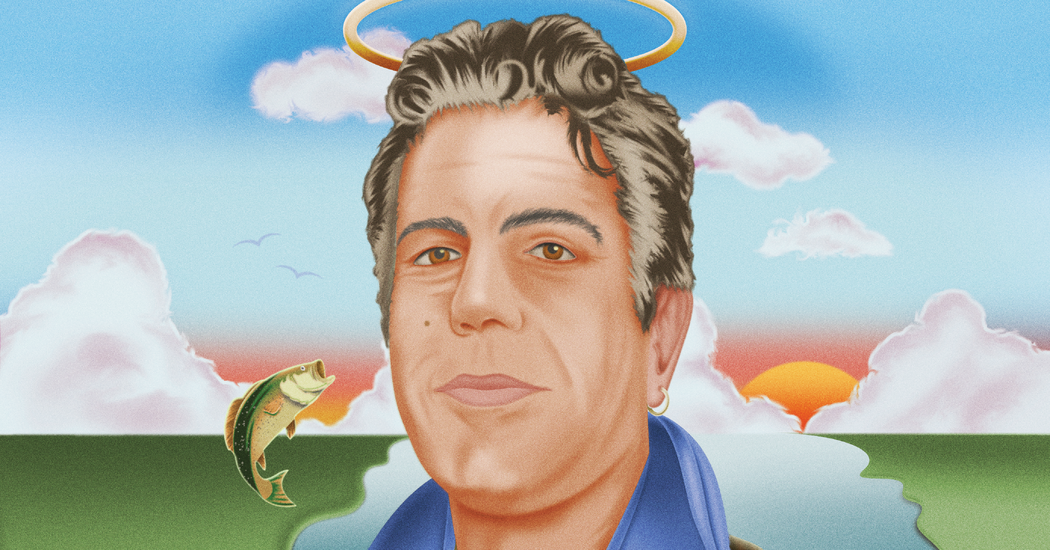
Now comes the biopic “Tony,” which confers on its subject modern America’s ultimate honor — the right to be known by a single name — and presents his late-adulthood celebrity as the stuff of misty, almost biblical, origins: If Bourdain had not tasted a freshly caught striped bass on Cape Cod in the summer of 1974, would history have ever been the same? Would the 18-year-old Tony have become Anthony Bourdain, chef, writer, traveler and eater extraordinaire? The collective rage to know this man shows no sign of abating; the dark prince of kitchen gonzo has become for the present generation what James Dean and Jim Morrison were in earlier times, the essence of acceptable rebellion.
Virtually every place Bourdain visited and endorsed still bears the trace of his memory. Before it closed last year, Chez Francis — the most recent successor to Les Halles, the Park Avenue bistro at which Bourdain served as executive chef before he found fame with his hit 2000 memoir, “Kitchen Confidential” — had a small glass display case paying homage to Bourdain. At Bun Cha Huong Lien, a plexiglass cube still encloses the table and stools where Bourdain dined with Barack Obama for an episode of his CNN show “Parts Unknown.” Today visitors to this modest, and now mobbed, Hanoi noodle house can marvel at the table, still set, that hosted this encounter of the high-liberal megafauna: the chopsticks that serviced the Bourdainian mouth, the box of tissues that brought succor to the presidential nose, the spoons that touched their lips.